
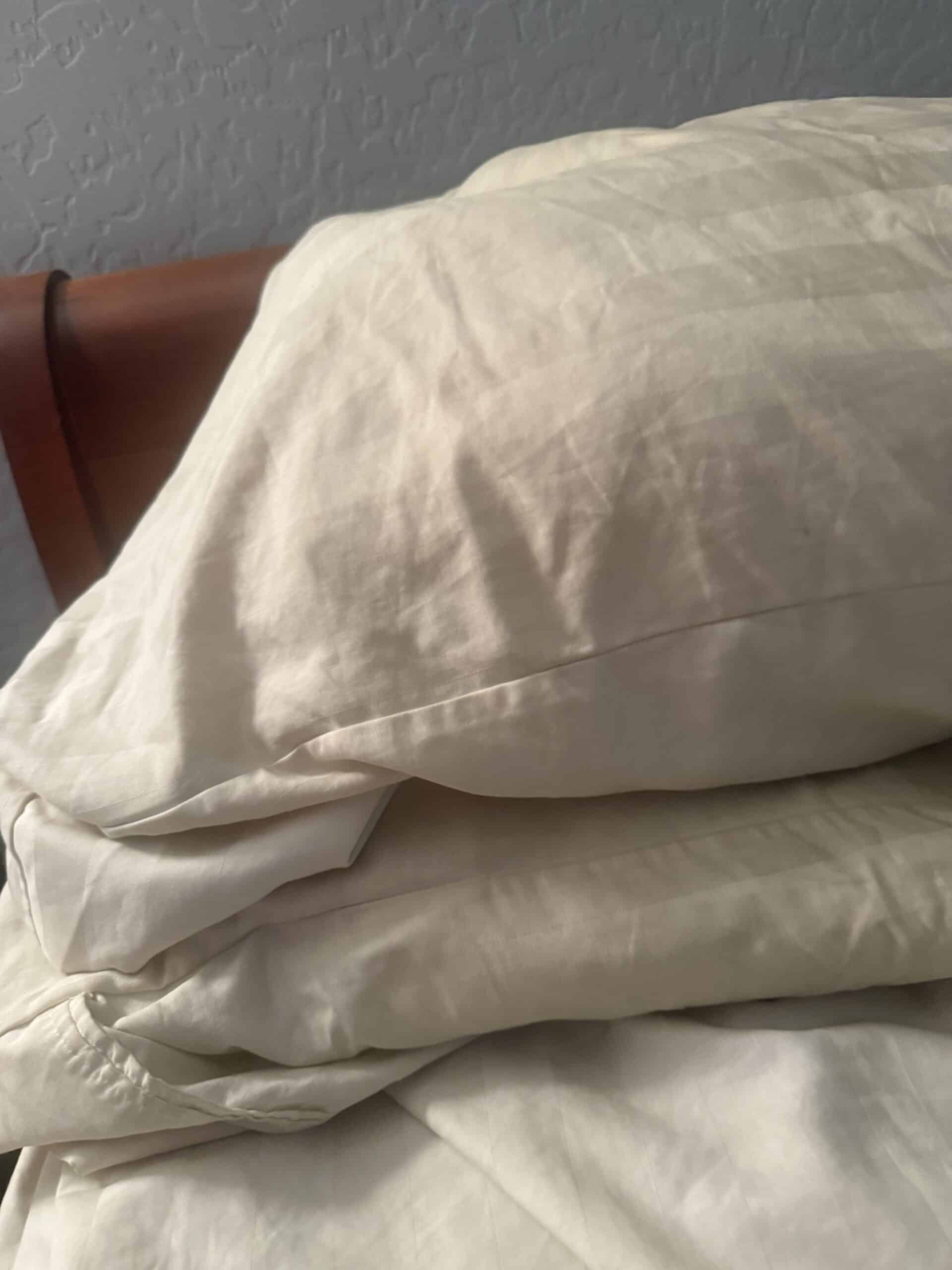
The question usually assumes stacking two pillows for height, which is the version that causes neck problems. The more common reality is several pillows doing different jobs rather than one job twice.
I use three normally, plus a cervical pillow I do not sleep on at all. That is four in play and none of them is a spare. Our roundup of pillows for side sleepers covers choosing them.
Quick Answer
Head support should come from one pillow of the right loft rather than two stacked. Additional pillows for positioning, between the knees, or for sitting up are a different question with a different answer.
What Each Pillow Is For
| Position | Job | Count |
|---|---|---|
| Under the head | Neck alignment | One of correct loft |
| Between the knees | Hip and spine alignment | One, side sleepers |
| Under the knees | Lower back relief | One, back sleepers |
| Hugged or under an arm | Shoulder comfort | One, side sleepers |
| Sitting up in bed | Back support | Varies, not for sleeping |
| Decorative | None | Removed at night |
Why Stacking Two Is the Problem
A pillow’s job under your head is filling the gap between your neck and the mattress so your spine stays level.
Two pillows stacked rarely produce the right height, because two of anything is either too much or awkwardly compressed rather than the correct amount.
They also shift independently through the night, so the height you started with is not the height you wake up with.
The fix is one pillow of the correct loft rather than two of the wrong one, and that is a purchase rather than an arrangement. Our note on why your neck hurts in the morning covers the consequence.
How Mine Are Arranged
Three pillows in normal use, and a cervical pillow that never gets slept on.
The cervical one lives in the bed for sitting up during the day, working or watching something, which is a genuinely different job from sleeping and it does that job well.
A gel cooling pillow is in the rotation and gets used nightly, year-round, with a satin case on it.
None of them is redundant, which is the point. Three is not two stacked plus one spare; it is three pillows in different places doing different things. Our note on using a cervical pillow while working in bed covers that use.
What Too Many Costs You
Pillows accumulate on a bed the same way they accumulate on a couch, and the costs are quiet rather than obvious.
Bed-making becomes a chore proportional to the count, which is why beds with many pillows are frequently the ones left unmade.
Storage overnight is the other problem, since decorative pillows removed at bedtime have to go somewhere and the floor is where they end up.
Washing multiplies too. Every pillow needs a case and every case needs washing, and the interval slips when there are more of them.
None of that argues for one pillow. It argues for every pillow on the bed having a reason, which is a different test from counting them. Our note on washing pillowcases covers the laundry side.
Positioning Pillows Earn Their Place
Between the knees for side sleepers
Keeps the upper leg from dropping forward and rotating the pelvis, which is where a lot of lower back complaints start.
Under the knees for back sleepers
Reduces the arch in the lower back, which relieves pressure without changing head position.
Under an arm or hugged
Supports the upper shoulder for side sleepers and stops the arm dropping across the body.
Behind the back for combination sleepers
Discourages rolling onto a position you are trying to avoid. Our roundup of knee pillows covers the leg version.
Different Pillows for Different Jobs
Once you accept that pillows do separate jobs, it follows that they do not all need to be the same pillow.
A head pillow needs the right loft and, for anyone who sleeps warm, cooling properties that matter most where your face contacts it.
A knee pillow needs firmness and shape rather than loft, since it is filling a gap between legs rather than supporting a head.
A pillow for sitting up wants to be firm and tall, which is close to the opposite of what most people want under their head at night.
Buying one type and using it for all three is how people end up with pillows that do every job adequately and none of them well. Our roundup of do cooling pillows actually work covers the positioning version.
Counting Wrong Causes the Confusion
Most advice counts pillows on a bed and concludes people own too many, which conflates decorative pillows with functional ones.
A bed with six pillows might have one under the head, one between the knees, and four that come off before anyone sleeps.
Separating the two categories makes the question answerable. Head support is one pillow. Everything else is optional and situational.
By that count mine is one head pillow with two others doing positioning and daytime work, which sounds like a lot until you separate the jobs. Our roundup of body pillows covers the multi-job option.
That framing is also what makes it possible to answer the question honestly. Counting pillows tells you nothing; counting jobs tells you whether the number is right for how you sleep.
Sleeping Position Decides Most of It
Side sleepers need the most loft under the head, because the gap between ear and mattress is the widest of any position, and they benefit most from a knee pillow.
Back sleepers need less loft and frequently want something under the knees instead.
Stomach sleepers need the least, and many are better with no pillow at all under the head, which is the opposite of the stacking instinct.
Combination sleepers are the awkward case, since no single loft is correct for every position they move through in a night. Our note on what pillow loft you need covers measuring.
Anyone unsure where they sit should start by identifying their dominant sleeping position, since that single fact determines more about pillow count and loft than any other consideration.
When Two Under the Head Makes Sense
Temporarily, while recovering from something that makes lying flat uncomfortable, though a wedge does that job better.
When one pillow has flattened and you are compensating, which is a signal to replace it rather than to add another.
For sitting up rather than sleeping, where the arrangement is doing a different job entirely.
And where the two are very different, such as a thin firm one under a soft one, which is closer to building the loft you need than stacking two of the same. Our roundup of wedge pillows covers the elevation case.
Each of those is a temporary or corrective arrangement rather than a setup worth building around, which is the distinction that matters here.
How Many Pillows on a Bed FAQ
Do you need two pillows on a bed?
Not stacked under your head. One pillow of the correct loft does that job better. Additional pillows for positioning are a separate and legitimate question.
How many pillows do you use?
Three normally, plus a cervical pillow I never sleep on. Each does something different rather than duplicating the others.
Why is stacking bad?
Two pillows rarely add up to the right height, and they shift independently overnight so the support changes while you sleep.
What should a second pillow do?
Positioning. Between the knees for side sleepers, under the knees for back sleepers, or hugged to support the upper shoulder.
Does sleeping position change the count?
Considerably. Side sleepers need the most loft and benefit most from a knee pillow, while stomach sleepers frequently do better with none at all.
Are decorative pillows part of the count?
No, and conflating them is why this question gets confusing. A bed with six pillows may have two functional ones and four that come off at night.
Is a pillow you do not sleep on wasted?
Not if it does another job. Mine is a cervical pillow used for sitting up in bed during the day, which it does well without ever being slept on.
When should I add a second under my head?
Rarely, and usually it means the first has flattened. Replacing it beats adding to it, and a wedge is better than two pillows for elevation.
For the wider picture, see our guide to do you need a dehumidifier during monsoon season.
