
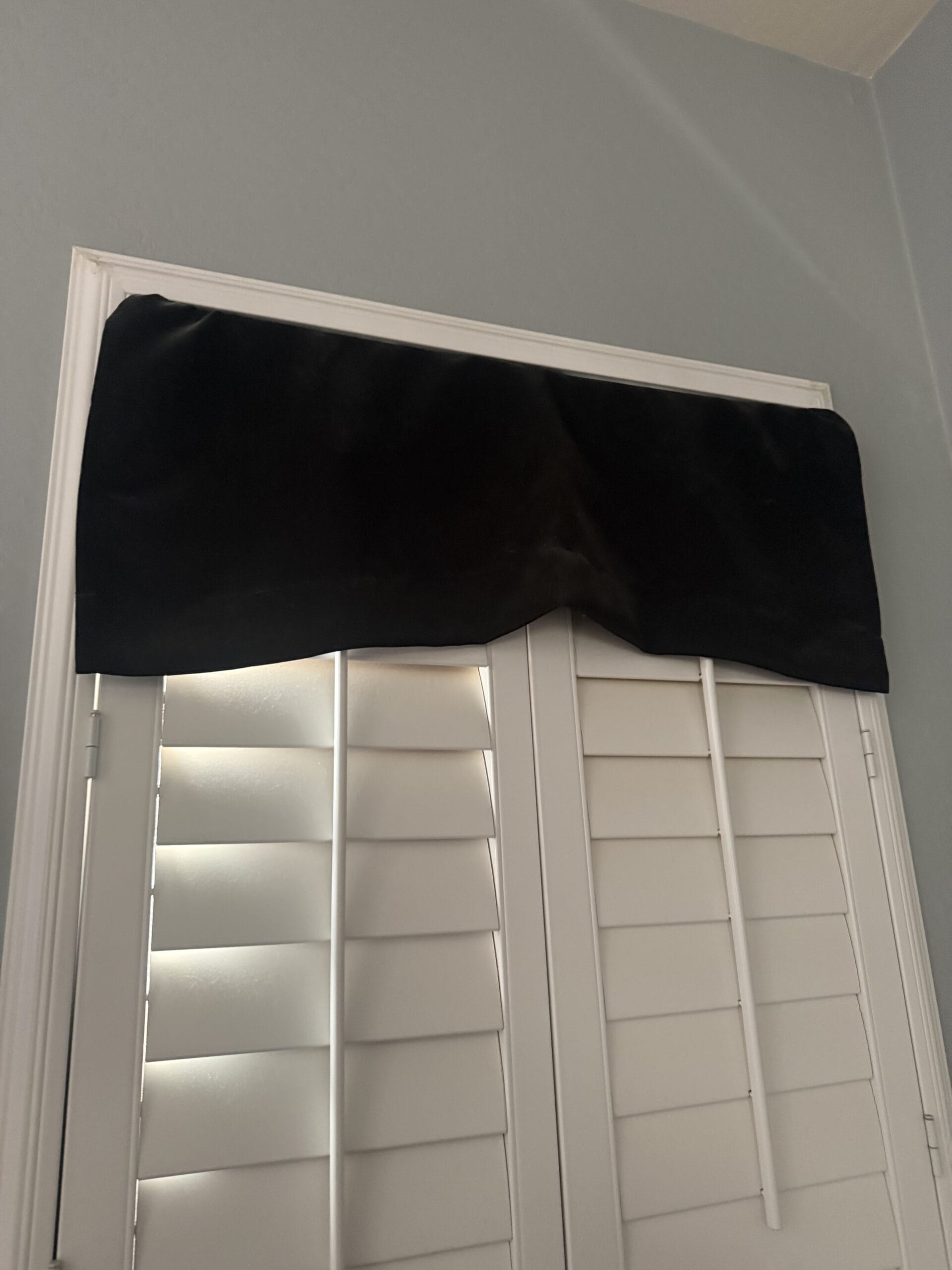
A blackout panel set should measure about twice the width of the rod, and the rod should run five inches past the frame on each side. That doubling lets the fabric gather instead of hanging flat. Flat fabric leaks light through the weave and around every edge.
Getting the blackout curtain size right comes down to four numbers: window width, rod width, total fabric width, and finished length. Most shoppers measure only the first. The result is a bright strip down each side and a glowing gap at the top, the same issue covered in this guide to stopping light leaks around the edges.
Quick Answer
Measure the window opening, add five inches to each side for the rod, then buy panels totaling twice that rod width. Split the total across two panels so each one equals the rod width. For length, run the fabric from the rod down to the floor rather than stopping at the sill.
Key Takeaways
- Rod width equals window width plus ten inches, since five inches of overlap sits on each side.
- Total fabric width should be roughly double the rod width. That surplus is fullness, and fullness stops light passing through the weave.
- With two panels, each panel should measure about the same as the rod width.
- Floor length seals better than sill length, because it removes the bounce off the sill and the wall below.
- An outside mount above and beyond the frame darkens a room more than an inside mount.
- Sizing fixes gaps only. Fabric grade and a poorly sealed frame are separate problems.
Enter the width of the window opening in inches. The calculator returns the rod width, the total fabric width needed, and the size of each panel in a two panel set.
| Window width | Rod width | Total fabric width | Two panels each |
|---|---|---|---|
| 24 in | 34 in | 68 in | 34 in |
| 36 in | 46 in | 92 in | 46 in |
| 48 in | 58 in | 116 in | 58 in |
| 60 in | 70 in | 140 in | 70 in |
| 72 in | 82 in | 164 in | 82 in |
| 84 in | 94 in | 188 in | 94 in |
| 96 in | 106 in | 212 in | 106 in |
Rod width adds five inches of overlap on each side of the window opening. Total fabric width then doubles that rod width. That doubling is deliberate fullness.
Why a panel that matches the window width fails
Buying a panel as wide as the window is the single most common blackout sizing mistake. Such a panel covers the glass on paper and still lets morning light fill the room.
A panel sized to the exact opening has no slack, so it hangs flat. Flat fabric presses its weave into one thin layer, and light passes between the threads. With nothing spare at the sides, daylight also slides in along both vertical edges.
What fullness means and why double the rod width works
Fullness is the ratio between the fabric you hang and the rod you hang it on. A rod carrying exactly its own width has a fullness of one, so nothing gathers. Blackout panels want a fullness of roughly two.
At double width, the panel gathers into deep folds when closed. Each fold puts two or three layers in the light path instead of one.
The five inch overlap on each side
The five inch overlap is the distance the rod runs past the frame on each side. It kills the vertical light strip where a panel edge meets the wall.
Five inches per side is a common rule of thumb. It gives the fabric solid wall to land on, so light must travel sideways behind the panel before it reaches the room.
Rod height above the frame and the gap at the top
The gap above the rod is where sunrise light usually enters, and height controls it. A rod mounted tight to the frame top leaves a shallow slot. Sunlight angles up through that slot and lands on the ceiling.
Mounting higher moves the slot away from the glass. Common practice puts the rod four to eight inches above the frame, or higher where the ceiling allows. Placement detail sits in this breakdown of how high to mount the rod.
Panel length at the sill, below the sill, and at the floor
Length has three normal stopping points: at the sill, a few inches below it, and at the floor. Sill length looks tidy, and it performs worst for darkness.
A sill length panel ends where the brightest surface begins, so light bounces off the sill and scatters under the hem. Below sill length pushes the hem past that bright band.
Floor length seals best. The fabric runs from above the frame to the floor with no break, so no opening sits under the hem. Many people add an inch so the hem rests on the floor.
That rule describes the general case, and a single room is not a study. Some of the panels in the room I sleep in stop a foot or two above the floor. The short length has caused no problem I can identify.
Inside mount versus outside mount
An inside mount fits the hardware within the window recess, and an outside mount fits it on the surrounding wall. Inside mounts look built in and keep the sill clear. They also guarantee gaps.
Inside mounting forces a small clearance on each side so the panel can move freely. That clearance is a permanent light channel that no amount of fabric width closes.
Outside mount is the darker option, because it lets the rod overshoot the frame exactly as the five inch rule assumes.
Renters comparing hard coverings can read this guide to curtains against blinds. Tension hardware helps too, as in this roundup of rods that need no drilling.
What I Have Up
I have had blackout curtains for three or four years, and they are the standard kind rather than the thermal type. The room I sleep in has blackout curtains, some on rods stopping a foot or two above the floor and some fitted into shutters. It also has a sliding glass door with blinds.
I measured for the doorway panels and for the ones fitted into shutters. Some of mine are fitted into shutters, and that pairing is the one that actually works. The shutter does the day, the curtain does the night.
I have panels hanging over a doorway leading to a bathroom and closet, on a tension rod. It handles an opening that would otherwise stay permanently uncovered. That rod goes through several passes a day, and it has never come down.
The rod hung panels in that room stop short of the floor, against the general advice above. Those short panels have caused no problem I can identify. That is one room’s outcome rather than a correction to the rule.
The light that remains arrives past the sliding glass door. Nothing I do to the window curtains changes that, because the light is not coming through the windows. That is my situation and I stopped trying to fix it.
Given that my sleep problem is falling asleep rather than being woken, the difference has not been worth the work. I have sleep masks and they cover exactly the gap my room leaves: dim, with one opening I am not going to re-engineer. It is dark enough that I sleep with ease.
I arrived at that setup by standing in the room and looking at where the light actually was. Mine are standard rather than thermal, so I cannot speak to the insulation difference.
Why side channels, tracks, and wrap around rods exist
Side channels, ceiling tracks, and wrap around rods all solve the same leftover problem. Even a correctly sized panel stands a few inches off the wall, and light slips around the fabric edge.
A wrap around rod curves back so the panel edge finishes flush against the wall. Side channels go further by trapping the fabric edge in a rail. The track and wrap around rod options are worth a look first.
Measuring for two panels versus one
Two panels split the total fabric width in half, so each panel matches the rod width. One panel carries the whole doubled width alone. The calculator returns both figures.
Two panels suit windows people open daily, since they part in the middle and stack at each end. A single panel removes the center seam but stacks all its bulk at one end.
Common blackout curtain sizing mistakes
Most sizing failures repeat a short list of errors. Measuring the glass instead of the full frame is the first, and it leaves the frame edge bare where light creeps in.
The second is ordering a stated width without checking whether it covers one panel or a pair. A listing showing 84 inches may mean either, and that ambiguity can halve the fabric someone receives.
What curtain sizing cannot fix
Sizing closes gaps, and that is the limit of what it does. A perfectly sized panel in thin fabric still glows in direct sun. Grade and construction decide how much light the material stops, as this comparison of thermal against standard blackout fabric explains.
An opening you are not covering is the harder case. A sliding glass door behind blinds, or a frame with worn seals, keeps letting light in no matter how the window panels are sized.
Room shape adds a third limit. Pale walls and mirrors bounce whatever light enters, so a dim room can still read as bright. Some people close the last gap at the eye, as this look at masks against curtains weighs.
Related Reading
For panels that already meet these width and length rules, start with the roundup of the best blackout curtains for sleep. Anyone sizing for hotels or rentals should read the guide to portable blackout blinds for travel. If summer heat is part of the reason for darkening a room, this piece on whether blackout curtains block heat is the next stop.
Blackout curtain size FAQ
How is blackout curtain size calculated?
Start with the window opening width, then add five inches to each side for the rod width. Double that rod width to get the total fabric needed. Split the total in half for a matched pair, so each panel equals the rod width and the folds still fall deep.
Should blackout curtains be wider than the window?
Yes, and by a large margin. The rod should extend about five inches past the frame on each side, and the fabric should total roughly twice that rod width. A 48 inch window therefore wants a 58 inch rod and about 116 inches of fabric across the pair.
What length should blackout curtains be for a bedroom?
Floor length is the strongest choice for a bedroom. It removes the opening under the hem where light bounces off the sill and the lower wall. Measure from the rod position down to the floor, then add an inch so the hem rests rather than hovering.
How much overlap do blackout curtains need in the middle?
A two panel set needs the panels to cross in the center rather than just meet. Several inches of overlap is typical, and the fullness built into a doubled width supplies it automatically. Panels sized to exactly half the rod width meet edge to edge instead, leaving a bright line.
Can blackout curtains be too wide?
Too wide is rarely a darkness problem, though it can be a practical one. Heavy stacks of fabric block part of the glass when drawn back and crowd the wall at each end. Fullness beyond about two and a half adds bulk without adding much darkness.
Should the window or the rod be measured for curtain width?
Measure the window opening first, because that number drives everything else. Rod width comes from the opening plus the overlap on each side, and panel width comes from the rod. Measuring the glass alone is the most frequent error, and it usually leaves panels ten inches short.
Why does light still leak with correctly sized curtains?
Correct sizing closes the side and bottom gaps, not every path. Light can still pass through thin fabric, slip over a low mounted rod, or travel between the panel and the wall. Frame seals, wall color, and fabric grade all play a part in the result.
