
They are considerably louder than most bedroom appliances, and plenty of people sleep through them anyway. Whether one disturbs you depends less on the decibel figure than on whether you find steady mechanical noise comforting or intrusive.
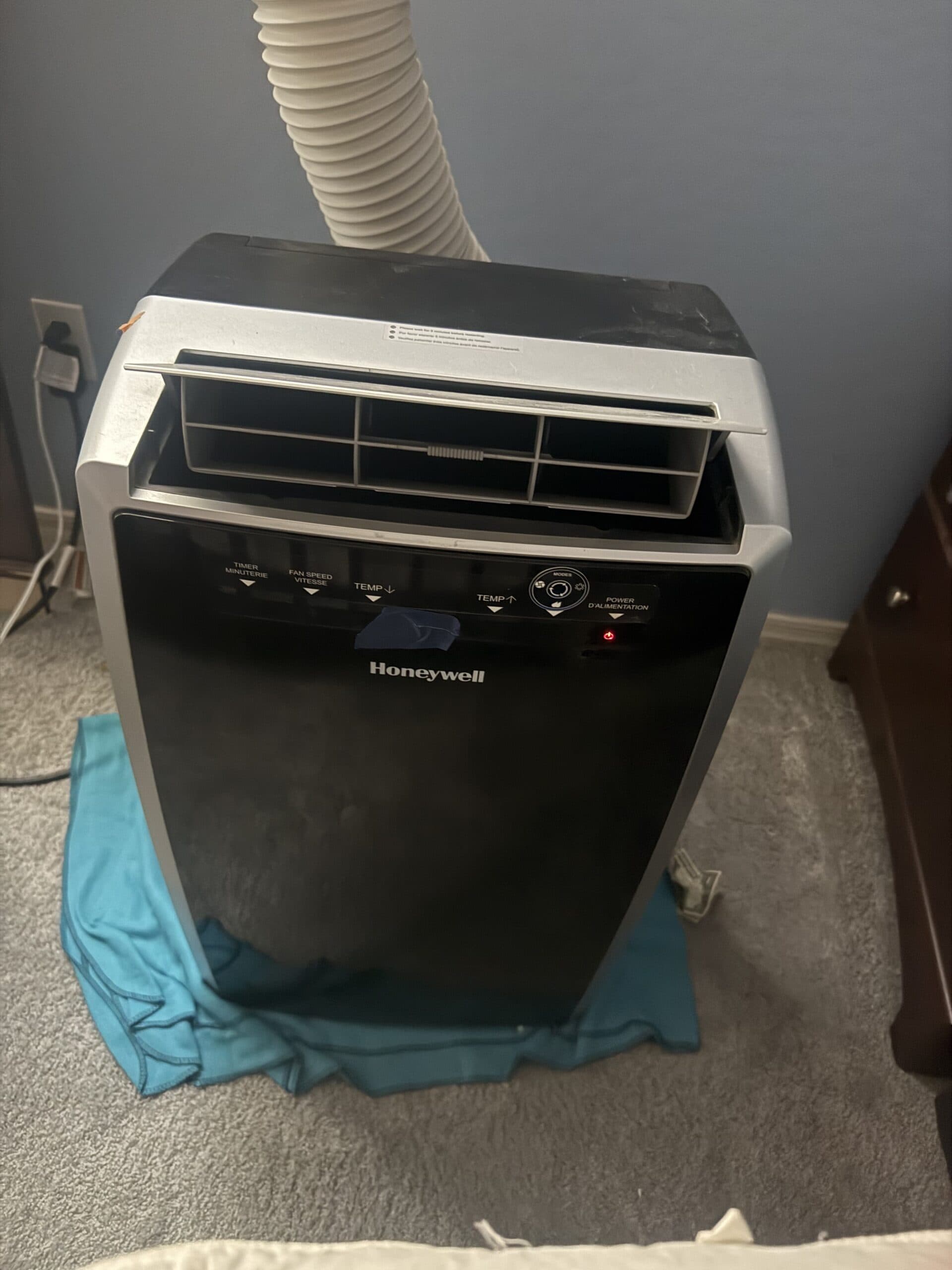
Mine has run in my bedroom through Arizona summers for more than five years. It cycles rather than running steadily, and it has never been a problem for me, which is not what I would have predicted from the specifications.
Quick Answer
Most portable air conditioners run between 50 and 60 decibels, which is louder than a fan and roughly a normal conversation. People who like background noise adapt quickly. Light sleepers and anyone sensitive to compressor cycling often do not.
A Quick Note
This covers appliance noise rather than sleep disorders. Persistent difficulty sleeping that continues in a quiet room is worth raising with a doctor rather than attributing to equipment.
How Loud They Actually Are
| Sound | Approximate level |
|---|---|
| Quiet bedroom | 30 dB |
| Standing fan, medium | 45 to 50 dB |
| Dehumidifier, normal | 45 to 55 dB |
| Portable AC, fan only | 45 to 52 dB |
| Portable AC, compressor running | 52 to 62 dB |
| Window unit | 50 to 60 dB |
The World Health Organization suggests bedroom noise stay below about 30 decibels for undisturbed sleep, which no air conditioner of any type meets.
That figure is a guideline for ideal conditions rather than a threshold beyond which sleep becomes impossible. Most people sleep in rooms well above it without noticing any problem.
Cycling Is the Part People Notice
A portable AC does not run at one level. The fan runs continuously while the compressor kicks in and out as the room reaches and loses temperature.
That produces a change rather than a constant, and change is what your brain reacts to. It is the same reason a fridge starting up wakes people who sleep through traffic.
The compressor engaging is typically a step of several decibels plus a lower-frequency hum, which registers as an event rather than as a gradual shift in level.
Some inverter models modulate rather than switching on and off, which smooths this considerably and costs more, and quieter alternatives sit in quiet fans for sleeping.
Five Years With One in the Bedroom
Mine cycles, and by the general principle that should bother me. It does not.
I think the reason is that I like consistent background noise when I am falling asleep, and the fan runs the whole time even when the compressor is off. The compressor is a change on top of something that is already there rather than sound arriving into silence. Drainage is the other bedroom problem, and self evaporating models remove the bucket from the routine.
Five summers in, I do not wake when the compressor kicks in. I could not tell you whether that is adaptation or whether it was never loud enough to matter, and I suspect it is mostly adaptation.
What I would not do is tell someone sensitive to noise that they will be fine. My experience is one data point from someone who already sleeps with fans running year-round.
The honest version is that if you like fan noise, a portable AC is a louder version of something you already tolerate. If you do not, it is a real consideration, covered in whether a portable AC is worth it for one room.
What Makes One Louder
Single hose against dual hose
Single-hose units create negative pressure, pulling warm air in through gaps, which makes them work harder and run longer. Longer running means more noise overall.
Undersizing
A unit too small for the room never reaches temperature, so the compressor runs almost continuously at full output rather than cycling down.
Hard floors
Compressor vibration transmits into tile and hardwood and travels through the room. A mat underneath addresses it cheaply.
Window kit fit
Gaps around a poorly sealed window panel let outside noise in and let cooled air out, which makes the unit run more, covered in window insulation kits for quiet sleep.
Adaptation Is Doing More Than You Think
Most people who live with a portable AC stop noticing it, and that is worth separating from the unit being quiet.
Habituation to steady sound is well documented. Your auditory system reduces its response to input that repeats without carrying new information, which is why the sound you found intolerable in week one is unremarkable by week four.
The catch is that adaptation is not complete. Studies of sleep and environmental noise consistently find that people report undisturbed sleep in conditions where their measured sleep quality is still affected. You stop noticing before the effect stops.
That does not mean a portable AC is quietly damaging your sleep. It means self-reported comfort is a weaker measure than it feels, and a genuinely quieter setup may still be better even when the louder one feels fine.
It also explains why people who already sleep with fans adapt fastest. There is less of a step to adjust to when the room was never silent.
Practically, the useful test is not how it sounds tonight but how you feel after a week. First impressions overstate the problem and long habituation understates it.
Reducing the Noise
Size it correctly for the room before anything else. An oversized unit short-cycles and an undersized one runs flat out, and both are louder in practice than a correctly matched one would be.
Use sleep or eco mode if there is one. These usually cap fan speed and widen the temperature band so the compressor cycles less often.
Put a mat under it. Vibration into a hard floor is the cheapest problem to fix and the one people overlook.
Seal the window kit properly with foam tape. That reduces outside noise, improves efficiency, and cuts how long the unit needs to run, and blackout options sit in blackout curtains for sleep.
When the Noise Helps
For people who sleep better with masking sound, a portable AC covers street noise, neighbors, and household activity more thoroughly than a fan does.
That is a genuine benefit rather than a consolation, and it is part of why some people run one on fan-only mode well outside the summer months.
It only works if you find the sound acceptable to begin with. A unit that annoys you does not become tolerable simply because it is covering up something else.
For anyone who wants masking without the machine, a dedicated device gives far more control, covered in white noise machines.
Related Reading
- is a portable AC worth it
- bedroom air conditioners
- quiet fans
- white noise machines
- cooling setups for hot climates
- window insulation kits
- waking up hot
Part of our guide to cooling a bedroom for better sleep.
Frequently Asked Questions
Are portable ACs loud enough to disturb sleep?
They run between 50 and 60 decibels, louder than a fan. People who like background noise usually adapt, and light sleepers often find the compressor cycling disruptive.
How many decibels is a portable AC?
Typically 45 to 52 on fan only and 52 to 62 with the compressor running. That is roughly the level of normal conversation.
Why does it wake me when it kicks in?
The compressor engaging is a step change rather than a constant, and your brain reacts to change. Inverter models modulate instead of switching, which smooths it.
Are single-hose units louder?
In effect, yes. They create negative pressure that pulls warm air in, so they work harder and run longer, which means more total noise even at the same rating.
Does size affect noise?
Considerably. An undersized unit runs flat out continuously, and an oversized one short-cycles. A correctly matched unit is quieter than either.
Can a portable AC work as white noise?
For people who already like fan noise, yes, and it masks more than a fan does. It will not become tolerable if the sound bothers you to begin with.
Will I get used to the noise?
Most people do within a few weeks, and adaptation is not the same as no effect. Judge it after a week rather than on the first night.
What is the cheapest way to make mine quieter?
A mat underneath to stop vibration reaching the floor, then sealing the window kit properly with foam tape so the unit runs less.
Sources
- World Health Organization. Night Noise Guidelines for Europe. https://www.who.int/europe/publications/i/item/9789289041737
- Sleep Foundation. How Noise Affects Sleep. https://www.sleepfoundation.org/bedroom-environment/how-noise-affects-sleep
- United States Department of Energy. Room Air Conditioners. https://www.energy.gov/energysaver/room-air-conditioners
