
An apartment dehumidifier is worth buying when your bedroom sits above roughly 60 percent humidity and the air feels heavy at night, and it is worth skipping entirely in a dry climate. That second half matters, because these get recommended universally and they solve a problem plenty of homes do not have.
Where humidity is real, the constraints in an apartment are specific: the unit has to be quiet enough to run beside a bed, small enough to live in a room you also sleep in, and the tank has to be easy to empty because you will do it constantly. Capacity ratings assume large basements, so the useful question is fit rather than raw extraction, which is the same reasoning behind choosing a bedroom unit generally.
Quick Verdict
A compact compressor unit with a removable tank and a sleep mode covers most apartments. Check the tank empties without tipping water everywhere, and confirm the noise figure rather than trusting the word quiet. If you live somewhere dry, save your money.
Key Takeaways
- Target bedroom humidity is roughly 30 to 50 percent
- Tank emptying is the daily chore that decides whether you keep using it
- Compressor units struggle in cold rooms; desiccant units do not
- Noise matters more in an apartment bedroom than extraction capacity does
- Continuous drain removes the emptying problem if you have somewhere to run a hose
- In a dry climate a dehumidifier is the wrong purchase entirely
How We Picked
Tank access came first, because it is the thing you interact with. A tank that slides out level, has a handle, and pours without spilling gets emptied. One that must be lifted awkwardly from the top gets emptied until it does not, and then the unit switches itself off and stays off.
Noise was second and weighted heavily for apartment use. A dehumidifier in a bedroom runs while you sleep, so a sleep mode that dims the display and slows the fan matters more than another pint of daily capacity.
Footprint finished the list. Apartment bedrooms have limited floor space, and a unit that has to sit where you walk gets moved and then unplugged. Compact units with the controls on top rather than the front suit tight placements better.
The One I Used and Why I Stopped
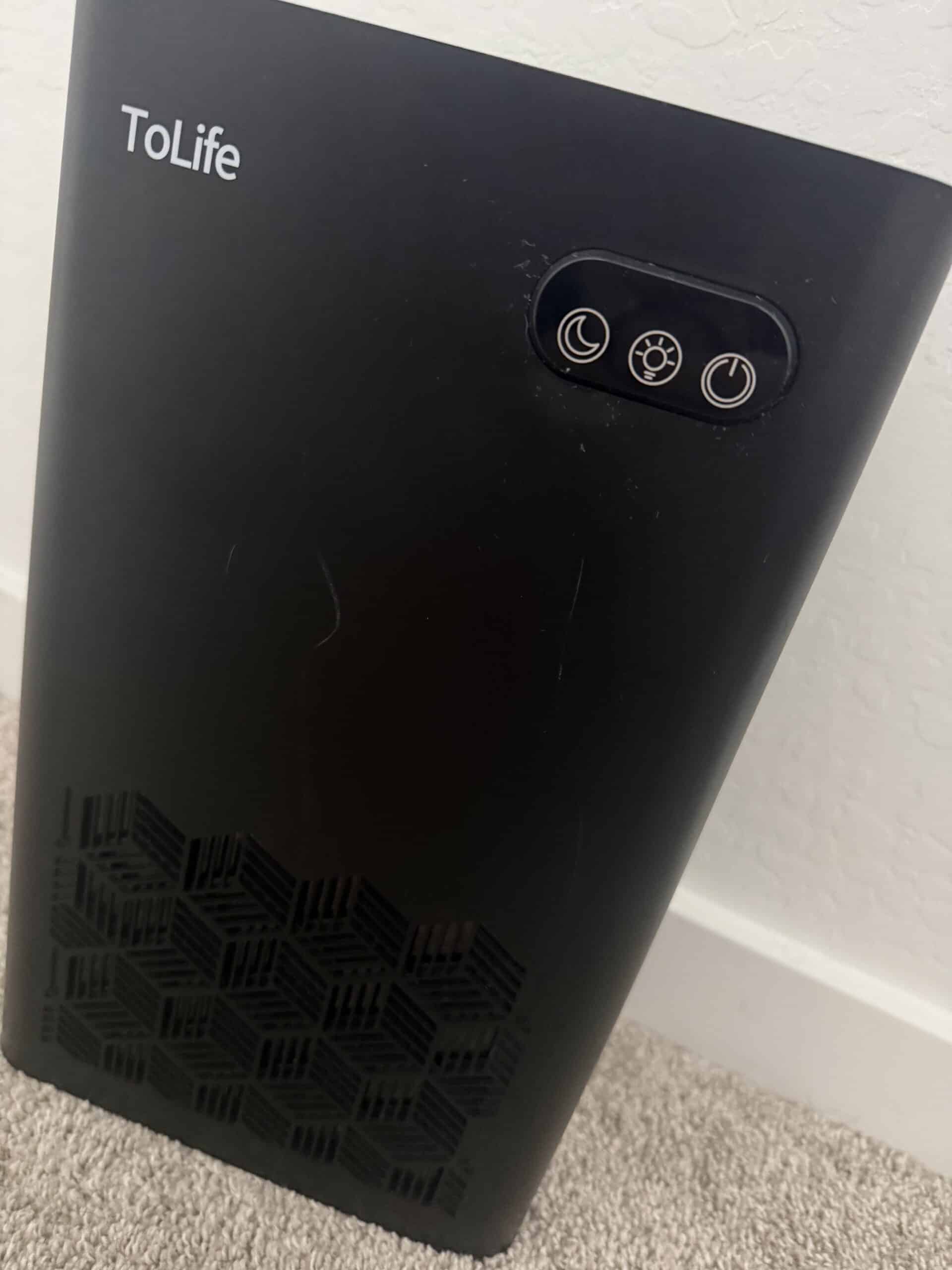
The dehumidifier I used was a compact black ToLife unit with touch controls for sleep, light, and power. It worked well. The water tank was easy to remove and empty, which sounds trivial and turned out to be the feature I appreciated most, and I never had any issues with it over regular nightly use.
The honest part is that I do not run it anymore. I moved to Arizona, and in dry desert air a dehumidifier is not doing anything worth the noise or the outlet. In the humid apartment I had before, it earned its spot beside the bed. That is the whole recommendation: this is a climate-dependent purchase, and the same unit can be essential in one apartment and pointless in the next.
My experience covers one compact unit used nightly in a humid apartment bedroom. It does not cover basements, whole-home units, desiccant models, or crawl spaces, where the sizing and the failure modes are different.
1. The Compact Compressor Dehumidifier
Why It Stands Out
The standard choice for apartment bedrooms. A small compressor pulls moisture onto a cold coil and drips it into a tank, using less power than desiccant alternatives and handling normal room temperatures well. Units in this class are sized for one room rather than a floor.
Worth Knowing
Compressor efficiency falls as the room gets colder, so an unheated space in winter is where these underperform. They also cycle audibly when the compressor kicks in, which is more noticeable at night than the fan noise is.
Right for bedrooms and apartments in normal temperature ranges. Skip it for cold garages or unheated storage.
2. The Desiccant Dehumidifier
Why It Stands Out
Desiccant units use an absorbent material rather than a cold coil, so they keep working at low temperatures where compressors falter. They also run without a compressor cycling on and off, which many people find easier to sleep beside.
Worth Knowing
They use more electricity for the same water removed, and they warm the room slightly as a byproduct. In a bedroom you are already trying to keep cool, that warming works against you.
Right for cold rooms and anyone bothered by compressor cycling. Skip it in a warm room where the heat output matters.
3. The Continuous Drain Model
Why It Stands Out
A hose port lets the unit drain straight to a floor drain, a sink, or a window, which removes tank emptying from your life entirely. For anyone running a dehumidifier daily through a humid season, this is the feature that stops it becoming a chore.
Worth Knowing
Gravity drain needs the unit higher than the drain point, which in an apartment often means propping it on something. Models with a built-in pump solve that and cost more, and any hose across a bedroom floor is something to trip on at night.
Right for heavy daily use with somewhere to route a hose. Skip it if there is nowhere sensible for the water to go.
4. The Quiet Sleep-Mode Unit
Why It Stands Out
Units built around bedroom use dim or extinguish the display, drop the fan speed, and publish a noise figure you can check. In a room you sleep in, that combination matters more than extraction rate, since a unit you switch off at bedtime removes no moisture at all.
Worth Knowing
Sleep mode reduces output as well as noise, so overnight extraction is lower than the headline figure. A bright status LED is also worth checking specifically, because plenty of otherwise quiet units keep a light on that will bother a dark-room sleeper.
Right for bedrooms and studio apartments. Skip it if the unit lives somewhere you do not sleep.
5. The Mini Peltier Dehumidifier
Why It Stands Out
Small thermoelectric units are nearly silent, cost very little, and suit closets, bathrooms, and cupboards where a compressor would be excessive. No moving compressor means almost nothing to hear.
Worth Knowing
Extraction is very low, and these cannot dehumidify a bedroom in any meaningful way. Buying one for a room-sized problem is the most common disappointment in this category, and the tiny tank fills quickly even at low output.
Right for closets, cupboards, and small enclosed spaces. Skip it for any actual room.
6. The Larger Capacity Unit
Why It Stands Out
Higher-capacity units cover a whole apartment rather than one room, running from a hallway or living area. For a genuinely damp flat, one larger unit is often more effective than several small ones.
Worth Knowing
They are physically bigger, heavier to move, louder, and use more power. In a small apartment the noise carries, and a unit sized for a basement in a one-bedroom is overkill that you hear all day.
Right for genuinely damp apartments with a central place to run it. Skip it for a single bedroom problem.
Apartment Dehumidifiers at a Glance
| Type | Room size | Noise | Best for |
|---|---|---|---|
| Compact compressor | One bedroom | Moderate, cycles | Most apartments |
| Desiccant | One room | Steady, no cycling | Cold rooms |
| Continuous drain | Varies | Varies | Daily heavy use |
| Quiet sleep mode | Bedroom | Lowest | Sleeping beside it |
| Mini Peltier | Closet only | Near silent | Enclosed spaces |
| Larger capacity | Whole apartment | Highest | Genuinely damp flats |
What to Look For in an Apartment Dehumidifier
Do you actually have a humidity problem?
Measure before buying. A cheap hygrometer tells you whether the room sits above the comfortable range, and in dry climates the answer is usually no. Condensation on windows, musty smells, and damp-feeling bedding are the signs worth acting on.
How easy is the tank to empty?
You will do this daily in a humid season. A tank that slides out level with a handle and a pour spout is the difference between a unit in use and one switched off in a corner.
How loud is it, in numbers?
Quiet is a marketing word. Look for a published decibel figure and compare it against a fan you already own. Compressor cycling is also worth considering separately from steady fan noise, since it is the change in sound that wakes people.
Where will it physically sit?
Apartment bedrooms are tight, and units need clearance around the air intake and exhaust. A dehumidifier pushed against a wall or into a corner works considerably worse than the same unit with space around it.
Dehumidifier vs Air Purifier
What each one does
A dehumidifier removes water from the air. An air purifier removes particles. They address different problems, and neither substitutes for the other despite frequently sitting side by side in listings.
Which you need
If the air feels heavy, windows fog, and things smell musty, that is humidity. If you have allergies, dust, or pets, that is particles. Some apartments need both, and running them together is fine as long as the room has space for two units.
Common Mistakes to Avoid
Buying one in a dry climate
The most expensive mistake in this category is buying a solution to a problem you do not have. Measure the humidity first, and if it sits in the comfortable range, put the money elsewhere.
Choosing a mini unit for a bedroom
Peltier units extract a tiny fraction of what a room needs. They are excellent in a closet and useless in a bedroom, and the price makes them tempting for the wrong job.
Ignoring where the water goes
A full tank stops the unit. If you will not empty it daily, plan a continuous drain before buying rather than discovering the problem in week two.
Running it with the window open
Dehumidifying a room connected to outside air is endless work with no result. Close the room, and see bedroom cooling for the temperature side, which is a separate problem.
Recommended Reading
- humidifiers for the opposite problem
- purifiers for particles rather than moisture
- fans for air movement
- why humid air feels worse at night
- the wider sleep environment
- masking the sound of a unit running overnight
Related: quiet dehumidifiers.
Frequently Asked Questions
What humidity should a bedroom be?
Roughly 30 to 50 percent suits most people for comfort and for keeping mold and dust mites down. Above about 60 percent the air starts feeling heavy and condensation appears on cold surfaces.
Do I need a dehumidifier in a dry climate?
Almost certainly not. In desert conditions the air is already below the target range, and a dehumidifier has nothing useful to remove. Measure before buying rather than assuming.
Can I run a dehumidifier while sleeping?
Yes, and units with a sleep mode are designed for it. The considerations are noise, the compressor cycling on and off, and whether a status light will bother you in a dark room.
How often will I empty the tank?
In a humid apartment, often daily. That frequency is why tank design matters so much, and why continuous drain is worth arranging if you have somewhere for the hose to go.
Are mini dehumidifiers any good?
For closets and cupboards, yes. For a bedroom, no. Thermoelectric units extract a small fraction of what a room-sized problem needs, and buying one for a bedroom is the most common disappointment here.
Does a dehumidifier make a room warmer?
Slightly, yes. Compressor units give off some heat as they run, and desiccant models give off more. In a bedroom you are also trying to keep cool, that is worth weighing against the humidity benefit.
Where should I place it?
Somewhere with clearance around the intake and exhaust, not jammed into a corner or against furniture. Central in the room works better than pushed to the edge, and it should not sit where you will trip on it at night.
