
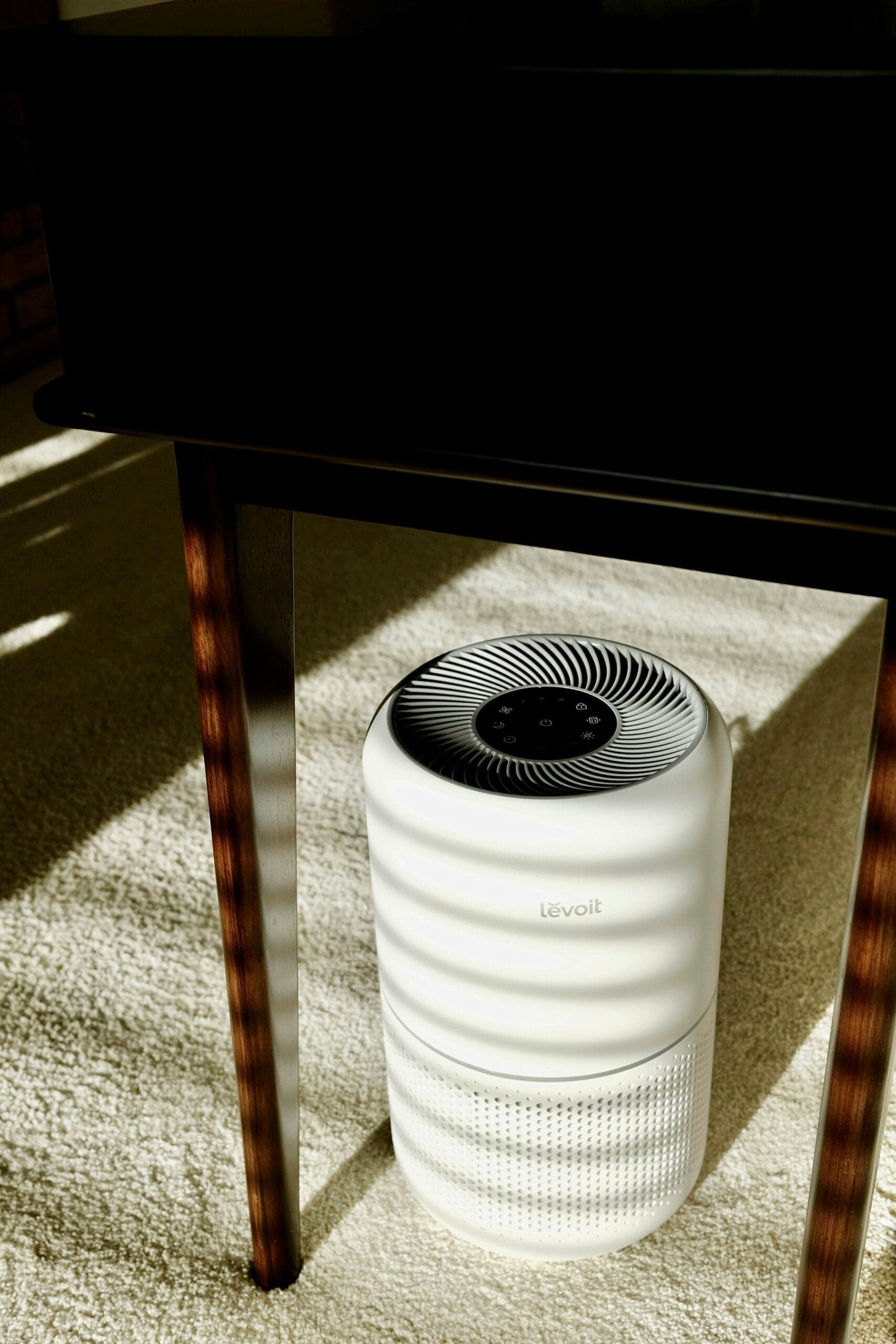
The air inside your bedroom is almost certainly worse than the air outside it, and most people are surprised to learn this because the inside of a bedroom feels clean and controlled compared to outdoor air.
Dust mite debris, pet dander, mold spores, pollen that drifts in through windows, and volatile organic compounds from furniture, paint, and carpet all accumulate in enclosed bedroom environments where ventilation is limited, and air circulation is lower than in the rest of the home. You breathe this air without interruption for 7 to 8 hours each night, during the hours when your respiratory system is most continuously active without the movement-driven ventilation that waking hours provide.
The result for sensitive sleepers shows up as morning congestion that clears after 30 minutes of being awake, allergy symptoms that are worse in the bedroom than outdoors, sleep disruptions from nasal inflammation that make breathing comfortable in one position and difficult in another, and a general sense of not feeling rested that disappears when sleeping in a different environment. A quality bedroom air purifier running continuously on its lowest fan setting overnight addresses all of these through consistent particle removal from the air you breathe during sleep.
For the complete sleep environment that air quality is part of our guides to the best white noise machines, the best blackout curtains for better sleep, and the best bedroom humidifiers for better sleep cover the sound, light, and humidity elements that work alongside air quality for the most complete sleep environment.
Disclosure: RestRight is reader-supported. As an Amazon Associate, we earn from qualifying purchases made through links on this page, at no extra cost to you.
What the Air Purifier Specifications Actually Mean for Sleep
True HEPA versus HEPA-type is the critical certification distinction.
True HEPA filters capture 99.97 percent of particles 0.3 microns and larger, the specific size range that includes dust mite debris, pet dander, mold spores, and most airborne bacteria. Filters marketed as HEPA-type, HEPA-style, or HEPA-like do not meet this standard and capture significantly fewer particles in the critical size ranges. The word HEPA in a product name is not sufficient, look specifically for TRUE HEPA or H13 HEPA certification before purchasing any air purifier for sleep use.
CADR rating determines how quickly it cleans your specific room.
Clean Air Delivery Rate measures the volume of filtered air the purifier produces per minute at maximum fan speed. To find the minimum CADR you need, multiply your room’s square footage by 0.75. A 200-square-foot bedroom needs at least 150 CADR. A 300-square-foot bedroom needs at least 225 CADR. Buying below this threshold means the air cycles through filtration too slowly to produce measurably cleaner air in your specific room, the purifier runs but does not keep pace with the particle accumulation rate.
Noise in sleep mode is the bedroom-specific specification that overrides everything else.
An air purifier that runs at 50 decibels on its sleep setting is not a bedroom air purifier, it is a noise machine that happens to filter air. The best bedroom air purifiers run at 20 to 35 decibels on their lowest fan setting, genuinely below the ambient noise level of most quiet bedrooms. Check the decibel rating specifically at the lowest fan speed rather than the overall noise rating that appears in marketing materials and typically reflects the highest fan setting. Whether to leave it running is worth deciding deliberately, and our piece on running an air purifier all night covers noise, cost and filter life.
The 5 Best Bedroom Air Purifiers for Sleep in 2026
#1, Levoit Core 300S Air Purifier
Best Overall Bedroom Air Purifier for Sleep | Price: ~$100
Check Price on AmazonThe Levoit Core 300S hits the combination that matters most for bedroom sleep use, genuinely quiet sleep mode, true HEPA H13 filtration, and smart auto-adjustment that maintains air quality without requiring manual attention during the night.
The Sleep-Specific Features That Matter
The sleep mode runs the fan at its absolute minimum speed, 24 decibels, which is quieter than most bedroom ambient noise levels and genuinely inaudible for most sleepers. The display dims automatically in sleep mode, so the indicator lights do not create light pollution in a dark bedroom. The auto mode uses a real-time air quality sensor that increases fan speed when airborne particles spike, like when pollen count rises in the early morning, and reduces it back to sleep-mode quiet when particle levels normalize.
The 360-degree cylindrical air intake draws particles from every direction simultaneously, rather than from one side only, producing more thorough coverage in typical bedroom placement against a wall or in a corner. The H13 HEPA filtration captures particles down to 0.1 microns, finer than the standard 0.3-micron HEPA threshold, addressing the finest airborne particles that standard HEPA filters allow through.
PROS:
- 24-decibel sleep mode, genuinely inaudible in most bedroom environments
- H13 HEPA captures particles down to 0.1 microns, finer than standard HEPA
- Display dims automatically in sleep mode, no light pollution in dark bedroom
- Auto mode adjusts fan speed based on real-time air quality sensor
- 360-degree intake for thorough room coverage regardless of placement position
- App control with scheduling and air quality history
CONS:
- 141 CADR covers rooms up to 219 square feet, not sufficient for large master bedrooms
- Replacement filters are needed every 6 to 8 months at approximately $25
- Cylindrical design requires clearance on all sides for optimal intake
Best for: Anyone with a standard bedroom up to 220 square feet who wants a completely quiet overnight air purifier with smart auto-adjustment, particularly allergy and asthma sufferers whose symptoms are worst in the bedroom.
#2, Blueair Blue Pure 411i Max
Best Ultra-Quiet Bedroom Air Purifier | Price: ~$130
Check Price on AmazonThe Blueair 411i Max runs at 17 decibels on its lowest fan setting, the quietest air purifier on this list by a meaningful margin and genuinely inaudible even for the lightest sleepers in the quietest bedrooms.
The Quietest Option Available for Light Sleepers
The HEPASilent technology combines mechanical HEPA filtration with electrostatic filtration, capturing particles through two complementary mechanisms simultaneously. The benefit is that the electrostatic component captures particles at lower fan speeds than mechanical filtration alone can achieve, which is why the 411i Max can run quietly while maintaining effective filtration. Standard HEPA-only purifiers must run the fan faster to pull enough air through the mechanical filter for effective particle capture, which produces more noise.
The fabric pre-filter wraps the exterior in a soft fabric that doubles as a pre-filter for larger particles, available in multiple colors that make the purifier look like intentional bedroom decor rather than an appliance. The 190 CADR handles bedrooms up to 260 square feet. At 17 decibels, it is the right choice for anyone for whom the Levoit’s 24-decibel sleep mode is still too audible.
PROS:
- 17 decibels, quietest air purifier on this list and genuinely inaudible for most sleepers
- HEPASilent technology achieves effective filtration at lower fan speeds than mechanical HEPA alone
- Fabric pre-filter in multiple colors, looks like bedroom decor rather than an appliance
- App control with scheduling and air quality monitoring
- 190 CADR covers bedrooms up to 260 square feet
- Blueair reputation for consistent long-term performance
CONS:
- Higher price at approximately $130 for 190 CADR, lower coverage than alternatives at similar cost
- Fabric pre-filter requires hand washing monthly, additional maintenance step
- Less effective in rooms above 260 square feet
Best for: Light sleepers for whom any audible mechanical noise during sleep is disruptive, the 17-decibel operation is the quietest practical option available in a bedroom air purifier at any price.
#3, Coway AP-1512HH Mighty Air Purifier
Best Value Bedroom Air Purifier for Sleep | Price: ~$90
Check Price on AmazonThe Coway Mighty is the bedroom air purifier that appears at the top of virtually every serious air quality review publication’s recommendation list, and the reason is straightforward. At $90, it delivers true HEPA filtration, an air quality indicator, and auto mode in a proven unit that has maintained consistent quality across hundreds of thousands of units sold over multiple years.
More Information on the Coway AP-1512HH Mighty Air Purifier
The 246 CADR covers rooms up to 360 square feet, a higher coverage rating than the Levoit Core 300S at $10 less. The colored air quality indicator ring provides real-time feedback without requiring a smartphone app, green for good, blue for moderate, yellow for poor, red for very poor, readable across the room without approaching the unit. The sleep mode quiets the fan and dims the display for overnight operation.
The Coway’s simplicity is a feature rather than a limitation, physical controls only, no app dependency, no firmware updates required. For sleepers who prefer an air purifier that works reliably without technological complexity, the Coway Mighty provides that without sacrificing filtration quality.
PROS:
- 246 CADR covers rooms up to 360 square feet, the highest on this list for the price
- True HEPA filtration at $90, best filtration-to-price ratio available
- Colored air quality indicator ring provides real-time feedback without an app
- Auto mode adjusts fan speed based on particle sensor readings
- Sleep mode quiets the fan and dims the display for overnight operation
- Proven reliability track record across years of consistent high-volume production
CONS:
- No app control, scheduling, or remote operation
- Sleep mode is slightly louder than Levoit and Blueair alternatives
- Basic design, less visually refined than premium alternatives
Best for: Budget-conscious buyers who want true HEPA filtration at the best price available, and anyone who prefers simple physical controls over app-connected smart features.
#4, Winix 5500-2 Air Purifier
Best Air Purifier for Larger Bedrooms | Price: ~$170
Check Price on AmazonFor master bedrooms above 300 square feet, where standard bedroom purifiers run out of CADR coverage, the Winix 5500-2 provides 243 CADR and four-stage filtration that handles larger spaces more effectively than compact purifiers designed for smaller rooms.
The four-stage filtration adds PlasmaWave technology, which creates hydroxyls that break down airborne pollutants at the molecular level, to the standard HEPA and activated carbon combination. This molecular breakdown addresses volatile organic compounds and odors that HEPA filtration cannot capture, providing more comprehensive air quality improvement than HEPA alone for bedrooms with chemical sensitivities or significant odor sources.
The washable pre-filter extends HEPA filter life by capturing larger particles before they reach the main filter, reducing the frequency and cost of HEPA filter replacements meaningfully over years of continuous operation. The dual air quality sensor detects both particle and odor pollution simultaneously, triggering fan speed increases when either type rises above the baseline.
PROS:
- 243 CADR covers rooms up to 360 square feet, handles larger master bedrooms
- Four-stage filtration, including PlasmaWave for VOC and molecular pollutant breakdown
- Washable pre-filter extends HEPA filter life and reduces replacement frequency and cost
- Dual particle and odor sensor detects both visible and chemical pollutants
- Sleep mode at 27.8 decibels, quiet enough for most sleepers
- Strong reliability track record backed by years of consistent production
CONS:
- Higher price at approximately $170
- Larger footprint than compact alternatives, takes meaningful floor space
- PlasmaWave technology produces trace ozone, negligible at levels produced but worth noting
Best for: Anyone with a bedroom above 220 square feet who needs higher CADR and four-stage filtration, particularly those with chemical sensitivities or significant VOC sources in the bedroom environment.
#5, Dyson Purifier Cool TP07
Best Premium Bedroom Air Purifier | Price: ~$550
Check Price on AmazonThe Dyson TP07 is the premium option for hot sleepers who want air purification and cooling airflow from a single bedroom appliance, addressing both air quality and temperature simultaneously in one device that serves as a fan in summer and a purifier year-round.
The fully sealed filtration system prevents air from bypassing the filter, a design flaw that undermines filtration effectiveness in competitors where the filter housing is not fully sealed, allowing some room air to enter without passing through the filter. The H13 HEPA filtration captures 99.95 percent of particles 0.1 microns and larger. The activated carbon filter layer captures gases, odors, and volatile organic compounds that HEPA alone cannot address.
More Information on the DYSON Purifier Cool TP07
The 350-degree oscillation distributes purified air throughout the full room rather than projecting it in a single direction. The app provides real-time indoor and outdoor air quality comparison, filter life tracking, and detailed pollutant identification. At $550, it is a significant investment that makes sense specifically for the hot sleeper who wants air purification and cooling airflow from one appliance rather than a separate purifier and fan.
PROS:
- Fully sealed filtration system prevents air bypass, more effective than unsealed alternatives
- H13 HEPA plus activated carbon addresses particles and gases simultaneously
- Doubles as a cooling fan, practical for hot sleepers who want both functions
- 350-degree oscillation distributes purified air throughout the room
- App provides detailed air quality data and pollutant identification
- Dyson build quality and multi-year warranty
CONS:
- Most expensive option on this list is approximately $550
- Replacement filters are costly, at approximately $80 to $100 per year
- Fan function adds noise, not as quiet as purifier-only alternatives at equivalent particle removal
Best for: Hot sleepers who want a premium air purifier that doubles as a cooling fan, and anyone willing to invest in the most comprehensive filtration available with detailed app-based air quality monitoring.
Quick Comparison: Best Bedroom Air Purifiers for Sleep 2026
| Air Purifier | Price | CADR | Sleep Noise | HEPA Grade | Coverage | Score |
|---|---|---|---|---|---|---|
| Levoit Core 300S | ~$100 | 141 | 24dB | H13 | 219 sq ft | 9.4 |
| Dyson TP07 | ~$550 | High | Variable | H13 | 800 sq ft | 9.3 |
| Blueair 411i Max | ~$130 | 190 | 17dB | HEPASilent | 260 sq ft | 9.2 |
| Winix 5500-2 | ~$170 | 243 | 27.8dB | True HEPA | 360 sq ft | 9.1 |
| Coway AP-1512HH | ~$90 | 246 | ~28dB | True HEPA | 360 sq ft | 9.0 |
Matching the Purifier to Your Bedroom
Standard bedroom under 220 square feet, the Levoit Core 300S at $100 is the right choice. H13 HEPA, 24-decibel sleep mode, and auto-adjustment in the most compact form factor on this list. Light sleepers for whom any mechanical noise is disruptive, the Blueair 411i Max at 17 decibels is the only air purifier quiet enough for the most noise-sensitive sleepers. Larger master bedrooms above 300 square feet, the Winix 5500-2 at $170 or the Coway at $90 both provide 360-square-foot coverage at their respective price points. Hot sleepers who want purification and cooling from one appliance, the Dyson TP07 at $550 is the only option that meaningfully addresses both.
Frequently Asked Questions: Best Bedroom Air Purifiers for Sleep
What is the best air purifier for bedroom sleep in 2026?
The Levoit Core 300S is the best overall bedroom air purifier for sleep, H13 HEPA filtration at 24 decibels in sleep mode, with auto air quality adjustment and display dimming makes it the most complete sleep-specific air purifier at $100. For light sleepers who find 24 decibels too audible, the Blueair 411i Max at 17 decibels is the quietest alternative available.
Does an air purifier actually help you sleep better?
Yes, for sleepers whose sleep is affected by airborne allergens, dust mite debris, pet dander, or other particles that cause nasal inflammation and respiratory discomfort during sleep. A HEPA air purifier running continuously overnight reduces the particle load in bedroom air by 50 to 80 percent within one hour of operation. For allergy sufferers, this translates to reduced nasal inflammation, easier breathing, and fewer nighttime awakenings from respiratory discomfort. The improvement is most dramatic for people whose allergic response to bedroom air has been causing symptoms, and less dramatic for people without significant allergen sensitivity.
More Questions About Bedroom Air Purifiers
Where should I place a bedroom air purifier for the best sleep results?
Place the purifier 12 to 24 inches from the head of your bed on the floor or a low nightstand, positioning the cleanest filtered air output as close to where you breathe during sleep as practical. Maintain 12 to 18 inches of clearance around the unit on all sides for optimal air intake. Avoid corners and against-wall placement that restrict intake airflow, reduced intake airflow reduces filtration efficiency significantly, regardless of the unit’s rated CADR. If the purifier’s fan noise at the closest position is disruptive, move it to the opposite side of the room, it will be slightly less effective but more comfortable.
How often do I need to replace the HEPA filter in a bedroom air purifier?
Most bedroom air purifiers need HEPA filter replacement every 6 to 12 months, depending on air quality and daily runtime. In areas with high pollen counts, pet households, or bedrooms with significant dust accumulation, the filter reaches capacity faster and requires replacement at the shorter end of the range. Most air purifiers include a filter life indicator that alerts when replacement is due based on actual runtime rather than a fixed schedule. Never vacuum or wash a HEPA filter, the fiber structure that captures particles is damaged by both processes, and the filter must be replaced rather than cleaned.
Recommended Reading
See also our guides to air quality monitors for bedroom, and bedroom air conditioners.
Related Reading
Explore more: bedroom air conditioners, air quality monitors for bedroom, space heaters for bedroom, how to keep your bedroom cool in summer, and dehumidifiers for bedroom.
Related guides: the best budget sleep upgrades.
