
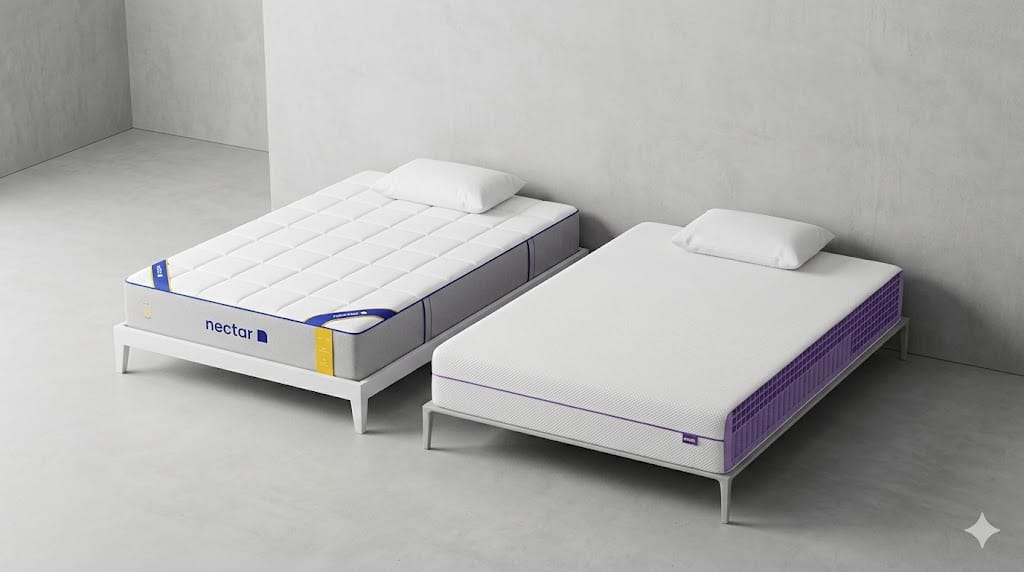
The Nectar vs Purple mattress comparison comes down to one fundamental question: do you want the contouring embrace of memory foam or the responsive feel of Purple’s unique GelFlex Grid? Both mattresses cost around $1,000-1,500 for a queen, both offer long trial periods, and both have millions of satisfied customers, but they provide fundamentally different sleep experiences that suit different body types, sleep positions, and preferences. For our current top picks, see the best mattress toppers guide.
The problem most buyers face is that online reviews for both mattresses are overwhelmingly positive, making the decision feel like a coin flip. Nectar reviewers describe the pressure relief as transformative. Purple reviewers describe the cooling and responsiveness as revolutionary. Both sets of reviews are accurate for their respective target audiences, but those target audiences are different, which means the right choice depends on understanding your specific sleep patterns and what each mattress actually does well.
This detailed Nectar vs Purple comparison breaks down the real construction differences, the scenarios where each mattress excels, and the specific sleeper profiles that match each design. We compared both mattresses on their specs and customer reviews to separate marketing claims from genuine performance differences. By the end of this guide, you’ll know exactly which mattress fits your situation, and which one to skip.
If you’re also considering other premium mattress options or want to understand mattress selection more broadly, our guides on best mattresses for back pain and best mattresses for side sleepers cover complementary analysis that works alongside this Nectar vs Purple comparison. For an isolated Purple review, see our dedicated Purple mattress review article.
The quick verdict on Nectar vs Purple
Choose Nectar if: You want classic memory foam contouring, sleep primarily on your side, prefer a plush feel, value pressure relief above all else, or are shopping on a tighter budget. Nectar delivers the hug-and-sink experience memory foam fans love.
Choose Purple if: You sleep hot, prioritize responsiveness over contouring, switch positions frequently during the night, have back pain that responds to firmer support, or want a mattress that doesn’t feel like traditional foam. Purple’s GelFlex Grid provides a genuinely unique sleep experience.
Why Nectar vs Purple is the most important mattress comparison for many buyers
The Nectar vs Purple comparison matters because these two mattresses represent the most divergent design philosophies at similar price points. Understanding the differences explains why matching mattress to sleeper matters so much.
Different materials, different experiences
Nectar uses traditional memory foam construction with modern cooling enhancements. The material contours to your body over 10-30 seconds as your body heat softens the foam, creating the characteristic “sinking into the mattress” feel memory foam enthusiasts love.
Purple uses its patented GelFlex Grid, a hyperelastic polymer arranged in a grid pattern. The material responds instantly rather than contouring slowly, providing support under pressure points while allowing flow-through for air and movement.
These aren’t minor differences. They create fundamentally different sleep experiences that work well for different bodies and preferences.
Different firmness approaches
Nectar positions itself at medium-firm (approximately 6.5/10 on the firmness scale). The memory foam softens over time as it warms, making the effective firmness decrease throughout the night.
Purple has multiple firmness options, but their flagship Purple mattress sits around 7/10 firmness that stays consistent because the GelFlex Grid doesn’t soften with body heat the way memory foam does.
Body weight affects these experiences differently. Heavier sleepers sink more into memory foam, which can change Nectar’s effective firmness substantially. Purple’s grid responds to pressure rather than heat, so firmness stays more consistent across body weights.
Different temperature performance
Traditional memory foam retains heat. Nectar addresses this with gel infusion and breathable covers, but the fundamental material still runs warmer than hybrid alternatives.
Purple’s GelFlex Grid is open by design, air flows through the grid spaces naturally, making Purple one of the coolest mattresses available, regardless of ambient temperature.
For hot sleepers, this temperature difference often drives the purchase decision more than any other factor.
Detailed Nectar mattress review
Nectar represents the mature evolution of memory foam mattress design. Understanding what the brand delivers helps frame whether it fits your needs.
Nectar Classic construction
The Nectar Classic (their flagship model) uses a 5-layer construction:
Layer 1 (top): Quilted cooling cover with phase-change materials Layer 2: 3″ gel memory foam comfort layer for contouring Layer 3: 2″ dynamic support layer for transition Layer 4: 7″ high-density support foam base Layer 5 (bottom): Stay-in-place base fabric
Total height: 12 inches, which is appropriate for most bed frames and bedroom aesthetics.
Nectar’s memory foam approach
The traditional memory foam approach creates specific benefits that other mattresses can’t match. The pressure-relieving contour distributes body weight across a larger surface area, reducing pressure points at the hips, shoulders, and spine.
This matters particularly for side sleepers, whose shoulders and hips need cushioning to prevent pressure-induced pain. Side sleepers on firm mattresses often wake with shoulder pain because the firm surface doesn’t allow the shoulder to sink into acceptable comfort.
Memory foam also isolates motion effectively. If you share the bed with a partner, their movement doesn’t transfer to your side as strongly as it would on an innerspring mattress.
Nectar cooling technology
Nectar addresses memory foam’s heat retention problem through multiple layers of cooling tech. The quilted cover uses phase-change materials that absorb body heat and release it when you reach optimal sleep temperature.
Gel infusion throughout the comfort layer helps dissipate heat away from the sleeper. The dynamic support layer provides airflow channels that traditional memory foam designs lack.
In practice, Nectar runs cooler than basic memory foam but warmer than hybrid or innerspring alternatives. Hot sleepers still tend to prefer Purple or hybrid options, but Nectar is significantly improved over older-generation memory foam.
Nectar pricing and value
Nectar positions itself as a premium memory foam at an accessible price. A queen Nectar Classic costs approximately $1,049 (often discounted to $799 during promotional periods).
The value proposition is strong for buyers who specifically want memory foam characteristics. Comparable memory foam mattresses from Tempur-Pedic cost 2-3x more while delivering similar (or marginally better) contouring performance.
Nectar includes a 365-night trial, which is genuinely exceptional. You can sleep on the mattress for nearly a year before deciding whether to keep it, enough time to experience every season, every sleep phase, and every possible use case.
Warranty and delivery
Nectar offers a Forever Warranty that covers manufacturing defects for the mattress’s lifespan. The warranty is appropriately detailed and has real-world enforcement mechanisms.
Delivery is compressed in a box to your door, the standard mattress-in-a-box format. The mattress expands over 24-72 hours after unboxing to reach its full shape and support.
Who should buy Nectar?
Nectar works best for:
- Side sleepers who need pressure relief
- Buyers preferring a contouring/hug feel
- Memory foam enthusiasts
- Couples prioritizing motion isolation
- Budget-conscious premium buyers
- Those who sleep cool to moderate (not hot)
Detailed Purple mattress review
Purple represents a fundamentally different mattress approach that some sleepers find revelatory. Understanding what it delivers helps frame whether it suits your needs.
Purple Classic construction
The original Purple mattress uses a 3-layer construction:
Layer 1 (top): 2″ Purple GelFlex Grid (Hyper-Elastic Polymer) Layer 2: 3.5″ high-density polyurethane support foam Layer 3 (bottom): 4″ high-density support foam base
Total height: 9.5 inches, shorter than Nectar’s 12 inches but adequate for the support structure.
Purple also offers Premier (11″) and Premier-plus (13″) options with thicker GelFlex Grid layers for different feel preferences and body sizes. Most buyers stick with the original unless they specifically need the enhanced Premier feel.
The GelFlex Grid technology
The GelFlex Grid is Purple’s patented innovation and the centerpiece of their mattress approach. The grid is made from a hyperelastic polymer arranged in roughly 1-inch columns with open spaces between.
When pressure is applied (your body lying down), the columns buckle directionally, supporting you where pressure is highest and allowing space where pressure is lighter. This creates instant contouring without the slow heat-activated response of memory foam.
The grid also allows continuous airflow through the open spaces. Your body heat dissipates through these channels rather than being absorbed by solid foam.
Purple’s responsiveness advantage
Purple’s GelFlex Grid provides a genuinely unique sleep feel that’s hard to describe without experiencing it. The mattress supports you without the sinking sensation of memory foam.
For combination sleepers who change positions during the night, this responsiveness matters enormously. Turning over on Purple requires less effort than memory foam alternatives, the grid adapts to new positions instantly rather than needing to reform around your new shape.
Partners who get into/out of bed during the night cause less disturbance on Purple because the grid doesn’t “remember” their position the way memory foam does.
Purple’s cooling performance
Purple’s open-grid construction produces the coolest sleep experience in the mainstream mattress category. Air flows continuously through the grid, dissipating body heat more effectively than any sealed foam alternative.
For genuinely hot sleepers, those who wake up sweating, live in warm climates, or have temperature dysregulation from medical conditions, Purple’s cooling performance is often the deciding factor. No amount of cooling gel infusion in memory foam matches the fundamental physics of open-grid construction.
Purple pricing and value
Purple’s queen Classic costs approximately $1,399 (often discounted to $1,099 during sales). This puts Purple slightly above Nectar’s pricing for a similar-quality mattress but below premium competitors like Casper Wave or Tempur-Pedic.
The Premier and Premier-plus models cost $1,999 and $2,899, respectively, genuinely expensive territory that requires specific preferences to justify.
The 100-night trial is shorter than Nectar’s 365-night option. This difference matters for buyers uncertain about the unique Purple feel, you have less time to decide. The shorter trial reflects Purple’s confidence that the material either works for you or doesn’t.
Warranty and delivery
Purple provides a 10-year warranty against manufacturing defects. The warranty terms are reasonable, and enforcement is consistent.
Delivery is in the box, similar to Nectar. Purple requires 24-48 hours of off-gassing before use, during which the hyperelastic polymer releases its packaging scent.
Who should buy Purple
Purple works best for:
- Hot sleepers (clearest use case)
- Combination sleepers who change positions frequently
- Back pain sufferers benefit from firmer support
- Buyers wanting to escape memory foam feel
- Those who find traditional memory foam “stuck” or heavy
- Back sleepers seeking specific spinal support
Nectar vs Purple: head-to-head comparison
Comparing specific features directly helps clarify where each mattress excels. This head-to-head Nectar vs Purple analysis covers the metrics that matter most.
Pressure relief comparison
Nectar wins on pressure relief for side sleepers. The contouring memory foam distributes weight across a larger surface area, reducing pressure at hip and shoulder pressure points specifically.
For side sleepers, Nectar’s pressure relief often translates to better sleep quality and fewer pain complaints after months of use.
Purple performs adequately on pressure relief, but through a different mechanism, the grid buckles under pressure points rather than contouring around them. The result is good, but not exceptional pressure relief compared to Nectar.
Winner for side sleepers: Nectar. Winner for back sleepers: Tie, both perform well
Temperature performance comparison
Purple wins decisively on temperature regulation. The open-grid construction physically allows more air circulation than any sealed foam design.
Nectar performs adequately for cool-to-moderate sleepers. The gel infusions and cooling cover help, but the fundamental material limits cooling performance compared to open-grid alternatives.
Winner for hot sleepers: Purple Winner for cool sleepers: Tie, personal preference
Motion isolation comparison
Nectar wins on motion isolation. Memory foam fundamentally absorbs motion better than responsive materials. A partner moving at 3 AM creates less disturbance on Nectar.
Purple performs adequately on motion isolation but not exceptionally. The grid transmits some motion between sides, though less than innerspring mattresses.
Winner for couples with partners who move: Nectar
Edge support comparison
Purple performs adequately on edge support. The firmer foam base prevents significant edge collapse.
Nectar performs adequately on edge support. The high-density support base maintains shape under edge pressure.
Winner: Tie, both are acceptable
Durability comparison
Both mattresses offer solid durability in the 7-10 year range for normal use. Purple’s GelFlex Grid is engineered for durability, the material doesn’t degrade like memory foam eventually does.
Slight edge: Purple for longer expected lifespan (10-12 years vs 7-9 for Nectar)
Value comparison
Nectar wins on initial value, lower price point for premium memory foam characteristics.
Purple wins on long-term value for hot sleepers or combination sleepers who need the specific features Nectar doesn’t deliver.
The right value depends on the match between mattress features and your specific needs.
Nectar vs Purple: matching to sleep position
Different sleep positions have different mattress needs. Here’s how Nectar vs Purple matches to specific positions.
Side sleepers
Side sleeping requires pressure relief at the hips and shoulders. Nectar’s memory foam contouring provides superior pressure relief for this specific need.
Best choice for side sleepers: Nectar (unless they also sleep very hot, in which case a Purple Premier or hybrid alternative might be better)
Back sleepers
Back sleeping requires spinal support that maintains the natural curve of the lumbar spine. Both mattresses handle back sleeping well, but slightly differently.
Purple’s responsiveness provides firm support without the sinking that memory foam creates, appropriate for back sleepers with back pain issues.
Nectar’s contouring can cause the lumbar spine to lose its natural curve as the hips sink into the memory foam. This works for some back sleepers but bothers others.
Best choice for back sleepers: Slight edge to Purple, particularly for those with lower back pain. See our how to sleep with lower back pain guide for complementary positioning advice.
Stomach sleepers
Stomach sleeping requires firmer support that prevents the hips from sinking below the shoulders and causing lumbar hyperextension.
Purple’s firmer feel works better for stomach sleepers than Nectar’s softer memory foam. A stomach sleeper on Nectar often experiences lower back pain from the hip-sinking effect.
Best choice for stomach sleepers: Purple (or our dedicated guide on best mattresses for stomach sleepers for more options)
Combination sleepers
Combination sleepers change positions frequently, typically every 30-60 minutes throughout the night. These sleepers benefit from mattresses that respond quickly to position changes rather than slowly reforming around new shapes.
Purple’s responsive GelFlex Grid handles position changes far better than memory foam. Nectar’s memory foam requires time to reform after each position change.
Best choice for combination sleepers: Purple, decisively
Nectar vs Purple: matching to body weight
Body weight significantly affects mattress performance. Here’s how Nectar vs Purple handles different weight ranges.
Lighter sleepers (under 150 pounds)
Lighter sleepers don’t generate enough pressure to fully engage either mattress’s support systems. Both Nectar and Purple work well for lighter sleepers, with slight preferences based on other factors.
Recommendation: Either works well. Choose based on temperature preference (Purple for hot) or pressure relief needs (Nectar for side sleepers).
Average weight sleepers (150-220 pounds)
This is the sweet spot for both mattresses. Both are designed and tested for this weight range. Both deliver their respective intended performance characteristics.
Recommendation: Personal preference based on features analyzed above.
Heavier sleepers (220-300 pounds)
Heavier sleepers generate more pressure and require more robust support. Both mattresses can handle heavier sleepers, but differently.
Purple’s responsive grid provides firm support that doesn’t degrade under heavier pressure. The GelFlex Grid performs consistently across weight ranges.
Nectar’s memory foam can feel different for heavier sleepers, they sink more into the foam, making the effective firmness seem less. For heavier sleepers who specifically want memory foam contouring, this is fine. For those wanting specific firmness, it can be inconsistent.
Recommendation: Slight edge to Purple for heavier sleepers seeking consistent firmness.
Very heavy sleepers (300+ pounds)
Both mattresses are rated for sleepers up to 300 pounds per side for couples. Above these weights, specialty mattresses designed for higher weight capacity often work better.
Purple Premier and Premier-plus handle heavier weights better than the standard Purple due to the thicker GelFlex Grid layer.
Recommendation: Consider specialty heavy-duty mattresses; Purple Premier-plus as the alternative from our comparison options.
Nectar vs Purple: cooling and temperature considerations
Temperature regulation matters more than most buyers realize. Here’s the detailed Nectar vs Purple cooling analysis.
How Purple’s cooling works
The GelFlex Grid is fundamentally open, air can flow through the column spaces. This construction provides passive cooling through natural air circulation.
As you lie on Purple, body heat rises and moves through the grid spaces. Fresh air from the sides and bottom flows in to replace the rising warm air. This continuous circulation prevents the heat accumulation that makes mattresses uncomfortable.
How Nectar’s cooling works
Nectar uses multiple cooling technologies to address memory foam’s inherent heat retention:
- Phase-change materials in the cover absorb and release heat
- Gel infusion throughout the comfort layer helps distribute heat
- The dynamic support layer includes airflow channels
These technologies genuinely improve cooling over basic memory foam. They don’t match the passive cooling of open-grid construction.
Real-world temperature performance
In practice, the temperature difference between mattresses is noticeable but not extreme for most sleepers. For cool-to-moderate room temperatures, both mattresses perform adequately.
For warm bedrooms (74°F+), hot climates, or sleepers with temperature regulation issues, Purple’s cooling advantage becomes significant. Many hot sleepers describe the switch from memory foam to Purple as “night and day” for sleep quality.
Our guide on cooling alternatives
If cooling is the primary priority, our guide on best cooling pillows for hot sleepers covers complementary cooling products that work alongside any mattress choice. Our best mattresses for hot sleepers guide also covers additional cooling-focused mattress options beyond just Purple.
Nectar vs Purple: pricing, trial, and warranty
Beyond performance characteristics, the practical considerations of buying matter for real-world decisions.
Pricing comparison
Nectar Classic Queen: $1,049 retail, often $799 with promotions Purple Classic Queen: $1,399 retail, often $1,099 with promotions
The Purple premium is approximately $300-400 for the unique GelFlex Grid technology. Whether this premium is justified depends entirely on how much you value Purple’s specific benefits.
Trial period comparison
Nectar: 365-night trial Purple: 100-night trial
Nectar’s trial is exceptional, one of the longest in the industry. This gives you nearly a year to test the mattress through every season, every sleep phase, and every possible use case.
Purple’s 100-night trial is shorter but adequate for determining whether the unique GelFlex Grid feel works for you. Most buyers know within the first 30-60 nights whether Purple suits them.
Warranty comparison
Nectar: Forever Warranty against manufacturing defects Purple: 10-year limited warranty
Both warranties cover typical manufacturing defect scenarios. Nectar’s “forever” framing is stronger, but real-world enforcement follows similar patterns for both brands.
Delivery and setup
Both mattresses: Free shipping in boxed form. Both require: 24-72 hours for full expansion after unboxing
Purple has a slight edge on setup because the GelFlex Grid doesn’t off-gas the same way memory foam does. Nectar’s memory foam off-gassing is mild but present for 1-2 days.
Return process
Nectar: Free pickup and donation through their return process Purple: Free pickup and donation for returns within the trial period
Both companies handle returns reasonably for trial-period decisions. Neither forces you to dispose of an unwanted mattress yourself.
Specific scenarios: which mattress wins
Real-world use cases often simplify the Nectar vs Purple decision. Here are the specific scenarios where each mattress is clearly the better choice.
Scenario: hot sleeper with back pain
Purple wins here. The cooling performance addresses the primary comfort issue, and the firmer support helps with back pain.
Scenario: side sleeper with shoulder pain
Nectar wins here. The pressure relief specifically addresses shoulder pain from side sleeping.
Scenario: couple with partner who moves frequently
Nectar wins here. Memory foam isolates motion dramatically better than responsive alternatives.
Scenario: combination sleeper with existing back issues
Purple wins here. The responsiveness supports position changes while the firmer feel helps with back pain.
Scenario: someone transitioning from an older memory foam mattress
Nectar is the simpler transition. Purple requires significantly more adaptation since the material feel is genuinely different from anything most people have experienced.
Scenario: budget-conscious buyer who sleeps cool
Nectar is the better value here. You get premium memory foam performance at lower pricing.
Scenario: premium buyer prioritizing a unique sleep experience
Purple is more appealing here. The GelFlex Grid is genuinely unique and provides an experience that can’t be replicated with traditional materials.
Alternatives to Nectar and Purple
Neither mattress is the right choice for every sleeper. Here are the top alternatives to consider.
Budget alternative
If Nectar at $800-1,000 still feels too expensive, consider Amazon Basics or Linenspa memory foam mattresses in the $400-500 range. The quality difference is real, but for occasional use or guest beds, the budget alternatives work adequately.
Premium alternative
If the budget is less constrained, Casper Wave at $2,000+ offers both pressure relief and responsiveness. Helix mattresses offer more personalization with multiple firmness options.
Specialty alternatives
For specific conditions, specialty mattresses often outperform general-purpose options:
- Back pain sufferers: See our best mattresses for back pain guide
- Hot sleepers: Our best mattresses for hot sleepers guide
- Side sleepers: Our best mattresses for side sleepers guide
- Stomach sleepers: Our best mattresses for stomach sleepers guide
Topper-based approaches
If you can’t afford a new mattress, a quality topper can approximate either experience on your existing bed. Our how to choose the right mattress topper guide covers the decision framework, and our best mattress toppers for back pain guide covers specific high-rated options.
Our verdict: Nectar vs Purple mattress comparison
The Nectar vs Purple decision comes down to what you value most in sleep.
Choose Nectar if you want classic memory foam contouring, pressure relief for side sleeping, motion isolation for couples, and accessible pricing, all wrapped in the best trial period in the industry (365 nights). Nectar is the safer choice for buyers who already know they like memory foam and simply want a quality version at a reasonable price.
Choose Purple if you sleep hot, change positions frequently, want a genuinely unique sleep experience, or need responsive support for back pain or combination sleeping patterns. Purple costs $300-400 more than Nectar, but the GelFlex Grid delivers cooling performance and responsiveness that memory foam fundamentally cannot match.
The broader point: neither mattress is objectively better than the other, they’re designed for different priorities. Buyers who understand their specific needs make the right choice quickly. Buyers who don’t often fall for marketing claims from either brand end up dissatisfied.
If you’re still uncertain after reading this comparison, our recommendation is to start with Nectar because:
- The 365-night trial gives you far more time to decide
- The memory foam feel is more familiar and less adjustment-requiring
- The price point is lower, reducing regret if it doesn’t work
- Returning Nectar for Purple is easier than the reverse situation
For a second opinion comparing these mattresses to other premium options, our best mattresses for back pain guide covers a broader category that includes both these brands.
Frequently asked questions about Nectar vs Purple
Which is better, Nectar or Purple mattress?
Neither is objectively better, they’re designed for different sleep priorities. Nectar is better for side sleepers wanting memory foam pressure relief, couples prioritizing motion isolation, and budget-conscious buyers. Purple is better for hot sleepers, combination sleepers, back pain sufferers, and those wanting a unique, responsive feel. The right choice depends on your specific sleep patterns and temperature preferences. Consider your priorities: contouring vs responsiveness, pressure relief vs cooling, and traditional vs innovative materials.
Does Nectar or Purple sleep cooler?
Purple sleeps significantly cooler than Nectar. The GelFlex Grid’s open construction allows continuous airflow through the grid spaces, dissipating body heat naturally. Nectar uses multiple cooling technologies (gel infusion, phase-change cover, dynamic support layer), but as a sealed foam design, can’t match Purple’s passive air circulation. Hot sleepers consistently rate Purple as dramatically cooler than Nectar.
Is Nectar or Purple better for back pain?
Both can help with back pain, but for different reasons. Purple’s firmer support and responsiveness work well for people with lower back pain because the mattress maintains the natural lumbar curve. Nectar’s contouring pressure relief helps people whose back pain stems from pressure points at hips and shoulders, causing compensatory lumbar strain. If you already know firm mattresses help your back pain, choose Purple. If pressure relief has been your pain solution in the past, choose Nectar.
Which mattress is more expensive, Nectar or Purple?
Purple is more expensive. A queen Purple Classic costs approximately $1,399 (typically $1,099 with promotions) while a queen Nectar Classic costs approximately $1,049 (typically $799 with promotions). The $300-400 difference reflects the unique GelFlex Grid technology, which costs more to manufacture than traditional memory foam. Whether the premium is justified depends on whether you value Purple’s specific benefits (cooling, responsiveness, unique feel).
Can I try both Nectar and Purple before deciding?
Only sequentially. Nectar offers a 365-night trial, buy Nectar, sleep on it for up to 365 nights, and return it if it doesn’t work. Purple offers a 100-night trial. You cannot easily test both simultaneously because mattress returns take 7-14 days to process. If you’re genuinely uncertain, start with Nectar (longer trial gives more flexibility), then switch to Purple if Nectar doesn’t work for you.
How do Nectar and Purple compare to other mattress brands?
Nectar competes with Casper (Casper Original is at a similar price point), Saatva (Saatva is an innerspring with a different feel), and Tuft & Needle (T&N Original is cheaper). Purple competes with GhostBed (similar unique-material approach), Helix (hybrid with more options), and high-end Casper Wave. Both Nectar and Purple have strong positions in the mattress-in-a-box market. For an alternative perspective, see our purple mattress review for more detailed Purple-specific analysis.
Which mattress is better for side sleepers, Nectar or Purple?
Nectar is better for most side sleepers because its memory foam contouring provides superior pressure relief for hips and shoulders. Side sleepers on firm mattresses often experience pressure-induced pain; Nectar’s deeper contouring prevents this. Purple still works for side sleepers but requires either the thicker Premier variants or additional topper for optimal pressure relief. The tiebreaker: if you’re a side sleeper who also sleeps hot, Purple Premier might be the compromise. Otherwise, Nectar for side sleepers.
Do both mattresses have a long warranty?
Yes, but different structures. Nectar offers a “Forever Warranty” covering manufacturing defects for the mattress’s lifetime. Purple offers a 10-year limited warranty. In practice, both warranties cover typical real-world scenarios. Nectar’s forever framing is stronger marketing, but real-world enforcement patterns are similar for both brands. Neither warranty covers normal wear and tear, body impressions under 1.5 inches, or damage from improper use.
Recommended Reading
See also our guides to how to store a mattress. Also see our Nectar mattress review, a firsthand look at the memory foam bed.
Related Reading
Explore more: why is my mattress sagging, how to store a mattress, mattress cleaners, heated mattress pads, Are Heated Mattress Pads Safe? A Practical Safety Guide, king vs california king mattress, mattress topper vs mattress pad, and hybrid vs latex mattress.
