
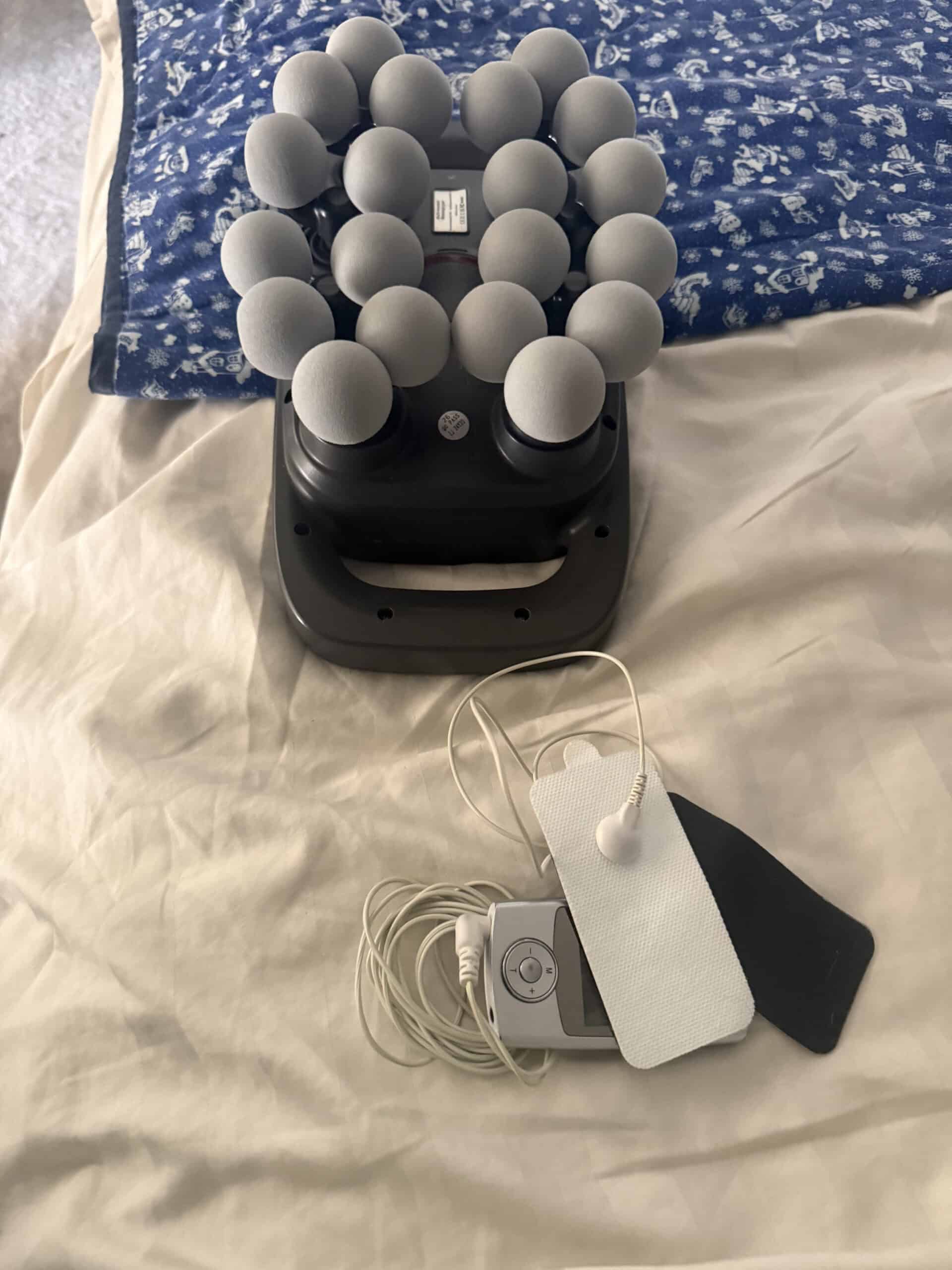
You can use both in the same session, and the sensible order is the massage gun first and the TENS unit second, because one works on tissue and the other works on signaling. What you should not do is run a massage gun and a TENS unit together on the same spot at the same time, since the vibration lifts electrode pads and makes intensity impossible to judge.
I own both and use them in the same session most nights, usually right before bed. Neither replaced the other, and I did not plan the split. They divided the work between themselves.
Medical Disclaimer
This describes how two comfort devices fit together and is not medical advice. TENS is not suitable for everyone, and anyone with a pacemaker or implanted device, epilepsy, a heart condition, or who is pregnant should speak to a doctor before using one.
What Each One Actually Does
A massage gun applies rapid mechanical pressure to soft tissue. It moves muscle, increases local blood flow, and works over a broad area quickly.
A TENS unit sends low-voltage current through the skin. The Cleveland Clinic describes it as interfering with pain signaling rather than treating tissue, which is a genuinely different mechanism.
That difference is why they stack rather than compete. One changes the tissue, the other changes what you feel from it.
The Short Version
Massage gun first for two to five minutes on the area, then TENS for twenty to thirty minutes with the pads placed after the skin has settled. Never both at once on the same spot. Finish before bed and take the pads off.
How the Two Split the Work at My House
My massage gun is one of the larger, big-coverage designs, which I like for working over broad areas like my back and legs. It is the tool for a whole muscle group.
The TENS unit is what I reach for when something specific is sore. I put the pads on, let the remote do its thing, and it takes the edge off ordinary back and neck aches. It has held up for years without trouble.
Most nights they run in the same session, and that session usually sits right before bed. If I am genuinely sore rather than just winding down, I will use them at any time of day instead.
The honest part is that I cannot separate the effects. I use both, close together, and what I can report is that the combination suits the end of an evening. Which device is doing what, or how much of it is twenty minutes of lying still, I do not know and will not claim to.
I also own a foam roller and a roller stick, and those ended up covering different jobs again without me deciding anything. Our comparison of foam roller versus massage gun covers that side of the split.
The Order That Makes Sense
| Step | Why it goes there | Rough time |
|---|---|---|
| Massage gun on the area | Moves tissue and warms it first | Two to five minutes |
| Wait, let skin settle | Pads stick badly to warm damp skin | A few minutes |
| Place TENS pads | Around the sore area, not on the spine | |
| Run the TENS session | Lower intensity for an evening | Twenty to thirty minutes |
| Remove pads, then bed | Never sleep with electrodes on |
Gun first is the order most people land on, and there is a practical reason beyond theory. Electrode pads adhere poorly to skin that is warm and slightly damp, which is exactly what a massage gun leaves behind.
Reversing it also wastes the TENS session, since you would then percuss the area you just spent half an hour calming.
Why Not Both at Once
Running them simultaneously on the same area is the one combination to avoid, for three straightforward reasons.
Vibration lifts electrodes. A partially lifted pad concentrates current on a smaller contact area, which is how skin irritation and burns happen.
You also lose the ability to judge intensity. Percussion masks the tingling sensation you use to set the TENS level, so it is easy to end up higher than intended.
And there is no benefit to buy with that risk. The mechanisms do not reinforce each other in any way that requires them to overlap in time.
Using them on different areas at once is a different question and is generally fine, though it is more faff than it is worth.
Where Heat Fits
Heat is the third common tool and it also does something distinct, which is warming and loosening tissue before anything else happens.
Heat first, then the gun, then TENS is a reasonable full sequence. I lay a heating pad on my massage table to warm up tight muscles before stretching, which is the same idea applied to a different job.
Do not use heat and TENS on the same spot at the same time. Warm skin has altered sensitivity, which makes setting intensity unreliable.
Our roundup of heating pads for back and neck covers the options, and recovery tools for bedtime tension puts the whole set side by side.
Do You Actually Need Both
Not necessarily, and the honest answer depends on what your problem is.
If your issue is tight muscles after exercise, a massage gun alone covers most of it. Our roundup of massage guns and our list of muscle roller sticks cover the mechanical end, and a stick costs a fraction of a gun.
If your issue is a persistent ache that is not really about muscle tightness, TENS addresses that in a way percussion does not. Our roundup of TENS units for pain relief covers that side.
People who own both usually got there the way I did, by buying one and later finding it did not cover everything. That is a fine reason, and it is different from buying both at once on the theory that they multiply.
Common Misconceptions
That combining them multiplies the effect
They address different things. Using both covers more ground rather than producing a stronger version of one result.
That longer is better on either device
Two to five minutes per area on a gun and twenty to thirty minutes of TENS are the usual limits. Extending both mostly produces sore skin.
That a strong setting means it is working
Visible muscle twitching on TENS is more than an evening session needs, and leaning hard on a massage gun bruises rather than releases.
That devices deal with the underlying problem
Both manage symptoms. Pain that wakes you regularly or lasts weeks is worth taking to a doctor, and our guide on relieving pain for better sleep covers the wider picture.
Related Reading
Massage Gun and TENS FAQ
Can you use a massage gun and a TENS unit together?
In the same session, yes, and many people do. At the same moment on the same spot, no. Percussion lifts electrode pads and masks the sensation you use to set intensity, which is how people end up with irritated skin.
Which should come first?
The massage gun. It moves and warms tissue, and doing it afterward would undo a TENS session you just finished. Give the skin a few minutes to settle before placing pads, since they adhere badly to warm, slightly damp skin.
How long should each part take?
Two to five minutes per area with the gun and twenty to thirty minutes for TENS. Both have practical limits rather than benefits that keep scaling, and manufacturers cap continuous use for a reason.
Can I use them on different body parts at the same time?
Generally yes, since the concerns are about electrodes lifting and sensation being masked on the same area. In practice it is awkward enough that most people just do one after the other.
Is it safe to use both every night?
For most people using them on ordinary muscle soreness, yes, though skin under electrodes needs a break. Rotate pad placement rather than using the identical spot every evening, and stop if you see redness that does not fade.
Should I use heat as well?
You can, and heat first is the usual order. Do not combine heat and TENS on the same spot at the same time, because warm skin has altered sensitivity and makes intensity hard to set accurately.
Who should avoid this combination?
Anyone who should not use TENS at all: people with a pacemaker or implanted electrical device, and anyone pregnant or with epilepsy, a heart condition or reduced skin sensation should speak to a doctor first. Massage guns should also stay off bone, joints, the neck front and any injury.
When should I see a professional instead?
If pain persists for weeks, follows an injury, wakes you regularly, or comes with numbness, weakness or tingling into a limb. Devices that make something bearable can quietly delay finding out what is actually going on.
Sources
- Cleveland Clinic, guidance on transcutaneous electrical nerve stimulation and its contraindications.
- National Institute of Neurological Disorders and Stroke, information on TENS and pain signaling.
- Mayo Clinic, guidance on when persistent musculoskeletal pain warrants medical assessment.
