
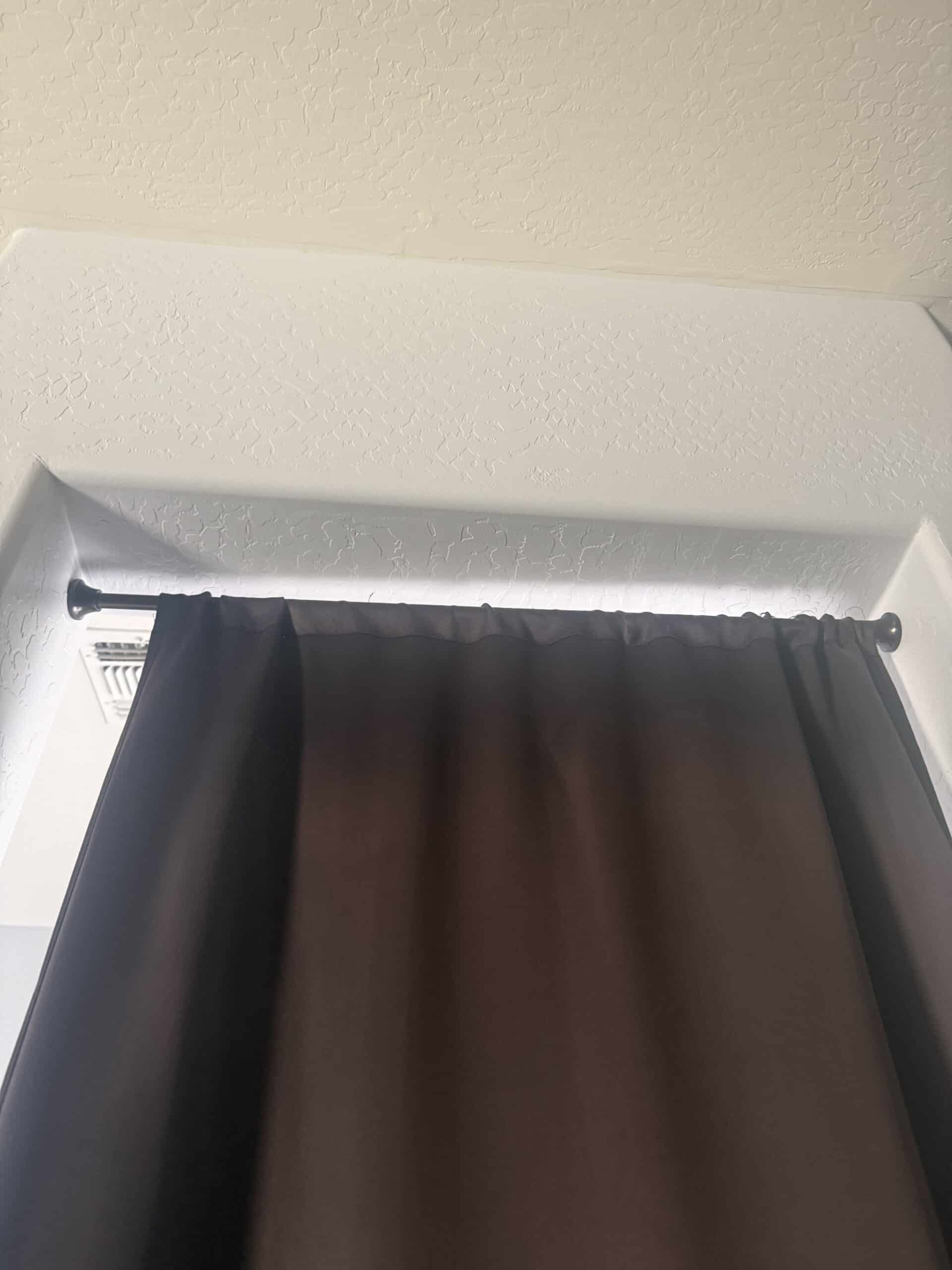
They can, and whether yours will comes down to friction rather than to the rod being good or bad. A tension rod stays up because outward pressure creates enough grip against two surfaces to resist the weight pulling down.
I have had both outcomes. A tension rod holding a shower curtain came down constantly, and the rod carrying blackout curtains has held for multiple years without moving. Same principle, opposite results, which is what makes this worth explaining. Our roundup of no-drill blackout curtain rods covers the hardware.
Quick Answer
Failure comes from too much weight, too little tension, or a surface the rubber ends cannot grip. Blackout curtains are heavy, so the rod has to be rated for them rather than merely long enough.
Why They Fail
| Cause | What happens |
|---|---|
| Curtain too heavy for the rod | Gradual slip, then a drop |
| Rod extended near its maximum | Less overlap, less strength |
| Slick or textured surface | Rubber ends cannot grip |
| Tension set by hand only | Rarely enough for heavy fabric |
| Repeated pulling on the curtain | Works the rod loose over time |
| Temperature swings | Materials expand and contract |
Blackout Curtains Are Heavy
The reason blackout curtains block light is that they are densely woven or backed with an opaque layer, and both of those add weight.
A pair of floor-length blackout panels weighs considerably more than the sheer or cotton curtains most tension rods were designed around.
That weight acts as a constant downward force on a rod held up by friction alone, which is a different demand than a lightweight curtain makes.
Manufacturers publish weight ratings for tension rods, and the ratings are the specification that matters here rather than the length range everyone checks first.
A rod rated for light curtains at its stated maximum length is not rated for blackout panels at that same length. Our roundup of blackout curtains covers the fabric weight.
Why My Shower Rod Failed and the Curtain Rod Did Not
The shower curtain rod came down repeatedly, and shower rods sit in the worst possible conditions for a friction fit.
Bathroom surfaces are tile or gloss paint, both of which are slick, and steam changes the humidity around the contact points constantly.
A shower curtain also gets pulled sideways every single day, which applies exactly the kind of repeated lateral force that works a tension rod loose.
The blackout curtain rod has held for multiple years, and the difference is that curtains get pulled far less often, the surfaces are ordinary painted drywall or trim rather than tile, and nothing is steaming the wall twice a day.
Neither rod was inherently better than the other one. The situations were completely different, and it is the situation rather than the hardware that determines whether a friction fit survives long term. Our note on washing blackout curtains covers handling them.
What Actually Holds a Tension Rod Up
Outward spring pressure
The internal spring pushes the ends against two opposing surfaces.
Friction at the rubber caps
Grip depends entirely on what the cap is pressing against.
Overlap between the tubes
A rod near maximum extension has minimal overlap and flexes more.
Nothing else at all
There is no mechanical fixing. Friction is the whole system.
Surface Is the Variable Nobody Checks
Rubber grips painted drywall and wood trim reasonably well, which is why most window recesses work.
Tile, gloss paint, and vinyl are considerably slicker, and the same rod at the same tension holds far less on them.
Textured surfaces are the surprising failure, since heavy texture means the rubber cap only contacts the high points rather than sitting flush.
Wallpaper is its own problem, because the rod may grip the paper perfectly well while the paper releases from the wall.
Testing before trusting it is worth thirty seconds. Push down firmly on an installed rod, and if it slides at all it will come down eventually with fabric hanging on it.
Extension Length Matters More Than People Expect
Tension rods are sold as a range, and the two ends of that range do not perform the same.
Near the minimum, the tubes overlap substantially and the rod is stiff and strong.
Near the maximum, overlap is minimal, the rod flexes in the middle under load, and that flex reduces the outward pressure at the ends.
Buying a rod where your span sits in the middle of its range rather than at the top gives you considerably more margin.
Sagging in the middle is the early warning sign, and a rod that visibly bows under the curtain weight is telling you it is near its limit. Our roundup of curtain rods for doorways covers spans.
Getting the Tension Right
Most people set a tension rod by hand until it feels tight, and for heavy curtains that is generally not enough.
The rod should be extended past the actual span before installing so the spring is genuinely compressed rather than just extended to fit.
Twisting the rod to lengthen it once in place adds tension beyond what the spring provides on its own, which is what most instructions describe.
Overtightening is possible on drywall, where too much pressure dents the surface and the rod then settles into the dent and loosens.
The right amount is firm enough that it does not move under a downward push and not so firm that it marks the wall.
When to Give Up on Tension
Heavy blackout panels on a wide span in a rental with tile or gloss surfaces is the combination where tension rods fail regardless of technique.
Adhesive brackets carry less weight than screws but grip differently, and they do not depend on two opposing surfaces.
Magnetic rods work on steel door frames and nowhere else, which is a narrow but genuinely useful case.
Screws remain the answer where drilling is permitted, since nothing else holds heavy fabric as reliably over years.
Where drilling is not an option and tension keeps failing, splitting the span with a center support or using two shorter rods is worth trying before giving up entirely.
Common Mistakes to Avoid
Checking length instead of weight rating
The length range is easy to find and the weight rating is what determines whether it holds blackout panels.
Running a rod at maximum extension
Minimal tube overlap means flex, and flex reduces pressure at the ends.
Hand-tightening only
Twisting the rod once in place adds tension the spring alone does not provide.
Assuming a slick surface will grip
Tile and gloss paint hold far less than painted drywall, which is why shower rods fail so often.
Recommended Reading
See our roundup of blackout blinds for shift workers, our note on blackout curtains with shutters, our roundup of blackout curtain tracks, and a note on curtains versus blinds.
Tension Rod FAQ
Do tension rods fall down with blackout curtains?
They can. Blackout panels are heavy, and a tension rod holds by friction alone. Weight rating rather than length range is the specification that matters.
Has yours fallen?
The one holding blackout curtains has held for multiple years. A tension rod holding a shower curtain came down constantly, which is a much harder situation for a friction fit.
Why do shower rods fail so often?
Tile and gloss paint are slick, steam changes humidity at the contact points, and the curtain gets pulled sideways every day. All three work against friction.
How tight should it be?
Firm enough that it does not move under a downward push, and not so firm that it dents drywall. A rod settling into a dent loosens over time.
Does extension length matter?
Considerably. Near maximum extension the tubes barely overlap, the rod flexes under load, and that flex reduces pressure at the ends.
What surfaces work best?
Painted drywall and wood trim. Tile, gloss paint, vinyl, and heavily textured surfaces all reduce grip, and wallpaper can release from the wall entirely.
How do I test it?
Push down firmly on the installed rod before hanging anything. If it slides at all, it will eventually come down with fabric on it.
What if tension keeps failing?
Adhesive brackets, a magnetic rod on a steel frame, or splitting the span into two shorter rods. Screws remain the most reliable where drilling is allowed.
