
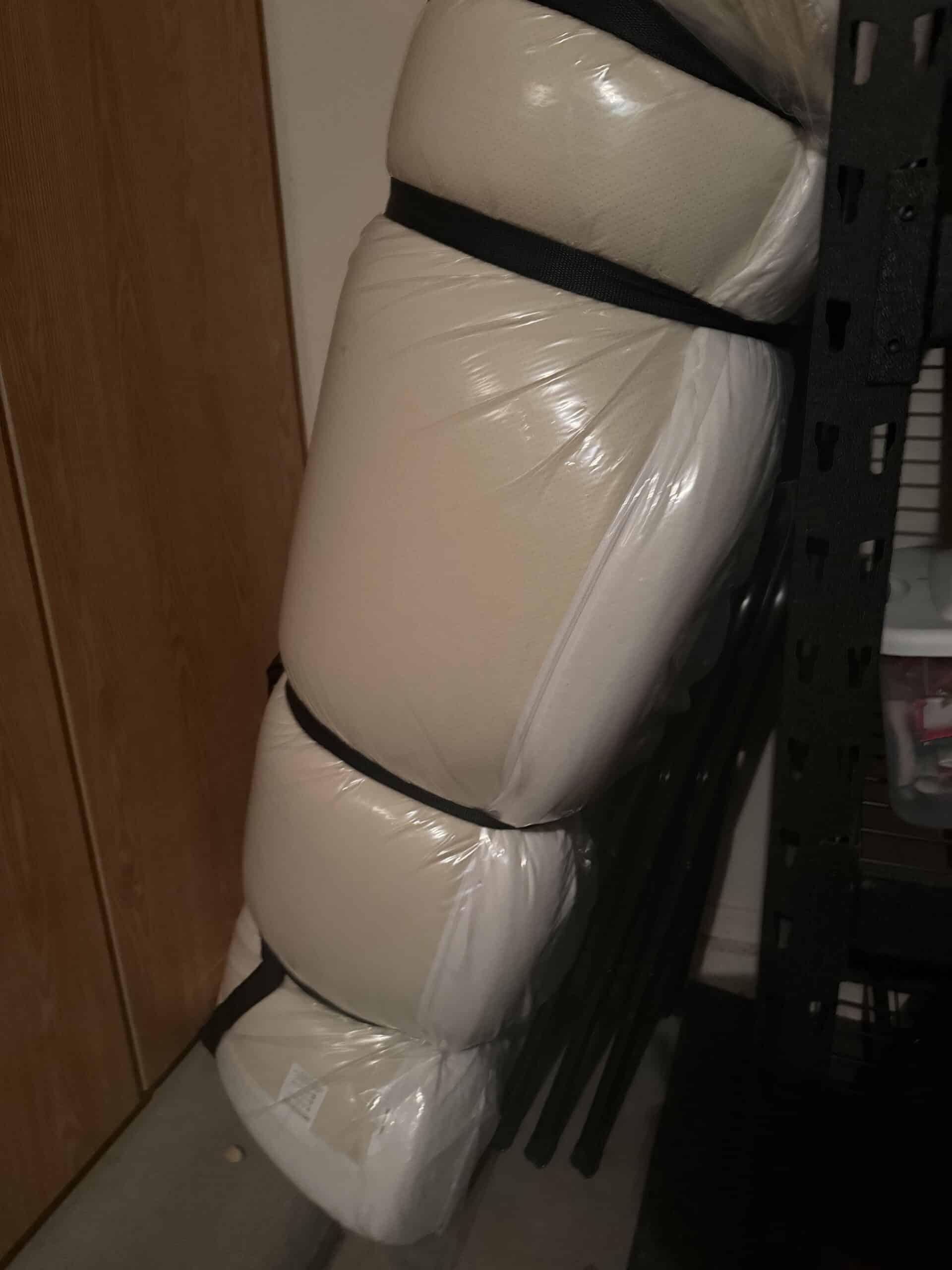
Moving straps solve two different problems that get sold as one. They give you something to hold on an object with no handles, and they hold a compressed load together once it is in place.
Mine came with a mattress bag kit rather than being bought separately. Four straps, arranged as two pairs with a gap across the middle, no padding anywhere on them. I used them to lift the mattress and they are now what holds it compressed in storage. Our roundup of mattress bags for moving covers the bag they came with.
Types at a Glance
| Type | Best for | Limitation |
|---|---|---|
| Plain webbing straps | Lifting and securing | No padding, cuts into hands |
| Forearm lifting straps | Long objects, two people | Needs coordination |
| Shoulder harness straps | Heavy loads, stairs | Setup takes longer |
| Ratchet straps | Holding compression tight | Can overtighten and damage |
| Cam buckle straps | Adjustable without overtightening | Less holding force |
| Padded lifting straps | Comfort on long carries | Bulkier, cost more |
How We Picked
Selections are grouped by whether they carry a load or hold one, since those are different jobs and most straps do one better than the other.
Descriptions come from documented specifications alongside my own use of plain webbing straps.
1. Forearm Lifting Straps, Best Overall
Why It Stands Out
Loops that go under an object and over your forearms transfer weight to your arms and legs rather than your hands and back.
That matters for anything with no grip point, which describes a mattress exactly.
Worth Knowing
Two people have to lift and lower together, and getting out of sync is awkward.
Less useful for a single-person lift. Our note on moving a mattress without a truck covers the job.
This suits two-person moves. Skip it if you are usually working alone.
Check Price on Amazon2. Plain Webbing Straps, Best Value
Why It Stands Out
Simple flat webbing does both jobs adequately for very little money, and it is what most mattress bag kits include.
Mine came with a kit and they have worked for lifting and for holding the mattress compressed since.
Worth Knowing
No padding, which is noticeable under load on bare hands.
Nothing stops you overtightening. Our roundup of furniture dollies covers moving the load once secured.
This suits occasional use. Skip it for repeated heavy moves.
Check Price on Amazon3. Cam Buckle Straps, Best for Compression
Why It Stands Out
A cam buckle tightens by pulling the free end and holds without the mechanical advantage of a ratchet, which makes overtightening much harder.
That suits holding foam compressed, where crushing is a real risk and maximum force is not the goal.
Worth Knowing
Less holding force than a ratchet, which matters for anything that could shift in transit.
The webbing can slip through the cam over long periods. Our roundup of under-bed storage covers other storage.
This suits compressed storage. Skip it for securing a load in a moving vehicle.
Check Price on Amazon4. Ratchet Straps, Best Holding Force
Why It Stands Out
A ratchet mechanism applies far more tension than hands alone, and it does not release under load the way a knot can.
The right choice for anything secured to a vehicle rather than sitting still.
Worth Knowing
The same mechanical advantage makes crushing foam easy, and there is no feedback telling you when to stop.
Bulkier hardware than a cam buckle. Our note on how to store a mattress covers storage conditions.
This suits vehicle transport. Skip it for compressing foam.
Check Price on Amazon5. Shoulder Harness Straps, Best for Heavy Loads
Why It Stands Out
A harness distributes weight across the shoulders and back rather than concentrating it on the forearms, which suits genuinely heavy items.
Hands stay free to steady and guide rather than bearing the load.
Worth Knowing
Setup takes longer than forearm straps, which is a real cost for a single item.
Overkill for a mattress. Our roundup of bed frames covers what else needs moving.
This suits appliances and furniture. Skip it for lighter awkward items.
Check Price on Amazon6. Padded Lifting Straps, Best Comfort
Why It Stands Out
Padding where the strap crosses the hand or forearm makes a long carry considerably less unpleasant.
Worth having if you move things regularly rather than once every few years.
Worth Knowing
Bulkier and more expensive than plain webbing for the same function.
Mine have no padding, which I notice under load. Our roundup of mattress protectors covers what goes on afterward.
This suits frequent moving. Skip it for a one-off.
Check Price on AmazonLifting and Holding Are Different Jobs
A strap used for lifting needs to be comfortable in the hand and long enough to loop underneath a bulky object with slack to spare.
A strap used to hold something compressed needs to stay tight across months without gradually loosening, and comfort in the hand is completely irrelevant to it.
Plain flat webbing does both of those jobs adequately, which is exactly why bundled kits include it, and it excels at neither one of them.
Mine came bundled with a mattress bag and have now done both jobs, first for the lift itself and since then as the thing keeping the mattress compressed. Our roundup of mattress encasements for bed bugs covers the kit.
Placement Matters More Than Count
Even spacing beats grouping
Mine sit as two pairs with a gap in the middle, and the middle is where it expands.
Long spans bulge
Foam pushes out wherever nothing is holding it, in proportion to the gap.
Pairs are redundant
Two straps close together do little more than one in the same place.
The ends need one too
The last foot before each end tends to expand first.
Webbing Material and What It Does Over Time
Strap material is the specification nobody reads and it decides how a strap behaves once it is holding something for months.
Polyester webbing has very little stretch, which is what you want for holding compression, since a strap that gives allows the load to expand against it.
Nylon webbing is stronger for its weight and stretches noticeably more, which is useful for absorbing shock in a moving vehicle and unhelpful for static compression.
Polypropylene is the cheapest and the one most likely to appear in a bundled kit, and it degrades faster in sunlight than either of the others.
For a mattress sitting in storage the relevant property is simply that the strap does not relax, and mine have held their tension across the time they have been on. Our note on metal bed frames covers the wider setup.
Padding Is Noticeable Under Load
A narrow unpadded strap concentrates the entire force onto a small area of the hand, and that is exactly where it starts to hurt on any carry longer than a few steps.
Wider webbing spreads the same load and helps considerably, which is why lifting straps are wider than tie-downs.
Mine have no padding and I notice it, though for a single lift it is a tolerable rather than a serious problem.
A pair of work gloves addresses most of that for considerably less than padded straps cost, which is worth knowing before buying a second set of anything.
Why Not to Overtighten
Compressing foam is the point, and crushing it is not, and there is a difference between the two that ratchets make easy to cross.
Foam compressed well beyond its designed range can take a set, which means it never fully recovers its original shape afterward.
Manufacturers compress mattresses for shipping using controlled industrial equipment rather than by simply pulling on a strap as hard as they possibly can.
Tight enough to hold the shape without deforming it is the actual target, and a cam buckle is considerably harder to take past that point than a ratchet is.
Lifting Technique Matters More Than Gear
Straps change where the load sits and they do not change the fact that a mattress is awkward rather than heavy.
The common injury is not from weight at all. It comes from twisting while holding something bulky, usually turning a corner or navigating a doorway.
Two people moving in the same direction at the same pace avoids most of that, and it is why forearm straps assume a pair rather than a solo lift.
Planning the route before picking anything up sounds obvious and is the step people skip, then discover a door that does not open wide enough while holding one end.
Clearing the floor along that route matters as much, since stepping over something while carrying a mattress is exactly the moment a lift goes wrong. Our roundup of rotate a mattress covers the alternative to carrying.
What to Look For
Width over length
Wider webbing spreads load across the hand and across the object.
A working load rating
Published rather than implied, particularly for anything holding weight overhead.
Cam buckle for compression
Harder to overtighten than a ratchet.
Spacing over count
Four straps bunched into two pairs holds no better than two well placed.
Common Mistakes to Avoid
Using a ratchet on foam
The mechanical advantage makes crushing easy and there is no feedback.
Grouping straps instead of spreading them
Four straps in two pairs leaves the same unsupported middle that two would, which is what mine does.
Lifting with bare hands on narrow webbing
Gloves cost less than padded straps and solve most of it.
Assuming a knot will hold
Webbing knots slip under sustained load in a way a buckle does not.
Recommended Reading
See our roundup of bed risers, our note on why mattresses sag, our roundup of bunkie boards, and a note on choosing a mattress.
Moving Strap FAQ
Do I need moving straps?
For anything with no handles, yes. A mattress has nothing to grip, and straps give you something to hold and take load off your hands.
What do you use?
Four plain webbing straps that came with a mattress bag kit, arranged as two pairs with a gap across the middle. No padding, used for lifting and now holding the mattress compressed.
Ratchet or cam buckle?
Cam buckle for compressing foam, since ratchets make overtightening easy. Ratchet for anything secured in a vehicle.
How many straps?
Spacing matters more than count. Mine has four in two pairs with a gap in the middle, and the middle is exactly where it has expanded.
Does padding matter?
On a long carry, yes. Mine have none and I notice it. Gloves solve most of it for less than padded straps cost.
Can I overtighten?
With a ratchet, easily. Foam compressed beyond its designed range can take a set and not fully recover its shape.
Will they hold compression long term?
Mine have. Webbing does not stretch much, and a buckle holds where a knot would slip under sustained load.
Forearm or shoulder straps?
Forearm for awkward light-to-medium items with two people. Shoulder harnesses for genuinely heavy furniture and appliances.
