
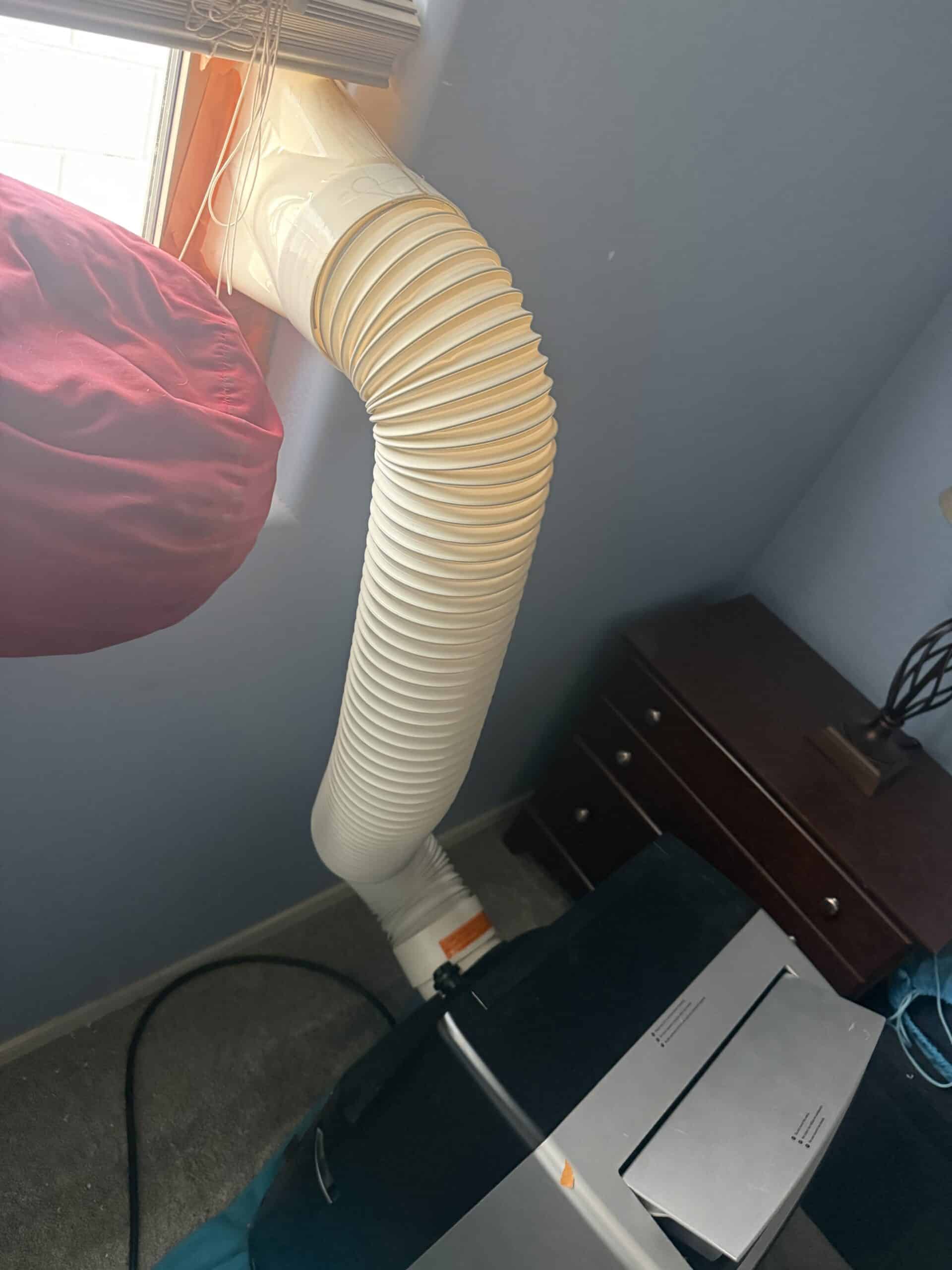
Near the window it vents through, with the shortest possible hose run, and out of the path you walk at night. Those three constraints usually decide the position before comfort or airflow get a say. For more on this, see our guide to single-hose versus dual-hose.
Quick Answer
Hose length dictates placement more than anything else, since a long or bent hose loses cooling and a stretched one leaks warm air. Keep the unit within a few feet of the window, clear of furniture, and off the route between the bed and the door.
A Quick Note
This covers placement rather than electrical or installation advice. Anything involving wiring, permanent venting, or a unit that trips a breaker is worth a qualified opinion rather than a workaround.
What Placement Has to Balance
| Factor | What it wants |
|---|---|
| Exhaust hose | Short, straight, near the window |
| Airflow | Clearance around intake and outlet |
| Noise | Distance from the bed |
| Vibration | Off bare hard floor |
| Walking | Out of the path to the door |
| Drainage | Gravity, if draining continuously |
These pull against each other in most bedrooms, and the position of the window removes most of your choice before you have started.
The Hose Decides Almost Everything
Exhaust hose is where portable air conditioners lose their efficiency, and it is the constraint that matters most.
The hose carries hot air out, and it radiates heat back into the room along its entire length. A longer run means more heat re-entering the room you are trying to cool.
Bends make it worse. Each turn restricts airflow and creates a spot where the hose sags and collects condensation, so a straight short run beats a longer one routed neatly.
Most manufacturers advise against extending the supplied hose, and the reason is that the unit is engineered around that length rather than that they want to sell you accessories, covered in whether a portable AC is worth it for one room.
Where Mine Ends Up
Mine sits between the window and the bed, which is not where I would put it if the room gave me options.
It vents through a window kit, and that kit is sometimes a pain, particularly when I am trying to walk through that part of the room. The panel and hose occupy a space you would otherwise pass through without thinking about it.
It has been in that position through more than five Arizona summers, so it plainly works. The awkwardness is a daily annoyance rather than a functional problem with the cooling.
Mine drains continuously rather than collecting in a tank, which removes the emptying question entirely and adds a second hose that also has to go somewhere sensible.
If I were setting a room up from scratch I would try to get the unit off the walking route, and in most bedrooms the window position makes that difficult.
Distance From the Bed
Perceived noise drops quickly with distance, and a portable AC is loud enough that a few feet matters, covered in whether portable ACs disturb sleep.
Direct airflow is the other consideration. Cold air blowing on you all night is uncomfortable even in a hot room, and many people wake with a stiff neck from it.
Angling the outlet across the room rather than at the bed keeps the cooling without the draft, and most units have adjustable louvers for exactly this.
Where the room forces the unit close to the bed, pointing the outlet away is the fix that costs nothing.
Clearance and Vibration
Portable units draw air in from the room and push cold air out, so both sides need space. Most manufacturers specify clearance, commonly around twenty inches.
Furniture pushed against the intake is a common cause of a unit that runs constantly without cooling, which people usually diagnose as the unit being too small.
Compressor vibration transmits into hard floors and travels through the room. A mat underneath is the cheapest improvement available.
Level matters too, since a tilted unit can affect internal drainage and some will not run at all, and window sealing sits in window insulation kits.
Sealing the Window Kit Properly
The supplied panel rarely seals well on its own, and gaps around it let hot air back in continuously while the unit fights it.
Foam tape around the edges costs very little and makes a measurable difference to how long the unit runs, which affects both electricity and noise.
Single-hose units create negative pressure in the room, pulling outside air in through every gap in the building. Sealing the window kit is the one gap you control.
Security is worth a thought too, since a window held partly open by a panel is easier to force, and light leakage around the panel matters if the room needs to be dark, covered in blackout curtains for sleep.
Working Around an Awkward Window
Most bedrooms give you one window and one sensible position, and the awkwardness is usually about what that position blocks rather than whether it cools.
A window behind the bed is the hardest case. Venting there means the hose runs past or over the bed, which is both a trip risk and a source of heat exactly where you do not want it.
Sliding and casement windows do not fit standard kits, which are built for sash windows. Kits for those exist and often need a custom panel cut to size.
High windows create a hose that runs upward, and condensation then collects at the low point rather than draining out. Keeping the hose sloping slightly downward toward the window avoids it.
Where the only workable spot is on a walking route, the practical fixes are running the hose tight along the wall rather than across open floor, and choosing a position where the panel sits at the edge of the window rather than the middle.
None of that makes an awkward window good. It reduces the daily friction to something you stop noticing, which is usually the realistic goal.
Places to Avoid
Directly beside the bed, where noise and airflow are both at their worst and where you are most likely to knock the hose.
In a corner or against furniture, which restricts intake and makes the unit run longer for the same result.
Anywhere requiring a long or bent hose run, since that undoes efficiency faster than any other placement error.
Across a walking route, which is what mine does and the one thing I would change if the room gave me another option.
Related Reading
- is a portable AC worth it
- bedroom air conditioners
- cooling setups for hot climates
- window insulation kits
- quiet fans for sleeping
- waking up hot
Part of our guide to cooling a bedroom for better sleep.
Frequently Asked Questions
Where should you put a portable AC in a bedroom?
Near the window it vents through, with the shortest straight hose run possible, clear of furniture and out of the path you walk at night.
Does hose length affect cooling?
Considerably. The hose radiates heat back into the room along its length, so a longer or bent run puts heat back into the space you are cooling.
Can I extend the exhaust hose?
Most manufacturers advise against it, since the unit is engineered around the supplied length. Extending it reduces efficiency and can cause overheating.
How much clearance does it need?
Commonly around twenty inches around intake and outlet. Furniture blocking the intake is a frequent cause of a unit that runs constantly without cooling.
Should it point at the bed?
Better not to. Cold air on you all night is uncomfortable and a common cause of waking with a stiff neck. Angling the louvers across the room works better.
Does it need to sit on a mat?
On hard flooring, yes. Compressor vibration transmits into tile and hardwood and travels through the room, and a mat is the cheapest fix available.
What if the window is behind the bed?
The hardest case, since the hose then runs past or over the bed. Running it tight along the wall rather than across open floor is usually the best available compromise.
How do I stop hot air coming back in?
Seal the window kit with foam tape. Single-hose units create negative pressure that pulls outside air through every gap, and the window panel is the one you control.
Sources
- United States Department of Energy. Room Air Conditioners. https://www.energy.gov/energysaver/room-air-conditioners
- Sleep Foundation. Best Temperature for Sleep. https://www.sleepfoundation.org/bedroom-environment/best-temperature-for-sleep
