
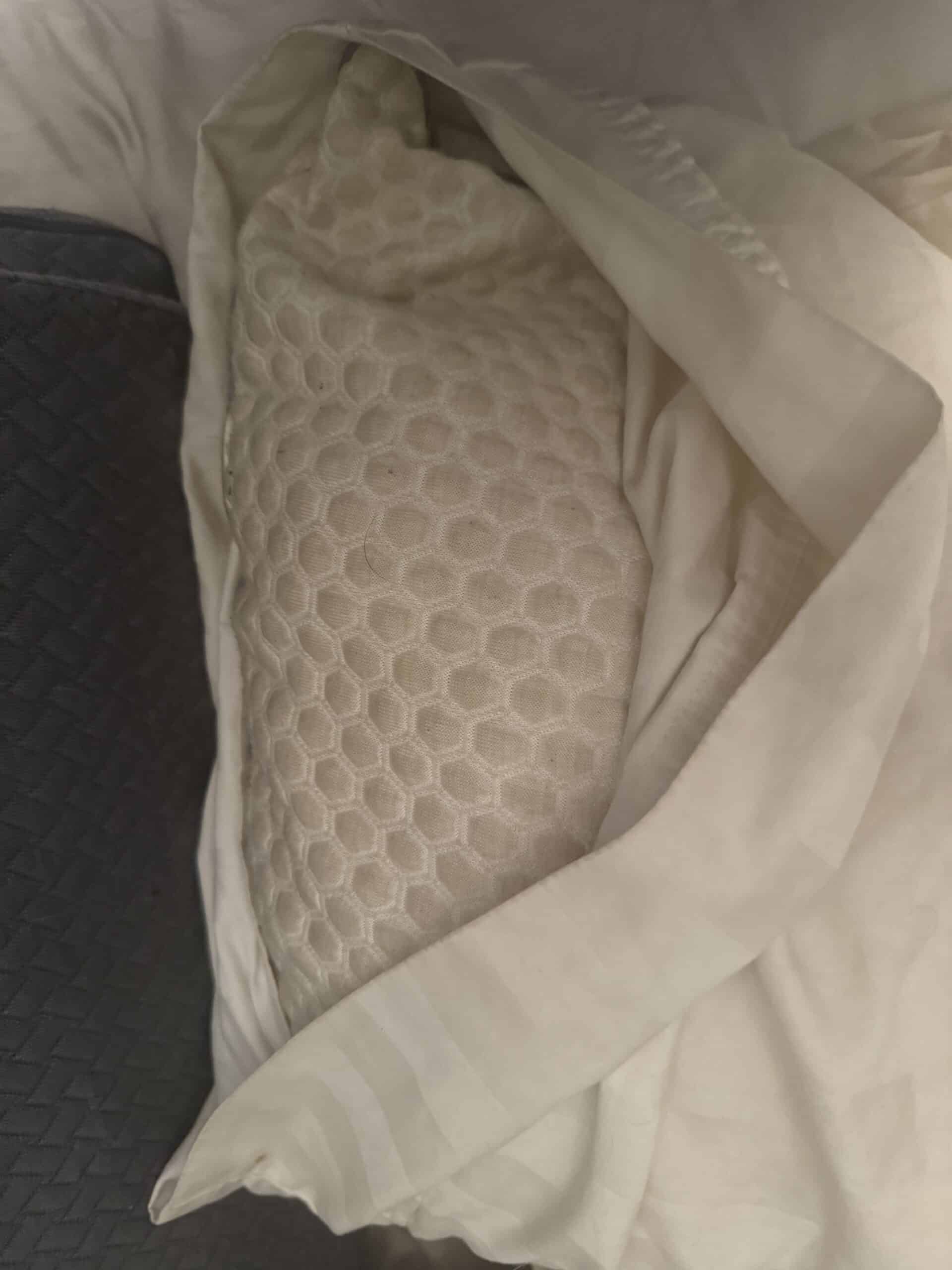
Gel pillows flatten because the foam underneath the gel compresses, not because the gel fails. That distinction explains the common experience of a pillow that still feels cool while no longer holding your head where it should.
Mine took about a year before I noticed. The cooling has not faded much and the shape has, and I flip it constantly for both reasons, mostly the shape.
Quick Answer
The gel layer is thin and sits on memory foam that loses its structure with nightly compression. Heat, body weight, and moisture all speed that up. Most gel pillows lose meaningful loft within one to three years.
A Quick Note
This covers pillow wear rather than medical advice. Neck pain that persists after changing your pillow, or that wakes you regularly, is worth raising with a doctor rather than solved with bedding.
What Actually Breaks Down
| Layer | What it does | How it fails |
|---|---|---|
| Gel top layer | Draws heat from your skin | Rarely, lasts longest |
| Memory foam core | Supports and shapes | Compresses, loses rebound |
| Cover | Wicks moisture | Wears, holds oils |
The gel is usually either infused into the foam or applied as a thin surface layer. Either way it is not the structural part.
What carries your head is the foam beneath, and that is what gives out. Which is why a pillow can feel cool to the touch and still leave your neck unsupported, and why whether cooling pillows actually work is a separate question from whether yours has worn out.
Why Foam Compresses
Memory foam works by softening under heat and pressure and recovering when you move. Every night is thousands of small compressions in the same spot.
Over time some of the cell structure stops rebounding fully. That change is permanent, and it shows up first as a shallow dip where your head sits every night.
Heat accelerates it, which is a mild irony in a pillow marketed for cooling. A warm bedroom keeps the foam softer and speeds the breakdown.
Body weight and sleep position matter too. Side sleepers load a pillow more heavily than back sleepers, since the gap between shoulder and mattress is larger, covered in choosing a pillow for your sleep position.
What I Have Noticed
About a year in was when it registered. Not a sudden change, just a point where I realized it was not doing what it used to.
The cooling is still there. It has faded somewhat and much less than the shape has, and I would not have replaced it on cooling grounds alone.
I flip it a lot through the night. Partly because the other side is naturally cooler after sitting unused, and mostly because the side I have been on has flattened under my head.
That is the honest version. Flipping a gel pillow feels like a cooling behavior and for me it is largely a shape behavior.
A year is not a failure for a pillow, and it is shorter than I expected from something sold on the cooling being the point rather than the support.
Moisture Is the Underrated Factor
Heads sweat, and a pillow absorbs that over hundreds of nights. Moisture degrades foam cell structure from within.
Body oils do the same more slowly, and they also affect the cover’s ability to wick, which makes the surface feel warmer than it did when new.
A pillow protector addresses both and is the cheapest thing that extends pillow life. Most people who own one bought it for allergies rather than durability.
Humid bedrooms make it worse, since foam does not dry out between nights, and bedroom humidity generally sits in bedroom humidity control products.
Why Cooling and Support Fail on Different Schedules
This is the part that makes gel pillows confusing to judge, and knowing it saves you from replacing one for the wrong reason.
Cooling depends on the surface. Gel conducts heat away from your skin through direct contact, and as long as the material is intact and the cover is clean, it keeps doing that.
Support depends on the interior. Foam structure carries your head, and it degrades from repeated compression regardless of what is happening at the surface.
Those two processes have almost nothing to do with each other, which is why the common experience is a pillow that still feels pleasant to lie on and no longer holds your neck in line.
The failure people notice first depends on their climate. In a hot bedroom the cooling gets scrutinized and the support decline goes unnoticed until neck stiffness appears. In a cool one, the flattening is obvious and the cooling was never the point.
It also means a pillow that stopped feeling cool is often a cover problem rather than a pillow problem. Body oils and detergent residue on the cover block heat transfer, and washing it properly sometimes restores the cooling entirely while doing nothing for the shape.
How to Tell If Yours Is Finished
The fold test
Fold the pillow in half and let go. A pillow with life left springs back. One that stays folded or recovers slowly has lost its structure.
A visible dip
A depression where your head sits that is still there in the morning, before you lie down, means the foam is not recovering overnight.
Waking with neck stiffness
Support loss shows up as morning stiffness that eases through the day. That pattern points at the pillow more than at anything else.
Constant repositioning
Folding it double, bunching it, or flipping repeatedly for shape rather than temperature all mean the loft is no longer right, and replacement timing sits in how often to replace a cooling pillow.
Getting More Life From One
Use a protector from day one. Sweat and oils reaching the foam are the main accelerants and a protector stops both.
Air it regularly. Leaving a pillow uncovered for an hour in a dry room lets absorbed moisture escape rather than sitting in the foam.
Rotate end to end as well as flipping. Most people flip and never rotate, which loads the same section repeatedly.
Keep the room from running hot, since heat is what keeps foam soft and speeds the breakdown, covered in bedroom cooling setups.
What Lasts Longer
Shredded foam
Loose fill can be fluffed and redistributed, and adjustable versions let you add or remove fill as it settles. Less consistent than a solid core.
Latex
Holds shape considerably longer than memory foam and resists the compression that flattens gel pillows. Heavier and more expensive.
Phase-change covers
Cooling in the cover rather than the core, so the cooling and the support wear on separate schedules and the cover can be replaced.
Higher density foam
Denser memory foam resists compression better, weighs more, and costs more. Options sit in gel cooling pillows.
Related Reading
- gel cooling pillows
- when to replace one
- do cooling pillows work
- why you keep flipping your pillow
- cooling pillows for hot sleepers
- cooling pillowcases
- pillows by sleep position
Frequently Asked Questions
Why does my gel pillow go flat?
The memory foam under the gel compresses with nightly use and stops rebounding. The gel layer is thin and not structural, so the support fails before the cooling does.
How long should a gel pillow last?
One to three years for most, with higher density foam lasting longer. Noticeable flattening within the first year is common in warm bedrooms.
Does the gel wear out?
Rarely. Gel is either infused into the foam or applied as a surface layer, and it usually outlasts the support underneath it.
Can a flat gel pillow be revived?
Not really. Foam compression is permanent, unlike shredded fill which can be fluffed and redistributed.
Why do I keep flipping it?
Two reasons that feel like one. The unused side is naturally cooler, and it has also not been flattened, so flipping restores both temperature and shape.
Does a warm bedroom shorten pillow life?
Yes. Heat keeps memory foam softer, which speeds the breakdown of the cell structure that provides support.
How do I know when to replace it?
Fold it in half and release. If it stays folded or recovers slowly, the structure is gone. A dip still visible in the morning is the other clear sign.
Sources
- Sleep Foundation. When to Replace Your Pillow. https://www.sleepfoundation.org/pillow-information/when-to-replace-your-pillow
- American Academy of Sleep Medicine. Healthy Sleep Habits. https://sleepeducation.org/healthy-sleep/healthy-sleep-habits/
