
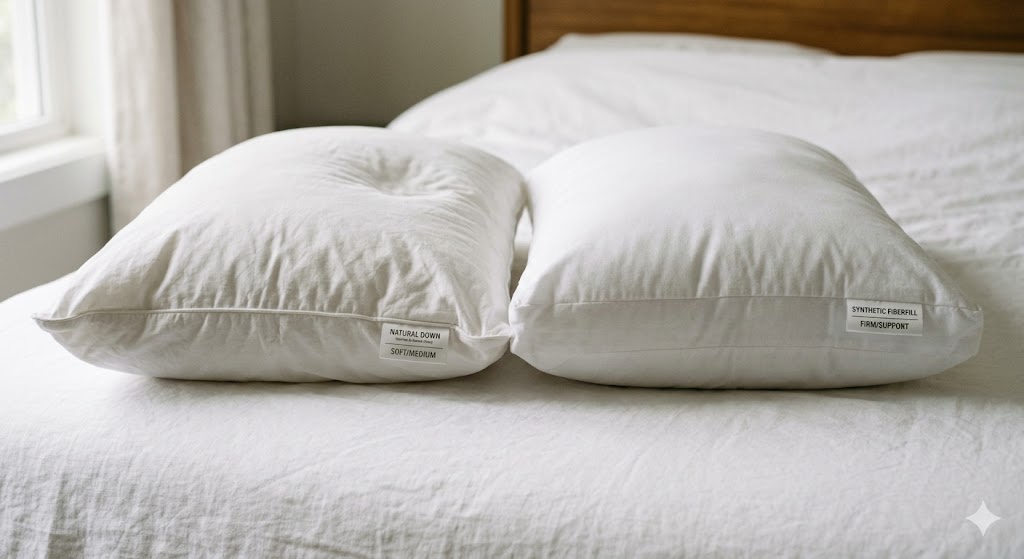
Most pillow buyers focus on feel, soft or firm, thick or thin, without considering what the fill material is actually doing to their sleep across months of nightly use. Down and synthetic fills both produce soft, comfortable pillows at first touch. They diverge significantly in how they perform over time, how they manage heat, how they affect allergy sufferers, and how they hold their loft across the months and years of compression and washing that nightly use produces. Comparing options? See our best red light bulbs evening wind down roundup.
This comparison breaks down every dimension of the down versus synthetic decision so you can choose based on your specific sleep needs, health considerations, and values rather than marketing claims or price alone. If you already know your fill preference and want specific product recommendations, our guides to the best pillows for side sleepers and best pillows for back sleepers cover the top options in each fill type for your sleep position.
How Each Fill Actually Works
Down, Natural Clusters That Trap Air
Down is the soft underplumage of ducks and geese, the layer beneath the outer feathers that provides insulation for the bird. Also, Down clusters trap air within their three-dimensional structure, creating thousands of small air pockets that provide loft and softness simultaneously. The fill power rating measures down quality, the number of cubic inches one ounce of down occupies. Higher fill power (700+) means larger, more mature clusters that trap more air per ounce, producing a lighter, loftier pillow than lower fill power down at the same total weight.
Synthetic, Engineered Fibers That Mimic Down
Synthetic pillow fill uses polyester fibers, some standard, some specifically engineered to mimic down cluster structure, that provide similar loft and softness through a different physical mechanism. Standard polyester fill uses continuous fibers that trap air through mass rather than through the three-dimensional cluster structure of down. Premium synthetic fills, microfiber, gel fiber, and cluster fiber designs, produce closer approximations to down’s loft and feel through increasingly sophisticated fiber engineering.
Down vs Synthetic, Direct Comparison
Comfort and Feel
Winner: Down, for most sleepers
Quality down provides a softness and moldability that synthetic alternatives approach but do not fully replicate, the ability to scrunch, fold, and reshape the pillow to support different positions and preferences throughout the night. High fill power down (700+) produces a luxurious loft that compresses under head weight and rebounds when pressure is removed, a responsiveness that standard polyester fill cannot match and that premium synthetic fills approximate more closely at higher price points.
The caveat is that comfort is subjective. Some sleepers specifically prefer the more consistent, less moldable feel of synthetic fill, particularly those who want a pillow that maintains its shape under head weight rather than conforming and shifting. For these sleepers, a quality synthetic fill provides a more predictable sleep surface than down’s variable loft response.
Allergy Considerations
Winner: Synthetic, for allergy sufferers
Down allergy is often misunderstood. True allergy to down protein is relatively rare. Most reactions attributed to down pillows are actually reactions to dust mites, microscopic organisms that colonize all pillow types but thrive in the protein-rich environment that natural down provides. Synthetic fill does not provide the same protein environment and is inherently less hospitable to dust mite colonization.
For confirmed allergy sufferers, synthetic fill is the safer choice, both because it provides less dust mite habitat and because it is easier to wash at the high temperatures that eliminate dust mite populations. Allergy-free certified down pillows with tightly woven covers exist and reduce dust mite penetration significantly, but require more maintenance vigilance than synthetic alternatives to maintain their allergen-reduction effectiveness.
Durability and Longevity
Winner: Down, by a significant margin
Quality down pillows last five to ten years with proper care. The three-dimensional cluster structure recovers its loft repeatedly across thousands of compression-and-release cycles without permanent flattening. Synthetic fill flattens progressively under sustained compression, most synthetic pillows require replacement every one to two years as the fibers permanently compress and lose their loft recovery. The durability advantage of down significantly offsets its higher initial purchase price when calculated on a per-year-of-use basis.
The True Cost Calculation Most Buyers Miss
A quality down pillow at $80 lasting eight years costs $10 per year. A synthetic pillow at $30 lasting two years costs $15 per year. Down costs less over time despite the higher upfront price, a calculation that most buyers do not make at the point of purchase because the upfront price difference is more visible than the longevity difference.
Temperature Regulation
Winner: Synthetic, for hot sleepers
Down traps heat effectively, the same property that makes it a superior insulating fill for cold environments makes it less comfortable for hot sleepers in warm sleeping environments. Standard polyester synthetic fill also retains heat but less effectively than down, and premium synthetic fills specifically engineered for cooling (gel fiber, microfiber with phase-change material) provide temperature management that down alternatives cannot match without specialty cooling treatments.
For hot sleepers, synthetic fill in a cooling-engineered formulation outperforms down for temperature management during sleep. Our guide to the best pillows for hot sleepers covers the specific cooling pillow options across both fill types.
Washability
Winner: Synthetic, for ease of care
Synthetic pillows are machine washable on a standard gentle cycle and tumble dry without the special care that down requires. Down pillows require gentle washing, specific detergents, and thorough drying, often with tennis balls in the dryer to break up clumping, to maintain their loft after washing. Improperly dried down clumps and loses its three-dimensional cluster structure permanently. For buyers who want simple, low-maintenance pillow care, synthetic fill is the more practical choice.
Ethical Considerations
Winner: Synthetic, for animal welfare concerns
Down is an animal product, harvested from ducks and geese through processes that vary in welfare standards. Responsible Down Standard (RDS) certification guarantees that the down was not harvested through live plucking or force feeding, the primary welfare concerns in conventional down production. For buyers whose purchasing decisions include animal welfare considerations, RDS-certified down provides verified ethical sourcing, and synthetic fill eliminates the animal product concern.
Price
Winner: Synthetic, for upfront cost
Quality synthetic pillows start around $20 to $40. Quality down pillows start around $60 to $150 for genuine high fill-power down, not the low fill-power down that budget retailers sell at synthetic price points, but with down’s durability limitations. The upfront price difference is real and significant at the point of purchase, though Downs’ longevity advantage reduces the effective cost difference over the full ownership period.
Quick Comparison: Down vs Synthetic Pillow
| Factor | Down | Synthetic |
|---|---|---|
| Comfort and feel | ✅ Superior moldability | ⚠️ More consistent, less moldable |
| Allergy suitability | ⚠️ Dust mite habitat | ✅ Less hospitable to dust mites |
| Durability | ✅ 5-10 years | ⚠️ 1-2 years |
| Temperature regulation | ⚠️ Retains heat | ✅ Better for hot sleepers |
| Washability | ⚠️ Requires special care | ✅ Standard machine wash |
| Ethical considerations | ⚠️ Animal product | ✅ No animal product |
| Upfront price | ⚠️ Higher | ✅ Lower |
| Cost per year | ✅ Lower long-term | ⚠️ Higher long-term |
Our Verdict
Choose down if you prioritize comfort, longevity, and long-term value, and if you are not an allergy sufferer or hot sleeper who would be better served by synthetic alternatives. RDS-certified down addresses the primary ethical concern for animal welfare-conscious buyers without sacrificing the comfort and durability advantages that make down the superior fill for most sleepers.
Choose synthetic if you have allergies, sleep hot, want simple washing, prefer lower upfront cost, or have ethical objections to animal products. Premium synthetic fills have closed the comfort gap with standard down significantly, quality microfiber and cluster fiber synthetic pillows produce a sleep experience that most people find satisfactory, even after trying down alternatives.
The one scenario where synthetic is clearly wrong, buying cheap synthetic fill and replacing it every two years, costs more than buying quality down once and caring for it properly. If you choose synthetic, buy quality synthetic fill that lasts as long as the category allows, rather than the cheapest option that requires the most frequent replacement.
Frequently Asked Questions: Down vs Synthetic Pillow
Is down or synthetic better for allergies?
Synthetic is the safer choice for confirmed allergy sufferers, the polyester fill does not provide the protein-rich environment that supports dust mite colonization the way natural down does. However, most people who believe they are allergic to down are actually reacting to dust mites rather than down protein. If dust mite allergy is confirmed, tightly woven pillow covers and regular high-temperature washing matter more than fill type for allergy management.
How long does a down pillow last compared to a synthetic?
Quality down pillows last five to ten years with proper care. Synthetic pillows typically last one to two years before the fill compresses permanently and loses meaningful loft. The durability difference makes down less expensive per year of use despite the higher upfront purchase price, a calculation worth making before choosing synthetic purely on initial cost.
Can you wash a down pillow in the washing machine?
Yes, with the correct approach. Use a gentle cycle with warm water and a small amount of mild detergent. Dry thoroughly on low heat with two or three clean tennis balls in the dryer to break up clumping as the down dries. Incomplete drying allows mildew to develop inside the fill, the most common reason down pillows develop unpleasant odors after washing. Multiple drying cycles may be required to ensure the fill is completely dry throughout.
What fill power should I look for in a down pillow?
600 fill power is the minimum for a quality sleeping pillow. 700 to 800 fill power produces a noticeably loftier, lighter pillow than 600 fill power at the same total weight, the difference that distinguishes premium down pillows from budget alternatives. Fill power above 800 is available but produces diminishing returns for standard sleeping applications, the primary benefit at very high fill power is ultralight weight for travel applications.
Are synthetic pillows as comfortable as down?
Premium synthetic fills, cluster fiber and microfiber formulations, produce comfort that most people find satisfactory, and some prefer them to standard down. The primary comfort gap between synthetic and quality down is in moldability, down’s ability to scrunch and reshape to different positions throughout the night, that synthetic fills cannot fully replicate. For sleepers who prefer a pillow that maintains its shape rather than conforming, the comfort gap between quality synthetic and down is minimal.
Recommended Reading
See also our guides to body pillow vs pregnancy pillow, and how to fluff a pillow.
