
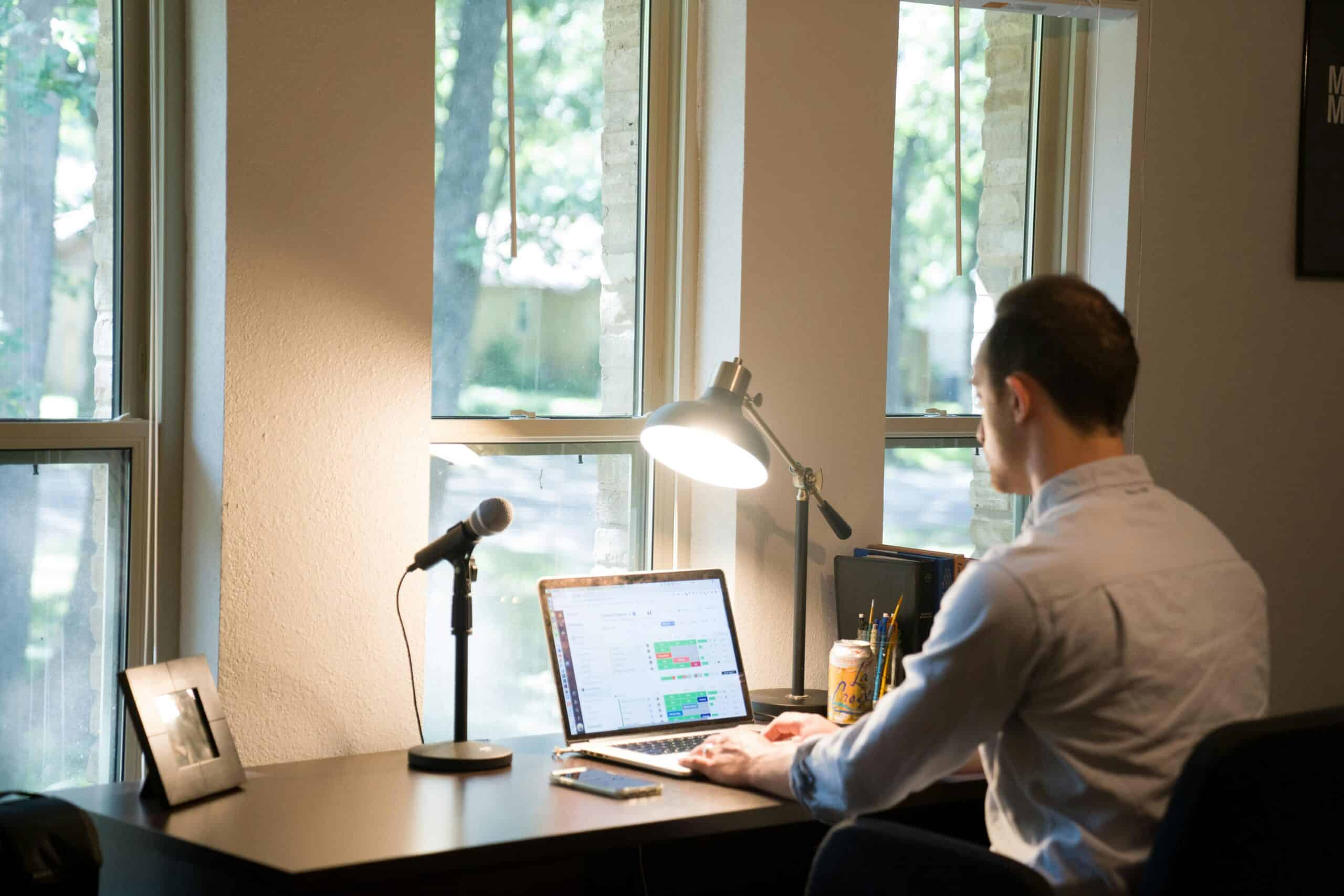
Working from home removes the commute, and with it the transition that told your body the day had ended. When the laptop closes twelve feet from where you sleep, there is nothing between work mode and bed.
| Problem working from home creates | What addresses it |
|---|---|
| No commute to mark the end of work | A deliberate wind-down routine |
| Bedroom doubles as an office | Physical separation, storage, screens |
| Screen use right up to bedtime | Dimming, warm light, a cutoff |
| Less daylight exposure | Morning light, a walk, a lamp |
| Working from bed | Anywhere else, even a small desk |
| Sleep and wake times drifting | A fixed alarm regardless of schedule |
Key Points
- The bed should not be a workspace if you can avoid it
- Light exposure in the morning matters more than at night
- A wind-down routine replaces the commute
- Room dividers create separation in one-room setups
- Fixed wake times hold the schedule together
- Working from bed weakens the bed-sleep association
How We Picked
Separation came first, since the core problem is that work and rest share a space and stop having boundaries.
Light management ranked next. Home workers often get far less daylight than commuters, and daytime light exposure is what anchors a sleep schedule.
Routine support mattered because the commute was doing work nobody noticed until it disappeared.
We excluded anything promising better sleep through a single purchase, since the underlying issue is behavioral and equipment supports rather than replaces the change.
Room Dividers and Screens
Why It Stands Out
In a studio or a bedroom doubling as an office, a folding screen puts the desk out of sight from the bed.
Seeing your work at eleven at night keeps it present. Removing the visual cue is a small change that costs little.
Folding designs fold flat during the day if the space needs to be open.
Worth Knowing
A screen divides visually and not acoustically, so it does nothing about noise from a housemate.
Tall lightweight screens fall over, and a weighted base matters in a small room.
Good for one-room living. Skip if you have a separate room already, and studio setups sit in sleep setups for studio apartments.
Check Price on AmazonDimmable and Warm Bedside Lighting
Why It Stands Out
An overhead light on until you get into bed keeps you alert right up to the moment you want to sleep.
Dimming the room in the last hour signals the transition that used to happen on the way home.
Warm-toned bulbs suit evening use better than the cool white many home offices run during the day.
Worth Knowing
Dimming needs compatible bulbs and switches, and mismatched pairs buzz and flicker.
Smart bulbs on a schedule remove the need to remember, which is what makes the habit stick.
Good in any bedroom used for work. Skip incompatible dimmer and bulb combinations, and lamp options sit in bedside lamps for reading.
Check Price on AmazonLight Therapy Lamps for Morning
Why It Stands Out
Home workers frequently go from bed to desk without meaningful daylight, and light exposure in the morning is what sets the timing of everything else.
A bright lamp on the desk during the first hour of work substitutes for the daylight a commute provided.
That matters most in winter, when a home worker may see very little natural light at all.
Worth Knowing
Timing matters more than intensity. Morning use supports the schedule and evening use works against it.
Anyone with an eye condition or taking photosensitizing medication should ask a doctor before using bright light therapy.
Good for anyone whose day starts indoors. Skip evening use, and light options sit in evening wind-down lighting.
Check Price on AmazonSunrise Alarm Clocks
Why It Stands Out
Without a commute, wake times drift. A fixed alarm is what holds a schedule together when nothing external requires you to be somewhere.
Gradual light waking suits a home worker who has no hard deadline to get up for, since it makes rising less unpleasant.
It also gets the phone off the bedside table, which removes the habit of checking work messages before getting up.
Worth Knowing
Light alone does not wake deep sleepers reliably, so a backup sound matters.
A consistent wake time is the actual intervention, and the clock only supports it.
Good for anyone whose schedule has drifted. Skip if you already wake consistently, and options sit in sunrise alarm clocks.
Check Price on AmazonDesk Storage That Closes
Why It Stands Out
A laptop and papers visible from the bed keep work mentally present. Storage that closes puts the day away physically.
A cabinet, a lidded box, or a desk with a fold-down front all achieve the same thing: the workspace stops existing at a set time.
The act of closing it is itself the transition ritual, which is what the commute used to be.
Worth Knowing
This only works if you actually do it, and a cabinet left open every evening changes nothing.
Small storage forces a decision about what stays out, which is part of why it works.
Good for bedrooms doubling as offices. Skip if the desk is in another room, and storage options sit in under-bed storage.
Check Price on AmazonWhite Noise for Daytime Household Sound
Why It Stands Out
Home workers hear the household all day, and by evening that accumulated noise exposure leaves some people unable to settle in the same room.
A machine running at night masks the sounds that continue after you go to bed, particularly in shared housing.
Continuous fan-based sound avoids the loop that becomes noticeable in recorded tracks.
Worth Knowing
Masking works better than blocking for variable household noise, since it handles sounds that come and go.
Running one during work hours as well as at night reduces its effect at bedtime, since it becomes background rather than a cue.
Good in shared housing. Skip running it constantly if you want it to signal bedtime, and options sit in white noise machines.
Check Price on AmazonWhat to Look For
Create separation however you can
A screen, a cabinet that closes, or simply working in another room. The bed keeping its association with sleep is the highest-value change.
Get light early, reduce it late
Morning brightness anchors the schedule and evening dimness signals the end. Home working often reverses both.
Fix the wake time first
Without a commute nothing forces it, and a drifting wake time pulls everything else with it.
Build a replacement transition
The commute was doing real work. Anything consistent between finishing and bed can take its place, and it does not need to be long.
Setting the Boundaries That Are Missing
The equipment supports a set of decisions, and the decisions do most of the work.
Pick a finish time and hold it. Without a building to leave, work expands into the evening unless something stops it, and that something has to be you.
Turn off notifications at that time. A phone buzzing with work messages at nine keeps you in work mode regardless of what you did with the laptop.
Get out of the house once a day, ideally in the morning. That covers the daylight exposure and provides the movement a commute used to.
Eat away from the desk. Lunch at the keyboard removes the only natural break in the day, and the day then runs as one unbroken block.
Keep weekends different. Working from home blurs the week into a continuous stretch, and a schedule that never changes shape stops feeling like it has an end.
None of that requires buying anything, which is worth saying on a page listing products.
Replacing the Commute
A short walk
Ten minutes outside after finishing work provides both the transition and daylight exposure, which covers two problems at once.
Closing the workspace
Shutting a laptop into a drawer or cabinet at a set time marks the end more clearly than simply stopping.
Changing what you wear
Changing clothes at the end of the working day is a small signal that costs nothing and works for a lot of people.
Keeping the last hour screen-light
After a full day on a screen, an hour without one before bed matters more for home workers than for people who left the office.
Separate Room Against Shared Space
Separate room
A door you close does most of the work. The bedroom keeps its single association and the transition happens naturally.
Shared space
Screens, closing storage, and lighting changes substitute for the door. None of them fully replaces it, and together they get close.
Common Mistakes to Avoid
Working from bed
It weakens the association between the bed and sleep, which is the thing making it easy to fall asleep there. Almost anywhere else is better.
Letting wake time drift
Without a commute nothing enforces it, and a schedule that slides later pulls sleep onset with it.
Skipping daylight entirely
Going from bed to desk to sofa means very little light exposure, which is what timing depends on. A short walk fixes it.
Ending work and going straight to bed
The commute provided a buffer. Without any transition, you arrive at bedtime still in work mode, and routines sit in creating a bedtime routine.
Worth reading next: bedtime routines covers the transition, studio setups covers one-room living, and white noise covers household sound. For light, waking up easier and wake-up lights and sunrise alarms are the relevant guides.
Frequently Asked Questions
Why is sleep harder when I work from home?
The commute provided a transition between work and rest that nothing replaces. Without it you go from work mode straight to bed, often in the same room.
Should I work from bed?
Better not to. It weakens the association between the bed and sleep, which is what makes falling asleep there easy. A small desk anywhere else works better.
What helps most in a studio apartment?
A folding screen putting the desk out of sight from the bed, plus storage that closes. Neither is expensive and both create separation the room lacks.
Do I need a light therapy lamp?
If your day starts and ends indoors, it substitutes for daylight a commute provided. Morning use supports your schedule and evening use works against it.
Why has my sleep schedule drifted?
Nothing enforces a wake time without somewhere to be. A fixed alarm regardless of your schedule is what holds the rest together.
How do I replace the commute?
Anything consistent between finishing work and bed. A ten-minute walk covers both the transition and daylight exposure, which handles two problems at once.
Does white noise help?
In shared housing, yes, for the sounds that continue after you go to bed. Running it all day reduces its value as a bedtime signal.
