
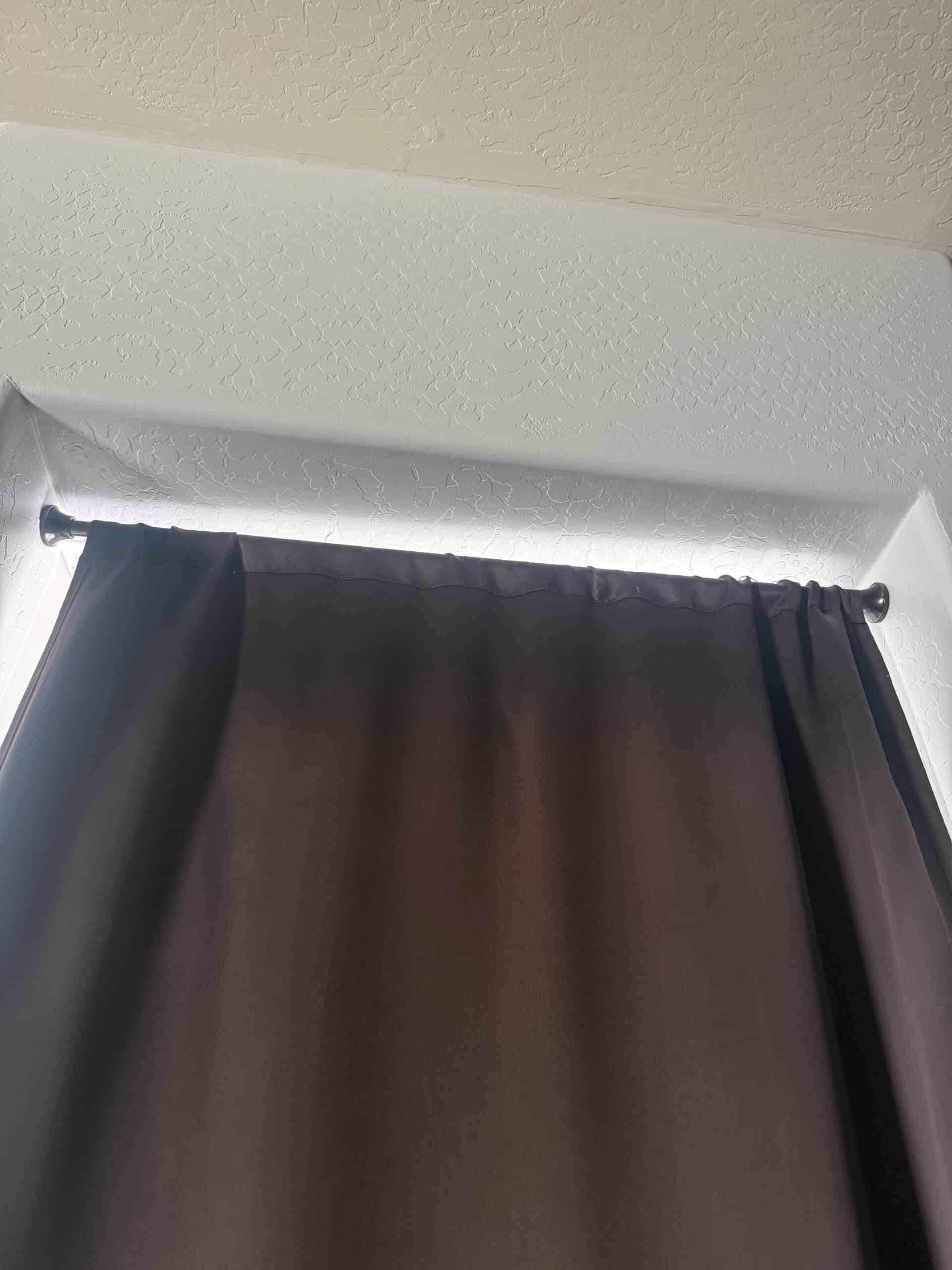
Use a tension rod inside a framed opening, adhesive hooks rated well above the panel weight, or a magnetic rod on a steel frame, and size everything to the weight of blackout fabric rather than to the size of the window. Hanging blackout curtains without drilling fails for one reason far more than any other, which is that the panels are heavier than the hardware people reach for.
Blackout fabric is dense by design. Our roundup of no-drill blackout curtain rods covers the hardware built to carry it.
Quick Answer
A tension rod is the most reliable no-drill option in a doorway or a window reveal, because it bears on the frame. Adhesive hooks work on smooth painted surfaces if you respect the weight rating and the cure time. Magnetic rods suit steel doors and frames. Command-style strips and light spring rods are what fail.
Key Takeaways
- Weigh the panel before choosing hardware, not after.
- A framed opening is what makes tension work.
- Adhesive needs a clean surface and a full cure before load.
- Size a tension rod to the middle of its range, not the end.
- Side light is the cost of most no-drill setups.
- Two lighter panels beat one heavy one on marginal hardware.
| Method | Best For | Main Limitation |
|---|---|---|
| Tension rod | Doorways, window reveals | Needs two solid sides |
| Adhesive hooks | Smooth painted wall or trim | Weight rating, cure time |
| Magnetic rod | Steel doors and frames | Only works on steel |
| Over-door hooks | Covering a doorway | Door must stay shut |
| Ceiling-track adhesive | Wrap-around coverage | Weakest for weight |
| Free-standing rod | Odd openings | Takes floor space |
Why Blackout Panels Break No-Drill Hardware
Blackout fabric gets its performance from density, often a triple weave or a coated backing. That density is weight, and a pair of full-length panels can run several pounds.
Most lightweight no-drill hardware is rated for sheers. A spring rod meant for a net curtain will bow and drop under a blackout panel, and it will usually do it a day or two after install rather than immediately.
Adhesive fails the same way. A hook rated for a picture frame holds a static load fine and then lets go when a curtain gets pulled sideways twice a day, because the real load includes the tug.
The Tension Rod Route
- Confirm you have two solid sides. A doorway or a window reveal gives you framing. Open wall does not.
- Measure the opening, then buy a rod whose range centers on it. A rod at full extension has the least thread engagement and the most flex.
- Check the rod’s weight rating against your panel. This is the step people skip.
- Fit soft end caps. Rubber or felt grips better and protects paint.
- Tighten to snug and stop there. Test by pulling the panel aside rather than by how immovable the rod feels.
- Re-check after a week. Settling shows up early if it is going to.
Our guide to whether tension rods fall down with blackout curtains covers the failure mode in detail, and our roundup of curtain rods for doorways covers the doorway case.
Three or Four Years on One Tension Rod
The rod holding my doorway curtain is a tension rod. It goes through several passes a day, and it has never come down.
It is the same age as the curtains at three to four years, and it has never been reseated. I installed it with nothing special done, no shimming, no prep, and no rubber tips added.
The doorway is an ordinary width, which I never measured, and the panel is a standard blackout rather than a thermal one. That combination has held without any attention at all.
In a doorframe of ordinary width, with a panel within the rod’s rating, the failure people warn about has not been my experience. What I would take from it is that the problem is about span and weight rather than about how hard you push the rod into place.
I have used one rod in one doorway, so I cannot compare adhesive hooks, magnetic rods, or over-door hardware from experience. Those sections are research rather than something I have run side by side.
The Adhesive Route
Buy well above the weight
Weigh the panel and the rod together, then choose hooks whose combined rating is at least double it. Adhesive ratings assume a static pull, and curtains are not static.
Prepare the surface properly
Clean with isopropyl alcohol rather than a household cleaner, which leaves residue. Let it dry completely.
Respect the cure time
Most adhesive mounts want an hour or longer before any load, and some want a full day. This is the instruction that gets ignored and it causes most failures.
Avoid textured or freshly painted surfaces
Adhesive needs smooth and fully cured. Textured paint gives it very little contact area, and new paint lifts.
Dealing With Side Light
No-drill setups usually mount inside or close to the opening, which leaves gaps at the sides where light comes around the panel. This is the honest cost of not drilling.
Overlapping the opening generously is the simplest answer, when the hardware allows it. A panel wider than the opening by several inches on each side closes most of the gap.
Layering is the other approach, and our guide to stopping light leaking around blackout curtains covers the specifics. Our guide to how high to hang blackout curtains covers the top gap, which is the one people forget.
When Nothing on the Wall Will Work
Some openings simply have no purchase: no framing, textured walls, and a lease that forbids holes. In that case stop trying to hang anything and cover the glass instead.
Suction-cup and static-cling panels attach to the glass and work for travel and short stays. Our roundup of portable blackout blinds for travel covers that category.
Free-standing rods are the option nobody thinks of. A pair of floor-standing poles carries real weight, needs no wall at all, and costs you floor space on both sides of the opening.
For a permanent setup with wrap-around coverage and no wall damage, a track is the other option worth pricing. Our roundup of blackout curtain tracks and wrap-around rods covers what is available and where mounting becomes unavoidable.
Frequently Asked Questions
How do you hang blackout curtains without drilling?
A tension rod inside a doorway or window reveal is the most reliable option, since it bears on framing. Adhesive hooks work on smooth cured paint if you buy well above the panel weight and respect the cure time. Magnetic rods suit steel frames.
Will a tension rod hold blackout curtains?
Yes, within its rating and in a framed opening. Blackout fabric is heavy, so check the rod’s stated weight capacity and size the rod so your opening falls near the middle of its range rather than at full extension.
Do adhesive hooks hold curtains?
They can, and the failures come from three things: underrating the weight, a surface that was not cleaned with alcohol, and loading before the adhesive cured. Double the rating you think you need, because a curtain gets pulled rather than just hung.
What is the strongest no-drill option?
A properly sized tension rod in a framed opening, because it uses compression against solid wood rather than sticking to a surface. Nothing adhesive matches it for a heavy panel in daily use.
Can you hang curtains from the ceiling without drilling?
Adhesive ceiling tracks exist and they are the weakest option for weight, since the load pulls straight down on the bond. They suit light panels. A heavy blackout curtain on an adhesive ceiling mount is asking for a failure.
How do you cover a doorway without a door?
A tension rod plus a panel is the standard answer, and it works well because doorways are framed on both sides. Over-door hooks are the alternative when the door itself stays closed.
Do magnetic curtain rods work?
On steel surfaces, yes, which usually means a metal door or a steel frame. They will not hold on wood, drywall, or aluminum. Check with a magnet before buying.
Will two panels work better than one?
On marginal hardware, yes. Splitting the load between two lighter panels reduces the peak weight at any one point and lets you pull one side without tugging the whole span. It also makes the overlap easier to manage.
