
Most bedrooms need about 20 BTU of cooling capacity per square foot of floor space, so a 150 to 250 square foot room usually lands between 3,000 and 5,000 BTU before adjustments. The right bedroom air conditioner size then moves up when the room faces afternoon sun, sits on the top floor, holds two sleepers, or has high ceilings.
Floor area is the starting input because anyone can measure it in a minute. Every other factor is an adjustment layered on top of that number. Readers facing a wider heat problem can also follow our guide to keeping a bedroom cool in summer.
Quick Answer
Multiply the bedroom floor area by 20 BTU per square foot to get a starting capacity. Common sizing guidance then adds roughly ten percent for heavy sun, a top floor room, or ceilings above eight feet. Add a few hundred BTU per extra sleeper, then round to the nearest size sold.
Key Takeaways
- Floor area sets the baseline. Sun, ceiling height, occupants and floor position adjust it upward.
- An oversized unit short cycles. It cools the air fast, shuts off early, and leaves the room clammy.
- Bedrooms usually need less capacity than the same square footage in a living room.
- The smallest window and portable units commonly sold start near 5,000 BTU.
- Noise generally rises with capacity, so extra BTU has a cost at night.
Enter the bedroom floor area in square feet, then set ceiling height, sun exposure, floor position and the number of sleepers.
| Room size | Starting capacity | Adjust up if |
|---|---|---|
| About 100 square feet | 2,000 BTU | Sunny exposure through an unshaded window, or a top floor room. |
| About 150 square feet | 3,000 BTU | High ceilings above eight feet, which add air volume. |
| About 200 square feet | 4,000 BTU | Extra occupants, since two sleepers add body heat all night. |
| About 250 square feet | 5,000 BTU | Sunny exposure combined with a top floor position. |
| About 300 square feet | 6,000 BTU | Extra occupants plus a wide west facing window. |
| About 350 square feet | 7,000 BTU | High ceilings paired with sunny afternoon exposure. |
| About 400 square feet | 8,000 BTU | Top floor position with extra occupants sharing the room. |
These figures are starting points from a common 20 BTU per square foot sizing rule, not a load calculation.
Why an oversized unit is a mistake, not a safe margin
An oversized air conditioner cools a bedroom too fast and then shuts off, which is the opposite of what a humid room needs. Cooling and drying happen in the same process, and drying is the slower half. The compressor must run long enough for moisture to condense on the coil.
A unit that is too large hits the thermostat target in minutes and stops, a pattern called short cycling. The air is cool, the bedding is still damp, and the room feels sticky.
Why bedroom air conditioner size starts with floor area
Floor area works as the anchor because it tracks how much heat a room gains and holds. The 20 BTU per square foot number is rule of thumb guidance, not a measurement of any house.
Four adjustments matter most after that. Direct sun through a large window adds load all afternoon, and a top floor room sits under a hot roof. Ceiling height counts because air conditioners cool volume rather than floor space, and each sleeping body is a constant heat source.
Why a bedroom is a different sizing problem than a living room
A bedroom is occupied at night, when outdoor temperature is usually falling rather than climbing. That single fact separates bedroom sizing from living room sizing. The unit fights stored heat in the walls and roof, not a peak afternoon load.
Hot climates break that assumption. August in Phoenix, my bedroom hits the high 80s by 10 p.m. and stays there until sunrise. Where nights stay warm, the stored heat never clears and the unit works closer to a daytime load.
In a milder climate a bedroom needs slightly less capacity than the same square footage elsewhere. Sizing from a living room chart is a common way to end up oversized.
Cooling capacity versus air movement
Cooling capacity lowers the temperature of the air, while air movement only changes how that air feels on skin. A fan speeds evaporation from the body.
Pairing a modest air conditioner with good circulation often beats buying a larger unit, and it adds far less compressor noise. The trade off is that a fan does nothing for humidity. For circulation right at the bed, our roundup of quiet bedside fans covers the practical options.
Single hose versus dual hose portable units
A single hose portable unit pulls room air, uses it to cool the condenser, and pushes it outside. That air has to be replaced, so outside air leaks back in around doors and windows. A dual hose unit draws condenser air from outside instead, which keeps the room closer to neutral pressure.
For sizing, treat a single hose unit as delivering less than its label suggests in a leaky room. Rounding up one size is reasonable. The full comparison sits in our breakdown of single hose and dual hose portable units.
What I Actually Run
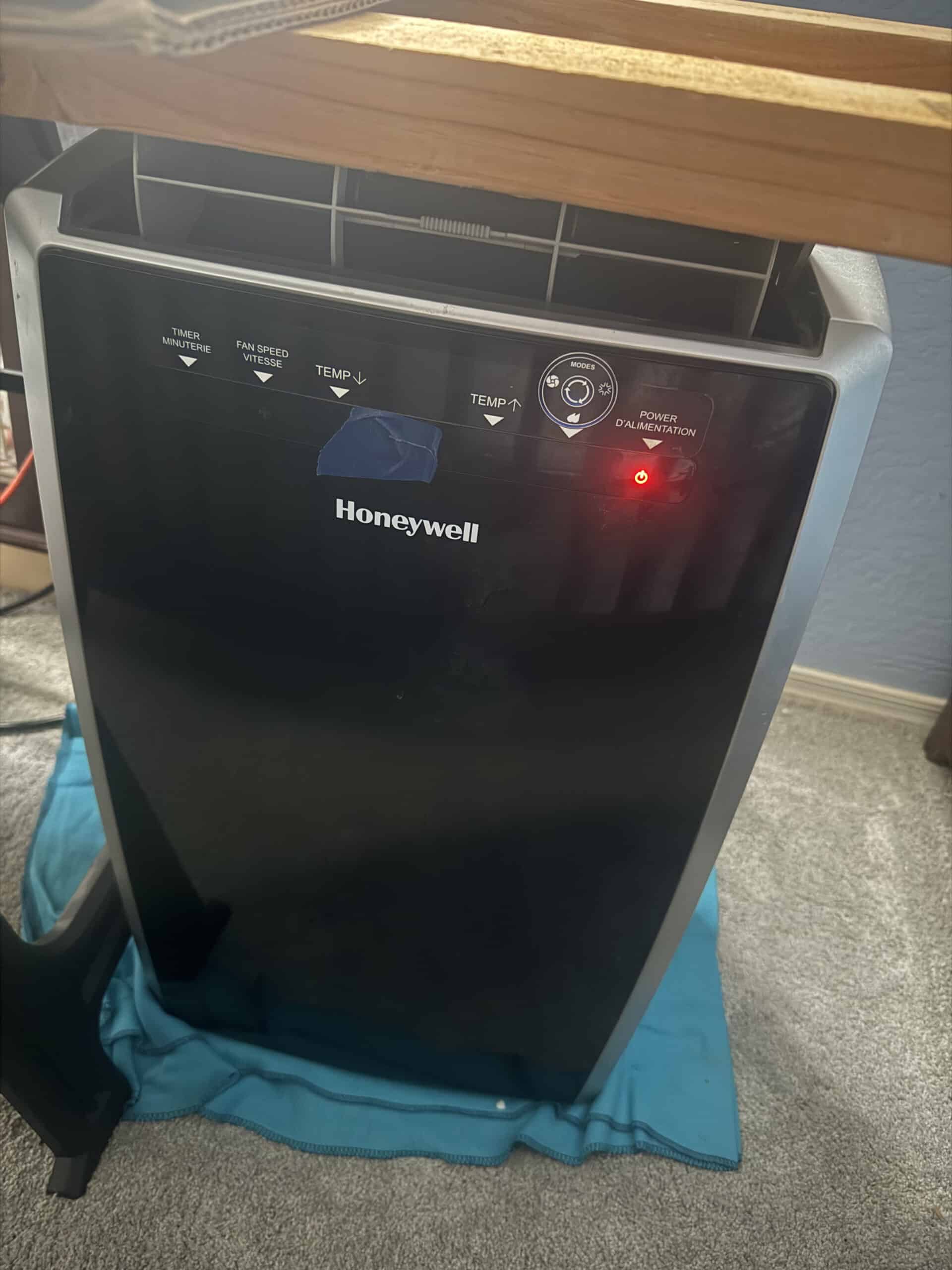
I have run a single-hose portable air conditioner overnight through five Arizona summers, and I have not felt a drop in how well it cools. Mine runs overnight only, in the bedroom, during Arizona summer. My bedroom is smaller.
I did not size it. I bought what was available, and I do not know the BTU rating. That was never a sizing decision.
None of that is evidence that sizing does not matter. A small bedroom cooled overnight is the easiest case a unit can face. The rule tightens as rooms get larger and as a machine has to work harder.
Placement was not a decision either. Mine sits between the window and the bed, which is not where I would put it if the room gave me options. I use the window kit that came with it.
Air leaks in sometimes, and when it does I improvise something to close the gap rather than replacing the panel. It cycles rather than running steadily, and it has never been a problem for me. I like consistent background noise when I am falling asleep, and the fan runs the whole time even when the compressor is off.
Mine has been going five or more summers, it is self-evaporating, and I have never emptied a tank in that time. I check my filter about every couple of months, and I would not recommend that to anyone. I have not owned a dual-hose unit, so nothing here compares the two in practice.
Cooling the whole house is the other option. Keeping that running would be much, much more costly than cooling the one room I am sleeping in. Through an Arizona summer the AC is the thing making the room survivable.
Why small bedrooms usually buy the entry size anyway
The smallest window and portable air conditioners commonly sold start around 5,000 BTU. A 100 square foot bedroom works out near 2,000 BTU, which no mainstream unit offers. Small rooms therefore buy more capacity than the rule suggests.
That gap is normal and usually workable. A variable speed compressor or a low fan setting lets the unit run gently instead of blasting and stopping.
Noise is a sizing consequence, not a separate feature
Bigger compressors and fans move more air, and moving more air makes more sound. Oversizing a bedroom unit tends to buy a louder machine.
The pattern that disturbs sleep is usually change rather than steady sound, since each on and off transition pulls people out of light sleep. Picking the right capacity is therefore the first noise decision. Our look at whether portable units are loud enough to disturb sleep goes further into the practical numbers.
Drainage and humidity after the size is settled
Window units sling condensate onto the outdoor coil and let it evaporate, while portable units collect it internally. Self evaporating designs push most of that moisture out through the exhaust hose, and our guide to self evaporating portable units explains where the limits sit.
Continuous drainage is the alternative for damp rooms, using a hose that runs to a floor drain or a low container. Details sit in our explainer on whether you can drain a portable unit continuously.
Common mistakes when sizing a bedroom air conditioner
The most frequent mistake is treating extra capacity as insurance. Capacity solves temperature, and only run time solves humidity.
The second mistake is ignoring the install. A portable unit venting through a loose window panel loses cooling straight back out the gap. Sealing that opening matters as much as the BTU number, so our roundup of window kits and seals is worth a look before buying.
What this calculator cannot account for
The calculator works from floor area and a short list of adjustments, so it cannot see what a tape measure misses. Insulation quality is the largest gap, since a poor wall or an uninsulated attic changes the real load a lot. Window glazing is the second gap, because single pane glass admits far more heat than double pane with a low emissivity coating.
Air leakage is the third. None of these are inputs here, so treat the output as a range and expect to round up in a leaky room.
Related Reading
Once the capacity range is clear, the next step is picking a machine, and our roundup of the best bedroom air conditioners sorts options by room size. Readers unsure a compressor is the right answer can weigh a cooling topper against a portable unit first. Anyone in a genuinely hot region should also review a cooling setup built for hot climates.
Bedroom air conditioner sizing: frequently asked questions
How do you work out the right bedroom air conditioner size?
Measure the room length and width, multiply them for square footage, then multiply that figure by 20 BTU. That gives the baseline. Move up one size for heavy afternoon sun, a top floor position, ceilings above eight feet, or a second sleeper sharing the room every night.
Is a bigger air conditioner always better for a bedroom?
No, and the reason is humidity. A unit that is too large reaches the target temperature quickly and shuts off before it has removed much moisture. The room ends up cool but clammy, the compressor cycles noisily, and comfort drops even though the thermometer looks correct.
How many BTU does a 12 by 12 bedroom need?
A 12 by 12 room is 144 square feet, which works out to roughly 2,900 BTU under the standard rule. No common unit is sold that small, so the practical choice is a 5,000 BTU model. Look for one with a low fan speed so it can run gently.
Does ceiling height change the BTU needed?
Yes, because air conditioners cool volume rather than floor space. A room with ten foot ceilings holds about a quarter more air than the same footprint with eight foot ceilings. Standard sizing charts assume eight feet, so anything taller justifies moving up one capacity step.
Does a fan allow a smaller air conditioner?
Often yes, within limits. Moving air makes a room feel cooler than the thermometer reads, which means a modest unit can feel sufficient. A fan does nothing about humidity though, so in damp climates the air conditioner still has to be sized to run long enough to dry the room.
Why does a correctly sized unit run almost constantly?
Long run times are usually a good sign rather than a fault. Steady operation is what removes humidity and holds a stable temperature. Constant running becomes a concern only when the room never reaches the set point, which points to undersizing, poor sealing, or heavy heat gain through glass.
Should sizing change for a single hose portable unit?
Generally yes, because a single hose unit exhausts room air outdoors and pulls warm outside air back in through gaps. That effect reduces the cooling the room actually receives. Rounding up one size, or sealing the room carefully, helps close the gap between the label rating and real performance.
