
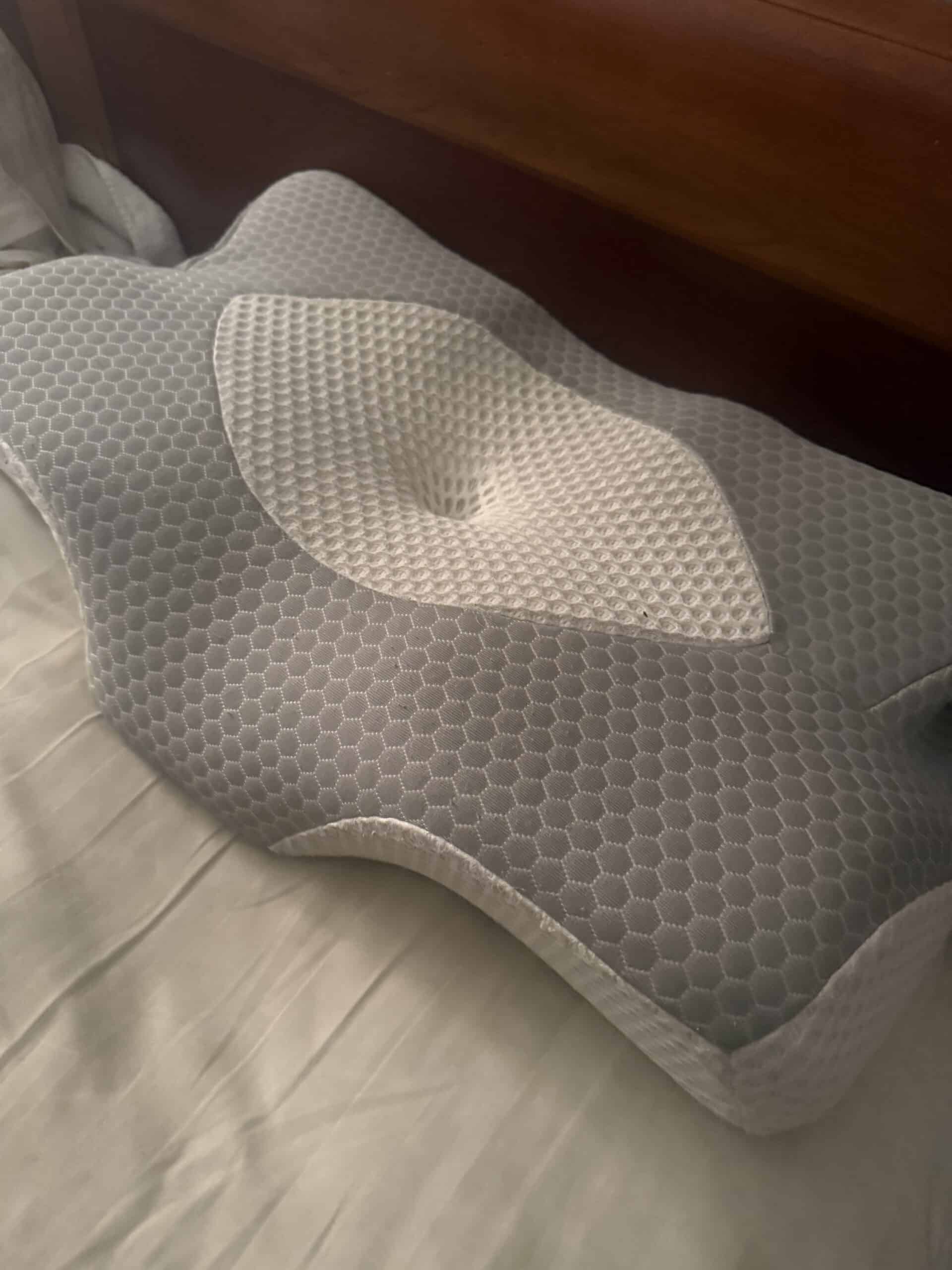
You can, and it is a reasonable use for one even though almost every cervical pillow is sold for sleeping. The contour supports your neck in roughly the same way whether you are asleep or reading a laptop screen.
That is how I use mine. I have had a fixed contour cervical pillow for around two years and I use it in bed during the day while working, lying back on it with a laptop leaned a little, or watching television. I do not sleep on it.
A Quick Note
This covers positioning and comfort rather than medical advice. Persistent neck pain, numbness, tingling into the arms, or pain that worsens is worth seeing a doctor about rather than solving with a pillow.
Quick Answer
A cervical pillow works for reclined daytime use, supporting the neck curve while you lie back. It is not a substitute for a proper working setup, and extended screen time in bed carries its own problems regardless of what is under your neck.
What the Contour Actually Does
| Position | What the pillow supports |
|---|---|
| Flat on your back, asleep | Neck curve, head neutral |
| Reclined with a screen | Neck curve, head slightly forward |
| Sitting upright against a headboard | Lumbar or upper back, not the neck |
| Propped on elbows | Very little, neck unsupported |
The design assumes you are lying back on it. A contoured pillow wedged behind your neck while sitting bolt upright is doing a different job badly, since the shape was cut for a reclined head rather than a vertical one.
Why It Works Reclined
The contour fills the gap between your head and the surface, which is the same gap whether you are sleeping or looking at a screen.
Without support in that gap, the neck muscles are holding the head up for however long the session lasts, and that sustained load is the tension people notice hours later rather than at the time.
Reclining slightly rather than sitting bolt upright also reduces the load on your spine, which is part of why a reclined position with proper support is often more comfortable than sitting for the same length of time.
None of that makes bed a good workplace, and it does make a reclined session more sustainable than the same time propped on pillows, covered in cervical pillows.
Two Years of Daytime Use
Mine is fixed contour rather than adjustable, and I lie back on it with a laptop leaned a little or while watching television.
It helps with neck tension for me and it is a big comfort item as much as anything else. I would not try to separate those two things cleanly, since I cannot.
It is very firm, which I happen to like, and I actually wish it were slightly taller than it is. That is a fit preference rather than a fault with the pillow, and it is exactly the sort of thing you only work out after living with one for a while.
It does get a bit warm against my neck over a session, which is the main friction. Foam holds heat and a contour puts more material in contact with you than a flat pillow does.
It also took a bit of getting used to at the start. Not long in the end, and it was certainly not comfortable from the very first minute, covered in how long it takes to adjust to a cervical pillow.
Getting the Position Right
Lie back rather than sit up
The contour is cut for a reclined head. Sitting upright with it behind your neck uses the shape for something it was not designed for.
Bring the screen to you
Looking down at a laptop on your lap undoes the neck support entirely. A stand, a cushion under the device, or a propped angle keeps your gaze closer to level.
Support your arms
Unsupported arms holding a device pull the shoulders forward, which loads the neck regardless of what is behind it.
Change position regularly
No position is good for hours. Moving every twenty to thirty minutes matters more than the setup itself, covered in sleep products for people who work from home.
The Honest Problems With Working in Bed
Sleep guidance consistently recommends keeping the bed for sleep, since associating it with alertness and work can make falling asleep harder over time.
That is a real consideration for anyone with existing sleep difficulties, and less pressing for someone whose sleep is otherwise fine.
Posture is the other issue. Even a good reclined setup encourages a forward head position over a long session, and beds offer no lumbar support at all.
None of that means never do it. It means treating it as a comfortable option for shorter stretches rather than as a workspace, covered in improving sleep quality naturally.
Where the Warmth Comes From
Heat build-up is the friction people report most with contoured foam, and the reason is structural rather than a quality problem.
A contour puts more material in contact with your neck than a flat pillow does. More contact means less air movement and more of your own heat held against you.
Memory foam compounds it, since the material responds to body heat by softening, which increases contact further as the session goes on.
Daytime use makes it more noticeable than sleeping does. You are awake to register it, the room is warmer than a bedroom at night, and you are generating heat from being active rather than resting.
The practical fixes are a breathable cover, a pillowcase changed to something cooler, or simply shifting position periodically to let air reach the surface.
Gel-infused and open-cell foams reduce it somewhat and none of them eliminate it, since the contact area is the underlying cause, covered in cooling pillowcases.
What a Cervical Pillow Will Not Do
It will not fix posture. Support under the neck helps that area and does nothing for a rounded upper back or unsupported lumbar spine.
It will not make long sessions in bed comfortable. Two hours is two hours regardless of what is behind your head.
It will not treat neck pain. It may reduce tension from an unsupported position, and persistent pain is a medical question rather than a bedding one.
And it will not replace a chair and desk for anyone working full days, where the setup matters considerably more than any single item.
Related Reading
- cervical pillows
- when to use one
- adjusting to one
- reading pillows
- cervical against reading pillow
- working from home
Frequently Asked Questions
Can you use a cervical pillow while working in bed?
Yes, for reclined use. The contour supports the neck curve whether you are asleep or looking at a screen, and it is not a substitute for a desk setup.
Should I sit up or lie back on it?
Lie back. The shape is cut for a reclined head, and using it behind your neck while sitting upright applies the contour to a position it was not designed for.
Is a reading pillow better for this?
For sitting upright, yes, since it supports the back and arms. A cervical pillow suits a reclined position where the neck is the thing needing support.
Does working in bed cause problems?
Sleep guidance recommends keeping the bed for sleep, since associating it with alertness can make falling asleep harder. Posture is the other consideration.
Will it help my neck pain?
It may reduce tension from holding your head unsupported. Persistent neck pain, or any numbness or tingling into the arms, is a question for a doctor.
How long can I use it in one session?
Changing position every twenty to thirty minutes matters more than the total. No position is good for hours regardless of the support.
Why does it get warm against my neck?
A contour puts more material in contact with you than a flat pillow, which means less airflow and more retained heat. Daytime use makes it more noticeable than sleeping does.
Do I need a different pillow for sleeping?
If you use one for daytime support, yes, since sleeping needs a pillow matched to your sleep position rather than to a reclined one.
Sources
- American Academy of Sleep Medicine. Healthy Sleep Habits. https://sleepeducation.org/healthy-sleep/healthy-sleep-habits/
- Sleep Foundation. Best Pillows for Neck Pain. https://www.sleepfoundation.org/best-pillows/best-pillow-for-neck-pain
- National Institute of Neurological Disorders and Stroke. Neck Pain. https://www.ninds.nih.gov/health-information/disorders/neck-pain
Recommended Reading
See our note on choosing the right pillow for your sleep position.
