
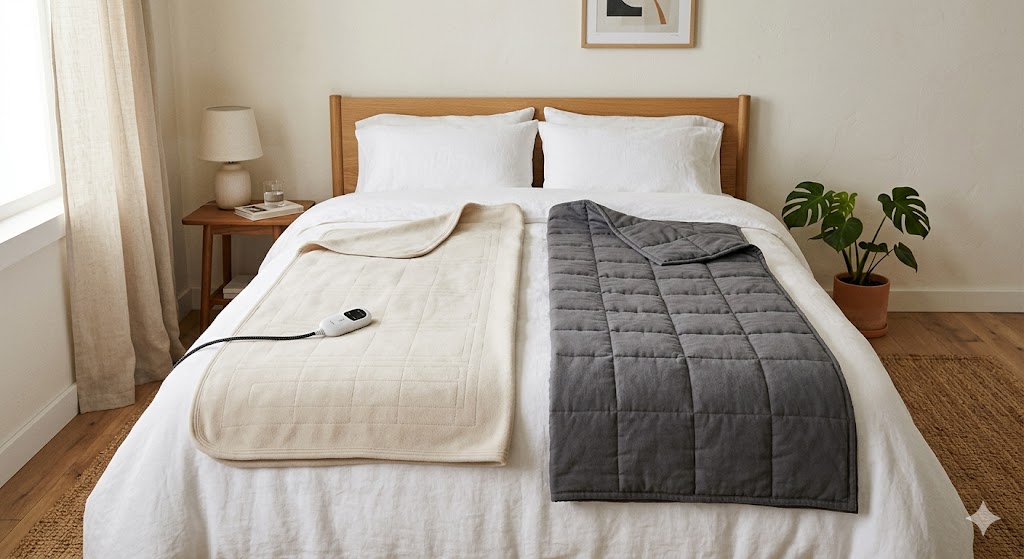
Two Very Different Solutions to the Same Problem
Both weighted blankets and heated blankets promise better sleep. Both deliver, but through completely different mechanisms and for completely different sleepers. Choosing the wrong one does not just mean a product that sits unused. It means spending money on something that actively works against your sleep needs. A hot sleeper who buys a weighted blanket compounds their temperature problem. A cold sleeper with anxiety who buys a heated blanket addresses one issue and ignores the other. If you’re shopping, start with our guide to the best weighted blankets for kids.
This comparison exists because the choice matters. If you already know you want a weighted blanket, our guide to the best weighted blankets covers the top options in detail. And if you already know you want a heated blanket, our guide to the best heated blankets covers the same. Another thing is that if you are not sure which solves your specific problem, this is the article you need.
How Each Blanket Actually Works
Weighted Blankets, Deep Pressure Stimulation
A weighted blanket uses distributed mass, typically glass beads or plastic pellets sewn into pockets across the blanket surface, to apply consistent, gentle pressure across the body during sleep. That pressure activates the same neurological response as a firm hug. It triggers serotonin and oxytocin release, suppresses cortisol, and shifts the nervous system from sympathetic activation into the parasympathetic state that sleep requires. The mechanism is called deep pressure stimulation, and it is well documented in sensory processing and anxiety research.
Who Weighted Blankets Actually Help
Weighted blankets work best for sleepers whose primary sleep problem is anxiety, racing thoughts, restlessness, or the inability to feel settled enough to fall asleep. They do not generate heat, they simply retain body heat the way any blanket does. For anxious sleepers, the deep pressure effect produces a measurable reduction in the physiological arousal that delays sleep onset. For hot sleepers, the additional thermal mass can make temperature management more difficult and is worth factoring into the decision.
Heated Blankets, Active Temperature Regulation
A heated blanket uses embedded electrical elements to generate warmth independently of body heat. The mechanism is straightforward, it raises the temperature of the sleep surface and the immediate environment around the sleeper. Modern heated blankets use low-voltage technology with auto-shutoff timers and dual zone controls that make them significantly safer and more practical than older electric blanket designs.
Who Heated Blankets Actually Help
Heated blankets work best for cold sleepers, people with chronic pain conditions where warmth reduces muscle tension and joint stiffness, and anyone whose sleep is disrupted by temperature drops in the early morning hours. They do not address anxiety, restlessness, or nervous system activation. For sleepers with Raynaud’s syndrome, fibromyalgia, or arthritis, conditions where cold temperatures directly worsen symptoms, a heated blanket addresses the primary sleep disruptor directly in a way that no weighted blanket can.
Weighted Blanket vs Heated Blanket, Direct Comparison
Anxiety and Restlessness
Winner: Weighted Blanket
Deep pressure stimulation directly reduces physiological anxiety symptoms, racing heart, muscle tension, and nervous system overactivation. A heated blanket provides comfort but does not address the neurological driver of anxiety-related sleep disruption. If anxiety is your primary sleep problem, a weighted blanket is the correct choice.
Cold Sleepers and Temperature Management
Winner: Heated Blanket
A weighted blanket retains body heat but generates none. For genuinely cold sleepers, people who wear socks to bed, pile on extra blankets, and still wake up cold in the early morning hours, a heated blanket solves the problem directly. A weighted blanket does not. If cold is your primary sleep disruptor, a heated blanket is the correct choice.
Chronic Pain Relief
Winner: Heated Blanket, with exceptions
Warmth reduces muscle tension, improves circulation, and decreases joint stiffness, making heated blankets the stronger chronic pain option for most conditions. The exception is fibromyalgia, where deep pressure stimulation from a weighted blanket can reduce the widespread pain sensitivity that characterizes the condition. For fibromyalgia specifically, either option can work depending on individual sensitivity. Our guide to the best electric blankets for fibromyalgia sufferers covers the heated blanket options most appropriate for that condition.
Hot Sleepers
Winner: Neither, but the weighted blanket with cooling fabric is closest
Hot sleepers have no strong reason to choose either standard option. A heated blanket actively worsens temperature regulation. A standard weighted blanket adds thermal mass that compounds heat retention. If you sleep hot and want a weighted blanket for anxiety benefits, look specifically for weighted blankets made with bamboo or cooling cotton covers that minimize heat retention while preserving the deep pressure effect.
Children and Sensory Needs
Winner: Weighted Blanket
Weighted blankets are widely used for children with sensory processing differences, ADHD, and anxiety. Heated blankets carry safety risks for young children and are generally not recommended for unsupervised use. For children whose sleep problems relate to sensory regulation, a weighted blanket sized appropriately for their body weight is the correct choice.
Can You Use Both Together?
Yes, and for some sleepers, it is the optimal combination. Cold sleepers with anxiety get the anxiety reduction from the weighted blanket and the temperature management from a low-heat electric blanket underneath. The combination works best when the heated blanket sits between the fitted sheet and the weighted blanket, warming the sleep surface from below while the weighted blanket provides pressure from above. Keep the heated blanket on a low setting to avoid overheating under the additional thermal mass of the weighted blanket.
Choosing the Right Weight and Heat Level
How Heavy Should a Weighted Blanket Be?
The standard recommendation is 10% of your body weight. A 150 pound person uses a 15 pound blanket. A 200 pound person uses a 20 pound blanket. That guideline exists because too light produces insufficient deep pressure stimulation and too heavy creates discomfort and restricted movement that disrupts sleep rather than improving it.
When the 10% Rule Breaks Down
The 10% rule is a starting point not a hard requirement. Anxiety sufferers often find slightly heavier blankets, 12 to 15% of body weight, produce stronger calming effects. People with sensory sensitivities, fibromyalgia, or chronic pain sometimes find even the standard weight too intense and do better starting at 7 to 8% of body weight. Children should always use lighter blankets, never exceeding 10% of body weight, and should not use weighted blankets under age 3. Our guide to the best weighted blankets covers the full weight range available and which options suit lighter and heavier users specifically.
What Heat Setting Should You Use on a Heated Blanket?
Start low. Most people reach for the highest setting first and find it uncomfortably hot within 20 minutes. The goal for sleep is not maximum warmth, it is maintaining a stable, comfortable temperature through the night without overheating. Low to medium settings, typically levels 2 to 4 on a 10-level controller, achieve that for most sleepers.
Timing Your Heated Blanket for Best Results
The most effective approach is pre-warming the bed 15 to 20 minutes before sleep and then reducing the setting or turning the blanket off once you get in. A warm bed surface accelerates sleep onset by signaling the body that the sleep environment is thermally safe. Sleeping on a continuously high heat setting through the night raises core body temperature, which actually disrupts sleep quality in the second half of the night when the body naturally tries to cool down. If you run cold specifically in the early morning hours, set the auto-timer to activate at a low setting around 4 am rather than running high heat all night.
Quick Comparison
| Factor | Weighted Blanket | Heated Blanket |
|---|---|---|
| Anxiety and restlessness | ✅ Strong | ❌ Minimal |
| Cold sleepers | ❌ Minimal | ✅ Strong |
| Chronic pain | ✅ Moderate | ✅ Strong |
| Hot sleepers | ⚠️ Choose cooling fabric | ❌ Avoid |
| Children | ✅ Appropriate | ⚠️ Safety concerns |
| Safety | ✅ No electrical components | ⚠️ Auto-shutoff required |
| Price range | $40-150 | $30-120 |
Our Verdict
Choose a weighted blanket if anxiety, restlessness, or nervous system overactivation is your primary sleep problem. You can choose a heated blanket if cold temperatures or chronic pain are disrupting your sleep. Or you can choose both if you are a cold sleeper who also struggles with anxiety, the combination addresses both problems simultaneously and is more practical than most people expect.
If you are still unsure after this comparison, the single most useful question to ask yourself is this: Do you struggle to feel settled and calm at bedtime, or do you struggle to stay warm? The answer points directly to the right choice.
Recommended Reading
See also our guides to heated mattress pad vs electric blanket, and what is fill power.
Related Reading
Explore more: weighted blankets for kids, heated mattress pad vs electric blanket, heated mattress pads, Are Heated Mattress Pads Safe? A Practical Safety Guide, bedspreads and blanket sets, weighted vs regular blanket, glass vs plastic weighted blanket, and weighted blankets anxiety.
