
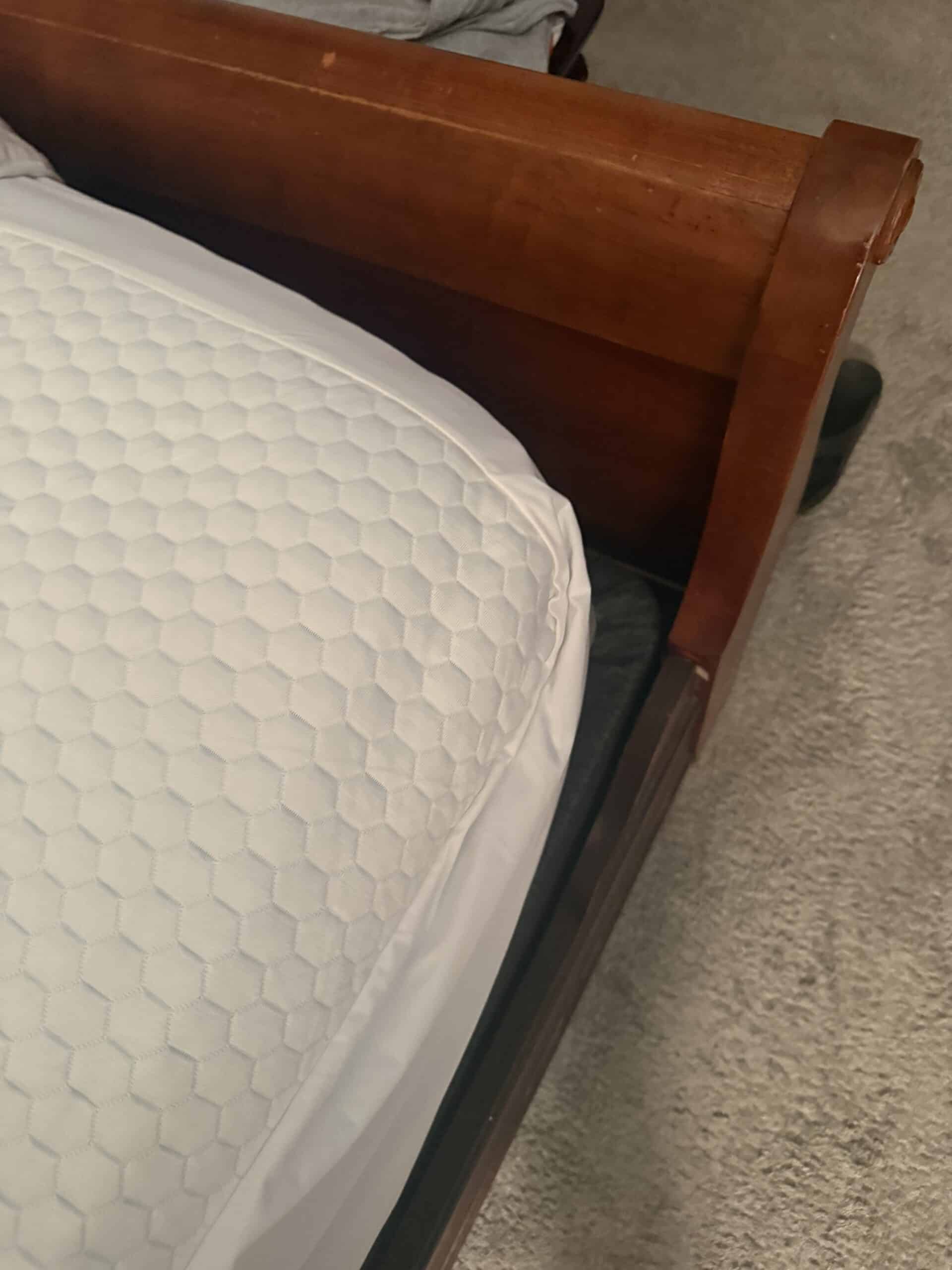
Buy a topper when the mattress supports you properly but feels wrong, and buy a new mattress when the support itself has failed. That single distinction answers the question for almost everyone, and it costs nothing to work out. Comfort problems are cheap to solve; support problems are not, and no topper has ever changed that.
Quick Verdict
Topper if the bed is structurally sound but too firm, too warm, or slightly off. New mattress if it sags, wakes you in pain, or is roughly eight years old or more. When both are arguably true, the mattress is the answer.
Key Takeaways
- Support versus comfort is the whole decision.
- A topper changes the surface. It cannot change what holds you up.
- Sagging, pain, and age all point at the mattress.
- Too firm, too warm, or slightly wrong all point at a topper.
- A topper is the cheap, reversible experiment when you genuinely cannot tell.
The Test That Decides It
| Symptom | What it means | Buy |
|---|---|---|
| Too firm, otherwise fine | Comfort | Topper |
| Sleeps hot | Comfort | Topper |
| Visible dip or sag | Support failed | Mattress |
| Waking in pain | Support failed | Mattress |
| Eight years or older | End of life | Mattress |
| Sleep better in hotels | Usually support | Mattress |
Lie on the bed and ask one question: is my spine held in line, and does it merely feel unpleasant? If support is intact and the surface is the problem, a topper is the right tool and it is a fraction of the price.
If your hips sink, if there is a dip you can see, or if you wake with aches that ease during the day, support has gone. That is not a surface problem, and a layer of foam over it will not reach the thing that is broken.
What a Topper Genuinely Does Well
A topper is very good at three things: softening a bed that is too firm, changing how the surface sleeps temperature-wise, and adding a little cushioning for a specific sleep position. Those are real problems and it solves them cheaply.
The temperature case is the one I know first-hand. My bed is memory foam, which runs hot, and I sleep in Arizona. A cooling topper takes the edge off it every night, and I have had mine for two to three years without an issue. That is a mattress problem solved for a fraction of what a new mattress would have cost, and the mattress itself is fine.
It also changed the feel, which is worth flagging as a genuine effect rather than a footnote. Mine makes the bed feel softer, and I like that, but it means a topper is not a neutral addition. If your mattress feels exactly right and only sleeps hot, understand that you are changing both.
What I cannot tell you is whether a topper would rescue a bed that is failing, because mine is not. My experience covers a sound mattress that runs warm, which is precisely the case where toppers work.
The Hotel Test
If you consistently sleep better in hotels, that is information worth taking seriously. Hotel beds are usually medium-firm with intact support and a plush layer on top, which is a specific combination rather than a mystery.
The useful part is what it points at. If hotel beds feel better because they are softer on the surface, a topper reproduces that cheaply. If they feel better because you wake without the ache you get at home, that is support, and no topper will bring it back.
When Only a Mattress Will Do
Sagging is disqualifying. A topper follows the dip rather than bridging it, so you get a few weeks of improvement and then the sag returns, having ruined the topper on its way through. This is the most common expensive mistake in the category.
Pain is the other one. Waking with back or hip pain that fades during the day usually means your spine is not being held in alignment overnight, and alignment is a support function. A softer surface can even make it worse by letting you sink further.
Age matters too. Most mattresses are done somewhere around seven to ten years, and foam beds often soften before that. A topper on a bed at the end of its life is money spent on a problem that is about to get worse regardless.
Use the Trial Period as the Tiebreaker
Most mattresses now ship with a sleep trial, often around a hundred nights, and that changes the maths of this decision. If you genuinely cannot tell whether you have a comfort problem or a support problem, a mattress with a real trial period is a reversible experiment too, which is the thing people assume only a topper offers.
Read the return terms rather than the headline number. Some trials require a minimum break-in period before you can return, some charge return shipping, and some only offer exchange rather than refund. A trial you can actually use makes the mattress the safer test; one loaded with conditions pushes the decision back to the topper.
The Money, Honestly
A topper costs a fraction of a mattress, and that gap is why the question exists at all. It is also why a topper is a reasonable experiment when you are genuinely unsure: it is cheap and it is reversible, and if it does not work you have learned something specific about your bed for a modest fee.
The trap is spending topper money repeatedly on a mattress problem. Two toppers in three years, plus the mattress you eventually buy anyway, costs more than the mattress alone would have. If you have already tried one and the problem came back, that is your answer.
And there is the middle option people forget: the foundation. A broken slat or missing center support produces a dip that reads as a dead mattress, and fixing it is nearly free. Check underneath before either purchase, since what looks like a sagging mattress sometimes is not one.
Recommended Reading
If a topper is the answer, use the selection framework, or see hot-sleeper picks and budget options. If it is the mattress, start with how to choose one and the firmness question. Also worth knowing: how toppers differ from pads, and whether a topper is worth it. It also helps to understand how to know a mattress is too firm.
Topper or New Mattress FAQ
Should I get a mattress topper or a new mattress?
A topper if the mattress supports you properly but feels too firm or sleeps hot. A new mattress if it sags, if you wake in pain, or if it is around eight years or older. Support problems need a mattress. Comfort problems are exactly what toppers are for, at a fraction of the cost.
Can a topper make a firm mattress softer?
Yes, and this is the case toppers handle best. A firm bed with intact support is a comfort problem living entirely at the surface, which is where a topper works. It is also reversible, so if you overshoot and the bed becomes too soft, you have lost very little.
Is it cheaper to buy a topper than a mattress?
Considerably, which is why it is a sensible first experiment when you are unsure. The caution is repetition: buying several toppers over a few years and then the mattress anyway costs more than going straight to the mattress. If one topper has already failed to fix it, stop.
Will a topper help if I wake up with back pain?
Sometimes, but treat it carefully. If the mattress is too firm and support is fine, a topper can help. If the pain comes from a sagging bed letting your spine fall out of line, a softer surface can make it worse. Pain that fades during the day usually points at support.
How old does a mattress have to be before a topper is pointless?
Around seven to ten years for most, and sooner for foam beds that have softened. Age itself is not the test, condition is, but an old mattress is usually close enough to failing that a topper is money spent just ahead of a purchase you are making anyway.
Can a topper fix a mattress that is too soft?
Rarely, and this is the reverse of the case toppers are good at. Most toppers add cushioning, so they make a soft bed softer. Firm toppers exist and can help slightly, but a mattress that is too soft is usually a support problem, and support is not something you add on top.
Do hotels use mattress toppers?
Many do, which is a fair clue about what toppers are for. They are laid over a sound, supportive mattress to add a plush surface. That is the topper working as intended: comfort on top of support. It is not a hotel rescuing a worn-out bed with foam.
Before you commit, what else you can do before replacing it.
Softening a firm bed needs specific properties. what actually softens a mattress covers low density and depth.
