
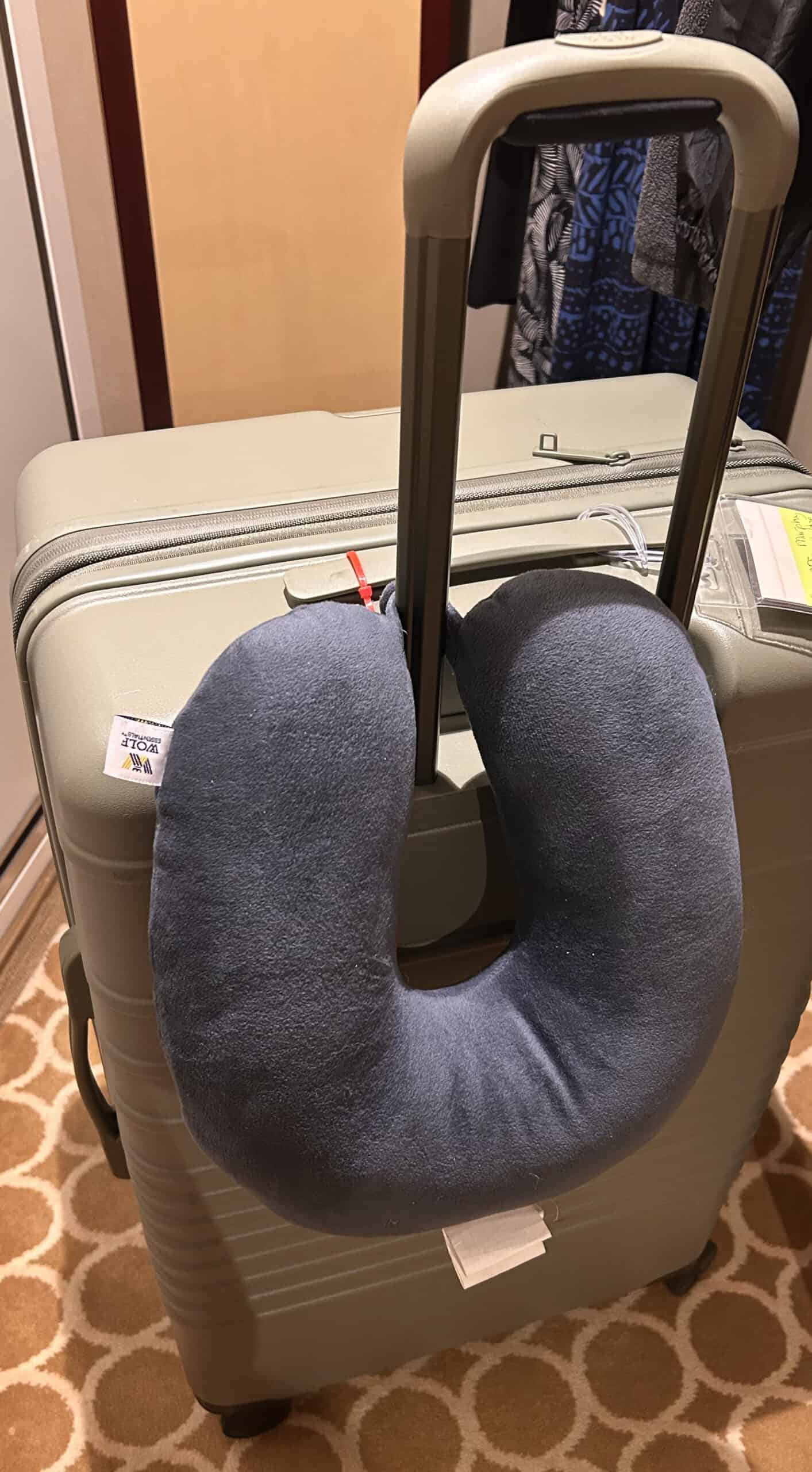
he clip has one genuinely useful function, which is strapping the pillow to a bag so your hands stay free, and one advertised function that mostly does not hold, which is keeping the pillow closed around your neck while you sleep. A travel pillow clip earns its place as luggage hardware rather than as neck support, and judging it any other way leads to disappointment.
Mine has a clip and I have had that pillow more than five years. The only thing the clip ever gets used for is wrapping the pillow around luggage when I am traveling. It never gets used otherwise.
The Job It Actually Does
A U-shaped foam pillow is bulky and will not compress into a bag, so it has to travel on the outside of your luggage. The clip is what makes that possible without a free hand or a carabiner.
That matters more than it sounds. The alternative is carrying the pillow, and a pillow carried through an airport is a pillow that gets put down on a seat and left behind. Attached to a bag handle it simply comes with you.
It also keeps the pillow off the floor, which is the other practical benefit nobody advertises. This is the use case our guide to travel pillows that attach to luggage is built around.
Quick Answer
Treat the clip as a carry feature. It fastens the pillow to a bag handle or strap so you are not holding it through a terminal, and that is its reliable function. The claim that clipping it closed at the front holds your head steady does not survive contact with actually falling asleep, because the clip resists opening and not lateral lean.
| Claimed Use | Does It Work | Why |
|---|---|---|
| Attach pillow to luggage | Yes | Bulky pillow, no pack space, hands free |
| Keep pillow off the floor | Yes | Hangs from a handle |
| Stop the pillow opening up | Partly | Holds the ends together, nothing more |
| Hold your head upright | No | Clip resists opening, not sideways lean |
| Add chin support | No | Requires material under the jaw |
| Secure it to a seat | Rarely | Nothing on a seat to clip to |
Why It Does Not Hold Your Head
Clipping the two ends of a U-shape together closes the front of the collar. That stops the pillow splaying open, which is a mild benefit if yours tends to.
Lateral head support is a different mechanism. To stop your head tipping sideways something has to push back against the side of your head at or above ear height, and closing the front does nothing at that height. The head still rotates over the top.
So a clipped pillow and an unclipped pillow behave almost identically once you are asleep. The shapes that do resist lateral lean add material at ear height or brace against the seat itself, and none of them achieve it with a fastener at the front.
There is a second reason the claim persists. Clipping the collar shut does make the pillow feel more secure while you are awake and holding your head up yourself, which is exactly when you do not need help. The moment your neck muscles let go, the fastener stops contributing.
Five Years of Using It One Way
My pillow is U-shaped memory foam and the foam still supports rather than flattening, more than five years in. It is bulky, which is exactly why the clip matters.
In all that time the clip has done one thing: wrapped the pillow around luggage when traveling. I have never used it for anything else.
That is the clip doing the job it is good at. If it vanished tomorrow the pillow would be harder to carry through an airport and would sleep exactly the same.
One pillow of one type is the limit of what I can tell you. Inflatable and wraparound designs use different fasteners and I have not owned those, so anything below about other closure types is research rather than experience.
Why Manufacturers Keep Featuring It
A clip is cheap to add and it photographs well. On a product page it reads as a support feature, and the copy rarely distinguishes between holding the collar shut and holding your head up.
It also gives the listing something concrete to claim in a category where most units are the same shape in a different color. That is worth remembering when two pillows differ only in the fastener.
Clip Types and What They Suit
Snap buckle
A plastic side-release buckle, the same hardware as a backpack strap. Easiest to work one-handed and the most durable, since there is nothing to lose grip. This is the one to want if you use the luggage function.
Hook and loop tab
A fabric tab that folds over. Quieter and lower profile than a buckle, and it loses grip as the hooks wear and fill with lint. Fine for closing the collar, weaker for hanging weight from a bag.
Magnetic closure
Neat and fast, and it releases under load, which is the wrong behavior for luggage attachment. Treat magnets as a collar closure only.
Integrated strap or loop
Some pillows skip the clip and use a loop that slides over a suitcase handle. More secure than any clip for that purpose and useless for closing the collar. Our guide to packing a travel pillow covers the carry options generally.
Should the Clip Affect Which Pillow You Buy
Only as a tiebreaker. Shape, size, and firmness determine whether the pillow works at all, and the clip determines how annoying it is to get to the airport.
If two pillows are otherwise equal and one has a snap buckle, take that one. If a pillow with a better shape has no clip, take the shape and add a carabiner for a couple of dollars.
One more thing worth separating out. A clip is not a substitute for a case, and a pillow clipped to the outside of a bag collects whatever the terminal floor and the overhead bin have to offer. A washable cover matters more than the fastener if the pillow lives on the outside of your luggage, and our guide to why travel pillows get hot covers the cover material question from the comfort side.
Size is the specification worth actual attention, and our guide to travel pillow sizing covers it. For the shape question, U-shaped travel pillows is the starting point, and road trip pillows covers the car case where carry matters less.
Frequently Asked Questions
Does a travel pillow clip actually do anything?
Yes, for carrying. It fastens the pillow to a bag handle so your hands stay free and the pillow stays off the floor, which is a real benefit with a bulky foam pillow. It does not hold your head upright, because closing the front of a U-shape does nothing about sideways lean.
Does clipping the pillow closed give more support?
It stops the pillow splaying open and adds essentially nothing once you are asleep. Lateral support needs material at ear height, not a fastener at the front. A clipped and unclipped pillow feel about the same in use.
Which clip type is best?
A plastic snap buckle, if you use the luggage function. It works one-handed, holds weight, and does not wear out the way hook and loop does. Magnetic closures release under load and suit collar closing only.
Can you attach a travel pillow to a backpack?
Usually yes, to a shoulder strap or a haul loop. A buckle or a carabiner handles it, and a pillow clipped to a strap sits out of the way better than one clipped to a rolling handle. Check that it does not swing into your legs.
What if your pillow has no clip?
A small carabiner through the seam loop or the zipper pull does the same job for very little money. Do not pass on a pillow with the right shape because it lacks a clip. The clip is the cheapest part to add.
Do clips break?
Plastic buckles are the most durable and hook and loop degrades as it fills with lint and fibers. A clip that has lost grip usually still closes and no longer holds weight, which is the failure that matters for luggage use.
Is the clip worth paying extra for?
Not by itself. Use it as a tiebreaker between two pillows you would otherwise buy either of. Shape and size decide whether the pillow works.
Does the clip help in a car?
Less, because you are not carrying the pillow through a terminal and there is rarely anything to clip to in a seat. In a car the shape and the headrest geometry do the work. The clip is mostly an airport feature.
