
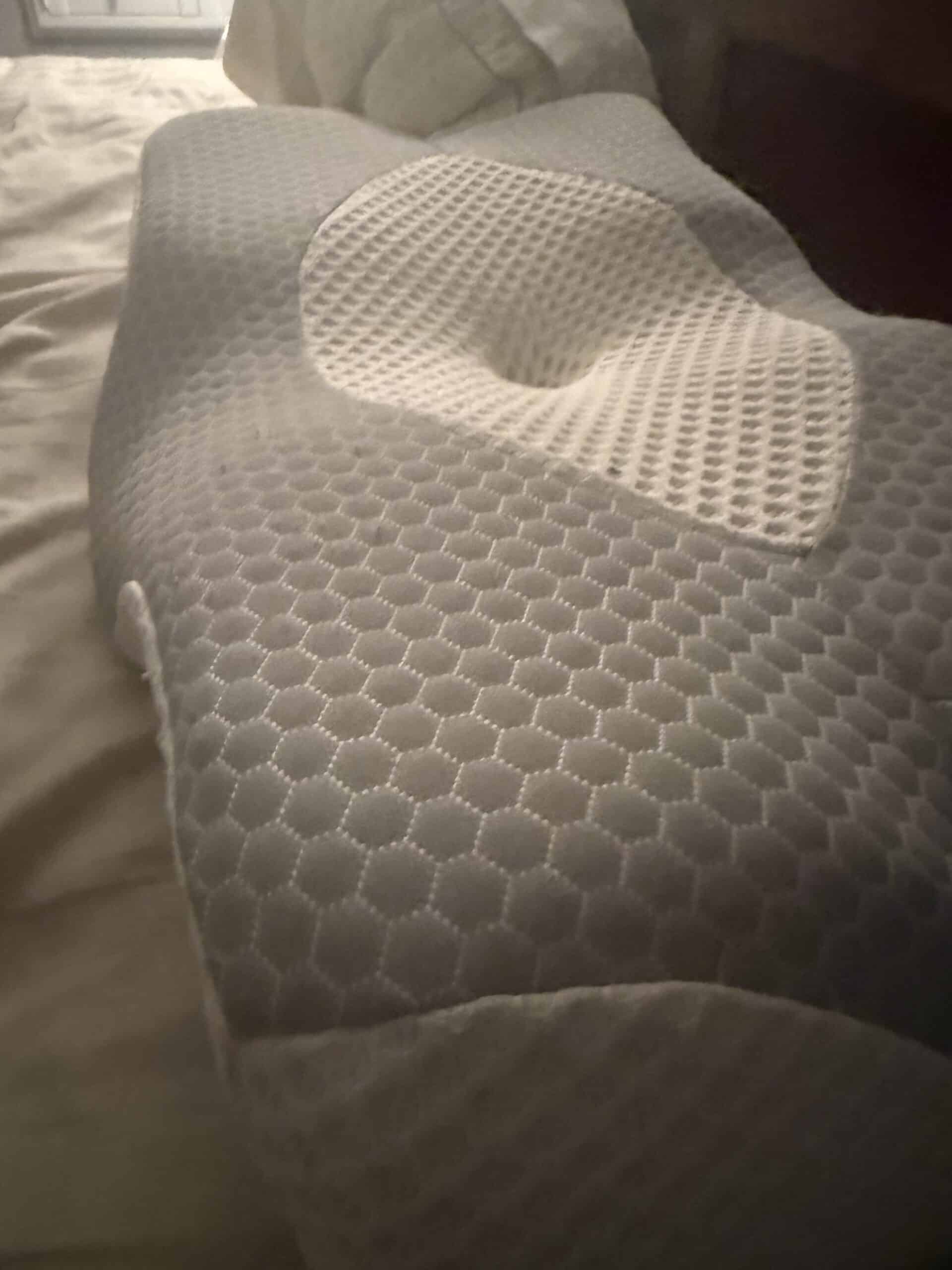
You can, and whether it works depends almost entirely on height rather than on the contour itself. Side sleeping needs considerably more loft than back sleeping, and most cervical pillows are cut with back sleeping in mind.
I tried lying on my side on mine and expected it to feel wrong. It was not bad, which surprised me. That was testing rather than sleeping, since I use mine during the day and would not sleep on it.
A Quick Note
This covers pillow fit rather than medical advice. Persistent neck or shoulder pain, and any numbness or tingling into the arms, warrants a doctor rather than a change of pillow.
Quick Answer
A cervical pillow works for side sleeping if it is tall enough to fill the gap between your ear and the mattress. Many are too low, since that gap is much larger on your side than on your back. Look for a pillow with a taller side section or an adjustable height.
Why Height Changes So Much
| Position | Gap to fill | Typical loft needed |
|---|---|---|
| Back sleeping | Neck curve only | 3 to 5 inches |
| Side sleeping | Shoulder to ear | 5 to 7 inches |
| Stomach sleeping | Very little | 2 to 3 inches |
On your back, the pillow fills the curve behind your neck, which is a small distance. On your side, it fills the distance from the mattress to your ear across the width of your shoulder.
That is a substantially bigger gap, and it varies with build. Broader shoulders need more loft than narrow ones for the same reason.
What a Good Cervical Pillow Does for Side Sleepers
Many contoured pillows have a raised outer edge and a lower center. The center suits back sleeping and the raised edges are meant for when you roll onto your side.
That design works when the edge height matches your shoulder width. When it does not, the pillow is either propping your head up at an angle or letting it drop.
Mattress firmness matters as much as the pillow. A soft mattress lets your shoulder sink in, which reduces the gap and means you need less loft than the same setup on a firm bed.
Which is why a pillow that worked for someone else may not work for you even at identical build, covered in cervical pillows.
What I Found Testing Mine
I am a side sleeper myself and I assumed a contoured pillow would feel plainly wrong on my side. It did not.
That said, it was a test rather than a night’s sleep, and a few minutes of something feeling fine is not the same as waking up without a stiff neck.
I would not sleep on it. My sleeping setup is separate and works, and I use this one during the day for support while I am reclined, covered in using a cervical pillow while working in bed.
It is also very firm and I wish it were slightly taller, and the height point is exactly the thing that would matter more for side sleeping than it does for how I actually use it.
So my honest position is that it was better than I expected on my side, and I have not put that to the test that would actually matter.
Checking Whether Yours Fits
Look at your alignment
Lying on your side, your nose should line up with the center of your chest and your spine should look straight from behind. A photo makes this easy to judge.
Head tilted down toward the mattress
The pillow is too low. That produces a stretch on the upper side of the neck that shows up as morning stiffness.
Head propped up toward the ceiling
Too high. That compresses the lower side and is the more uncomfortable of the two errors.
Shoulder pain rather than neck pain
Often a pillow problem rather than a mattress one, since the wrong loft pushes your shoulder into an awkward position, covered in why your neck hurts after sleeping on your side.
What to Look For If You Side Sleep
Taller side sections, which many contoured pillows have specifically for this and which vary considerably in how high they actually are.
Adjustable height, either through removable inserts or shredded fill, which removes the guesswork that makes fixed contours risky for side sleepers.
A cutout or recess for the shoulder, which some designs include so the shoulder sits under rather than against the pillow.
And a trial period long enough to cover the adjustment, since fit here is individual enough that reviews tell you very little, covered in how long it takes to adjust to a cervical pillow.
Why Side Sleepers Get This Wrong Most Often
Side sleeping is the most common position and the one where pillow fit goes wrong most, and the reasons compound each other.
The margin for error is smaller. On your back, a pillow an inch off still leaves your head roughly neutral. On your side, an inch changes the angle of your whole neck noticeably.
Shoulder width varies far more between people than neck curve does, so a single pillow height suits a much narrower range of side sleepers than back sleepers.
Sinking changes over the night as well. Foam mattresses continue to give under your shoulder for the first hour or so, meaning the gap you started with is not the gap you have at three in the morning.
And most people do not sleep in one position anyway. A pillow set up perfectly for your side becomes too tall the moment you roll onto your back.
That combination is why side sleepers cycle through more pillows than anyone else, and why an adjustable design tends to outperform a fixed contour for this position specifically.
If You Switch Positions Overnight
Most people move between back and side, which is the case a two-height contour is designed for.
The practical issue is that switching means moving your head between sections, and a pillow you have to aim for is one you will end up half on.
Wider pillows help, since there is more room to land on the correct section without thinking about it.
An adjustable pillow set to a compromise height often works better in practice than a contoured one optimized for two positions, covered in choosing a pillow for your sleep position.
Related Reading
- cervical pillows
- pillows for side sleepers
- pillows by sleep position
- neck pain from side sleeping
- adjusting to one
- pillows for neck pain
Frequently Asked Questions
Can you use a cervical pillow as a side sleeper?
Yes, if it is tall enough. Side sleeping needs more loft than back sleeping because the gap between your ear and the mattress spans your shoulder width.
How much loft do side sleepers need?
Commonly five to seven inches, against three to five for back sleeping. Broader shoulders need more, and a soft mattress needs less because the shoulder sinks in.
Why do many cervical pillows not work on the side?
They are frequently cut for back sleeping, where the gap is much smaller. A contour that suits your back can leave your head dropping toward the mattress on your side.
How do I know if the height is wrong?
Check alignment lying on your side. Head tilted down means too low, head propped toward the ceiling means too high, and your nose should line up with your chest.
Does my mattress affect it?
Considerably. A soft mattress lets your shoulder sink in and reduces the gap, so the same pillow behaves differently on a firm bed.
What if I switch between back and side?
Two-height contours are designed for that, and in practice adjustable pillows at a compromise height often work better than aiming for the correct section half asleep.
Why do side sleepers struggle most with pillows?
Smaller margin for error, shoulder width varying more than neck curve, mattresses continuing to sink over the night, and most people rolling onto their back partway through.
Could shoulder pain be the pillow?
Often, yes. The wrong loft pushes your shoulder into an awkward position, and people usually blame the mattress for that rather than the pillow.
Sources
National Institute of Neurological Disorders and Stroke. Neck Pain. https://www.ninds.nih.gov/health-information/disorders/neck-pain
Sleep Foundation. Best Pillows for Side Sleepers. https://www.sleepfoundation.org/best-pillows/best-pillow-for-side-sleepers
American Academy of Sleep Medicine. Healthy Sleep Habits. https://sleepeducation.org/healthy-sleep/healthy-sleep-habits/
Recommended Reading
See our note on insomnia versus light sleeping.
