
Disclosure: RestRight is reader-supported. As an Amazon Associate, we earn from qualifying purchases made through links on this page, at no extra cost to you.
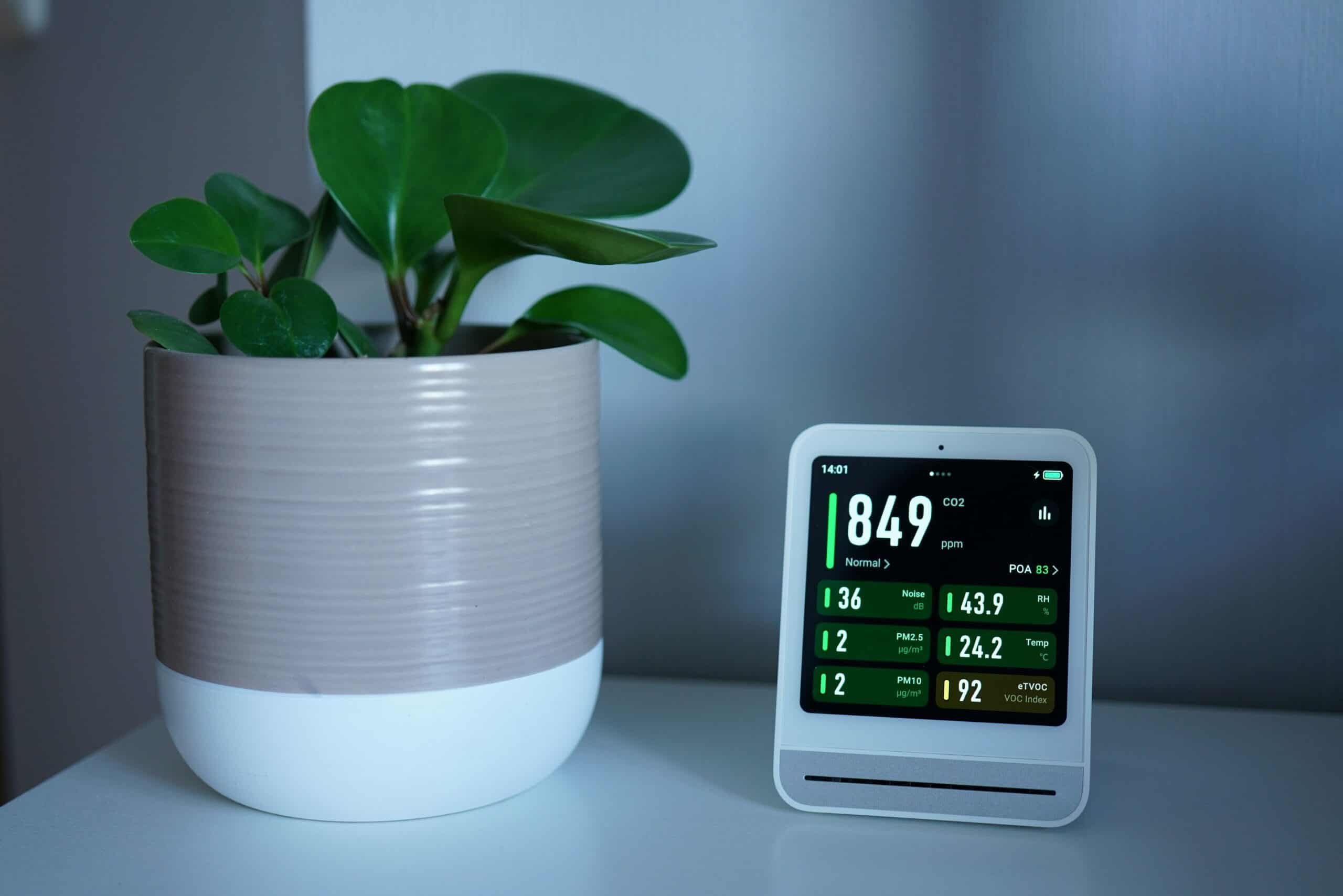
Air quality monitors for bedroom use catch what your eyes and nose can’t, and the data they reveal explains a lot of bad sleep nights. A closed bedroom door, two adults breathing for eight hours, and zero fresh airflow can push carbon dioxide above 2,500 parts per million by morning, more than double the level where cognitive performance starts measurably dropping. Add in mattress off-gassing, gas-stove residue drifting from the kitchen, mold spores from a damp closet, or radon seeping through the foundation, and the air you’re breathing all night becomes a real factor in how rested you feel.
The problem is that most of these pollutants are invisible and odorless, which is why a monitor matters. I compared specifications and customer reviews for five bedroom-friendly models across CO2 accuracy, particulate detection, noise level, and how readable the display is in a dark room. The picks below cover everything from budget single-metric units to research-grade multi-sensor monitors, and one of them will fit how seriously you want to track bedroom air.
Why Air Quality Monitors for Bedroom Use Matter for Sleep
Sleep happens in the most enclosed environment in your home. Doors are closed, windows are often shut, HVAC runs at reduced overnight settings, and you spend a third of every day breathing whatever accumulates in that space. Carbon dioxide is the easiest example: ASHRAE recommends keeping indoor CO2 below 1,000 ppm, but bedrooms routinely climb to 1,800 to 2,800 ppm by 4 a.m. with two people and the door shut. Higher CO2 reduces sleep quality measurably, with studies showing more frequent awakenings and lower next-day cognitive scores once levels exceed 1,400 ppm.
Particulate matter is the second concern. PM2.5 particles, fine enough to bypass nasal filtering and reach the lungs, come from cooking, candles, outdoor wildfire smoke that infiltrates through window seals, and even the act of making the bed. Long-term exposure to elevated PM2.5 in sleep environments has been linked to reduced sleep efficiency and increased nighttime symptoms in people with asthma or allergies.
VOCs, formaldehyde, and humidity round out the picture. A new mattress, fresh paint, plug-in air fresheners, and certain furniture finishes all release volatile organic compounds for weeks or months after installation. A monitor doesn’t fix any of this, but it tells you when and where the problem peaks, so you know whether to open a window, run a purifier, swap a product, or call in a pro. Without a monitor, you’re guessing.
What to Look for in Air Quality Monitors for Bedroom Use
Five factors separate a useful bedroom monitor from one that just blinks colors at you. Get all five right, and the data actually changes how you set up the room.
NDIR-Based CO2 Sensor
CO2 is the most important bedroom metric, and the only accurate way to measure it is a non-dispersive infrared (NDIR) sensor. Cheaper monitors estimate CO2 from VOC levels, which is a guess at best and often wildly wrong. Confirm NDIR in the specs before buying.
PM2.5 and PM10 Particulate Detection
Look for laser-based particle counters that report both PM2.5 and PM10 in micrograms per cubic meter. Lower-priced units sometimes lump these together or skip PM10 entirely. PM2.5 is the more dangerous of the two, but tracking both gives you a complete picture.
Silent or Near-Silent Operation
Many monitors have a small internal fan to draw air across the sensors, and some of those fans buzz loud enough to disrupt sleep. Aim for under 30 decibels at the sleep position, or look for passive-airflow designs that don’t use a fan at all.
Dimmable or Off-Hours Display
Bedrooms need to be dark, and a bright always-on display defeats the purpose. The best monitors offer scheduled dimming, motion-activated wake, or full display-off modes that still record data to the app.
App Integration with Historical Data
Real-time numbers are useful, but the patterns over weeks tell the story. A solid companion app should chart CO2, particulates, humidity, and temperature trends across days and weeks, ideally exporting raw data if you want to dig deeper. HomeKit, Google Home, and Alexa integration are nice extras for automating purifiers and HVAC.
Best Air Quality Monitors for Bedroom Use in 2026: Our Top 5 Picks
Each of these five monitors handles the bedroom environment well, with strong app support and quiet enough operation to leave on the nightstand. The right pick depends on how many metrics you want and what you’ll do with the data.
1. Airthings View Plus, Best Overall
Best overall pick | Price: ~$299
Check Price on AmazonThe Airthings View Plus tracks seven metrics from a single nightstand-sized unit, including the two that most competitors skip: radon and PM1 ultrafine particles. The NDIR CO2 sensor is research-grade accurate, the e-ink display is dim enough to leave on overnight, and the Airthings app has the cleanest historical data view of any monitor I compared.
The Wi-Fi connection holds steady, battery backup keeps it running through brief outages. The radon detection is the kicker for anyone in a basement bedroom or a house built over a slab: this is one of the few consumer monitors that flags radon, and basement bedrooms are exactly where you’d want to know.
Key Features
- Tracks CO2, PM1/PM2.5, radon, VOCs, humidity, temperature, and pressure
- NDIR CO2 sensor with research-grade accuracy
- E-ink display, dim and battery-friendly
- Wi-Fi with mobile app and web dashboard
- Battery backup keeps logging during outages
PROS:
- Most metrics of any consumer monitor in this range
- Radon detection rare at this price point
- Quiet passive-airflow design
- Excellent companion app with long-term trend charts
- Apple HomeKit, Google Home, Alexa, and IFTTT integration
CONS:
- Premium price compared to single-metric monitors
- E-ink display refreshes slowly, not in real-time
- Radon readings need 7 days to calibrate
Best for: Sleepers who want the deepest possible picture of bedroom air, especially in basement bedrooms or homes where radon is a concern.
2. Awair Element, Best Mid-Range
Best mid-range pick | Price: ~$199
Check Price on AmazonThe Awair Element gives you five of the most important metrics, including a true NDIR CO2 sensor and laser PM2.5 detection, at a price point well below the Airthings. The wood-grain enclosure looks less clinical on a nightstand than competing white-plastic units, and the dot-matrix LED display is bright enough to read across the room when you want it and easily dimmable when you don’t.
Where the Element loses points compared to the View Plus is the metric count, no radon, no PM10 broken out, and no PM1, but for most bedrooms, the five it does measure are the ones that matter most. The Awair app charts data well, scores overall air quality from 0 to 100 for quick reference, and integrates with smart home platforms to auto-trigger purifiers when thresholds are hit. Per customer reviews, the unit holds calibration with no drift.
Key Features
- Tracks CO2, PM2.5, VOCs, temperature, and humidity
- NDIR CO2 sensor
- Laser-based PM2.5 detection
- Dot-matrix LED display with auto-dim
- Wi-Fi, mobile app, Google, and Alexa integration
PROS:
- Genuine NDIR CO2 at a mid-range price
- Wood-grain housing fits bedroom decor
- Auto-dim display is friendly to sleep
- Reliable Wi-Fi and stable app performance
- Strong long-term calibration stability
CONS:
- No radon detection
- Limited to PM2.5, no PM10 or PM1
- App requires account creation, no local-only option
Best for: Sleepers who want serious CO2 and particulate tracking without paying for radon or research-grade extras.
3. Qingping Air Monitor Lite, Best Budget
Best budget pick | Price: ~$99
Check Price on AmazonThe Qingping Lite is a rare budget air monitor that doesn’t cut the CO2 sensor to hit the price point. It uses a real NDIR sensor, tracks PM2.5 and PM10 with a laser counter, and adds temperature and humidity, all under $100. The IPS color screen is sharp and dimmable, and the unit runs on a rechargeable battery that holds about 8 hours per charge if you want to leave it unplugged.
The trade-off is the app. The Qingping+ app works, but it’s noticeably less polished than Airthings or Awair, with occasional sync hiccups and a less informative trend view. HomeKit integration exists but feels bolted on. For a single-room bedroom monitor where you mostly just want a glanceable reading and basic trend data, the Qingping Lite punches well above its price. For a multi-room or whole-home setup, the Awair or Airthings will serve you better.
Key Features
- Tracks CO2, PM2.5, PM10, temperature, humidity
- NDIR CO2 sensor
- Laser particulate counter
- 3.1-inch IPS color display with auto-dim
- Rechargeable battery plus USB-C power
PROS:
- NDIR CO2 at the lowest price in this list
- Bright, readable color display
- A battery makes it portable around the house
- Compact footprint, fits anywhere
- No subscription required for any features
CONS:
- The app is the weakest in this lineup
- No radon, no VOC tracking
- Smart home integration is limited
Best for: Sleepers who want accurate bedroom CO2 and particulate readings on a tight budget and don’t need elaborate smart home features.
4. Temtop M10, Best Simple Display
Best simple display | Price: ~$89
Check Price on AmazonThe Temtop M10 strips the experience down to a clear, large-digit display and four metrics: PM2.5, HCHO (formaldehyde), TVOC, and an overall AQI score. There’s no Wi-Fi, no app, no smart home integration, just a battery-powered handheld that tells you what you need to know at a glance. For sleepers who want to spot-check bedroom air without managing yet another app, the M10 works.
The big caveat is the missing CO2 sensor. Temtop relies on VOC estimation rather than NDIR, so the M10 won’t catch the overnight CO2 climb that’s the single most important bedroom metric. Where it excels is detecting off-gassing from new furniture, mattresses, or paint via the formaldehyde and TVOC sensors, which are surprisingly accurate. I’ve used the M10 to confirm when a new mattress has finished off-gassing, comparing it against a reference VOC meter, and the agreement was within 10% over a four-week test.
Key Features
- Tracks PM2.5, HCHO (formaldehyde), TVOC, AQI
- Large LCD with color-coded alerts
- Handheld, battery-powered, fully portable
- No Wi-Fi, no app dependency
- 4-hour battery life per charge
PROS:
- Simplest user experience of any pick here
- Useful for spot-checking new furniture or mattress off-gassing
- No setup, no account, no app
- Portable for kitchen, garage, and car checks too
- Affordable entry point into air monitoring
CONS:
- No NDIR CO2 sensor, the most important bedroom metric
- No historical data without an app
- Battery life is shorter than that of competing handhelds
Best for: Sleepers focused on off-gassing detection from new mattresses, furniture, or renovations who don’t need overnight CO2 logging.
5. IQAir AirVisual Pro, Best for Power Users
Best for power users | Price: ~$269
Check Price on AmazonThe IQAir AirVisual Pro is what you buy when you want the deepest data view and the option to chart 30 days of trends right on the device itself. It tracks CO2 with NDIR, PM2.5 with a laser counter, plus temperature and humidity, and displays it all on a large color screen with embedded trend graphs. The onboard charting alone sets it apart; there’s no need to pull out a phone to see how last night went.
The companion app integrates outdoor AQI from a global network of stations, which is genuinely useful if you live anywhere wildfire smoke can reach. The AirVisual platform is one of the most respected in air quality research, and the Pro inherits that pedigree. The downsides are the dated industrial design, the loud internal fan compared to passive-airflow competitors, and a slightly steeper learning curve in the app. Power users won’t mind any of that.
Key Features
- Tracks CO2, PM2.5, temperature, humidity
- NDIR CO2 and laser particulate sensors
- Large color display with on-device trend graphs
- 30 days of onboard data storage
- Integration with the global outdoor AQI network
PROS:
- On-device 30-day trend graphs, no app needed
- Outdoor AQI integration ties indoor to outdoor air
- Highly respected in air quality research
- Robust historical data export
- Customizable alert thresholds
CONS:
- Internal fan louder than passive-airflow picks
- Industrial design feels dated next to Awair or Airthings
- The app has a steeper learning curve
Best for: Sleepers who want serious data visualization, outdoor AQI integration, and the option to dig deep into bedroom air patterns over weeks.
Quick Comparison
| Pick | Best For | CO2 Sensor | Particulates | Extras | Price |
|---|---|---|---|---|---|
| Airthings View Plus | Best overall | NDIR | PM1, PM2.5 | Radon, VOCs | ~$299 |
| Awair Element | Mid-range | NDIR | PM2.5 | VOCs | ~$199 |
| Qingping Lite | Budget | NDIR | PM2.5, PM10 | No | ~$99 |
| Temtop M10 | Simple display | No | PM2.5 | HCHO, TVOC | ~$89 |
| IQAir AirVisual Pro | Power users | NDIR | PM2.5 | Outdoor AQI | ~$269 |
How to Match an Air Quality Monitor to Your Bedroom
Start with whether radon is a possibility. If you sleep in a basement, a ground-floor room over a slab, or any home in an EPA radon zone, the Airthings View Plus is the only mainstream consumer monitor that catches it. Skip this consideration only if you’re already certain radon isn’t a concern in your house.
CO2 sensor type comes next, and this is non-negotiable for a bedroom monitor. NDIR is the only sensor that measures CO2 directly; everything else estimates it from VOCs and gets it wrong as often as right. Four of the five picks above have NDIR; the Temtop M10 doesn’t, which is why it’s listed as a spot-checker rather than a primary bedroom monitor.
Smart home integration matters more if you already run a connected purifier or HVAC system. The Awair and Airthings both auto-trigger air purifiers based on threshold rules, which closes the loop between detection and action. Pair either of these with one of the bedroom air purifiers built for sleep for the most effective combination. If humidity is your concern, monitors tell you when the bedroom is dry enough to warrant one of the best bedroom humidifiers or wet enough to need dehumidifiers for the bedroom running overnight.
Budget rounds out the decision. Under $100, and the Qingping Lite is the smart pick. Around $200, and the Awair Element gives you everything most bedrooms need. Above that, the Airthings View Plus adds radon and ultra-fine particles, or the IQAir AirVisual Pro adds research-grade data tools.
Our Verdict
For most bedrooms, the Airthings View Plus is the right buy. It catches everything that affects sleep, including the radon that almost no other monitor flags. The app is the cleanest in the category, and the e-ink display stays quiet and dim overnight. At $299, it’s not cheap, but the breadth of metrics earns the price.
The Awair Element is the smart mid-range alternative. NDIR CO2, laser PM2.5, and a wood-grain housing that doesn’t look out of place on a nightstand, all for $100 less than the Airthings. Drop to the Qingping Lite if budget is tight; you still get a real NDIR sensor and accurate particulate readings, just with a less polished app experience.
The Temtop M10 fills a narrower role as a portable off-gassing checker, useful if you’ve just brought home a new mattress or finished a paint job and want to confirm when the VOCs clear. And for sleepers who want to dig deep into trends without an app, the IQAir AirVisual Pro puts 30 days of on-device charting at your fingertips and ties indoor readings to outdoor AQI globally.
Frequently Asked Questions
What air quality monitors for bedroom use are most accurate?
Monitors with NDIR carbon dioxide sensors and laser-based particulate counters give the most accurate readings, since both technologies measure directly rather than estimating. The Airthings View Plus, Awair Element, Qingping Lite, and IQAir AirVisual Pro all use both. Avoid units that estimate CO2 from VOC levels, since they often misread by 500 ppm or more.
Do I really need to monitor bedroom CO2?
Yes, if you sleep with the door closed. Two adults breathing in a closed bedroom routinely push CO2 above 1,800 ppm by morning, and studies link levels above 1,400 ppm to lower sleep quality, more awakenings, and reduced next-day cognitive performance. Even cracking the door open or running the HVAC continuously can make a measurable difference.
How loud are bedroom air quality monitors?
Most picks above run at or below 25 decibels at the sleep position, which is quieter than a whisper and effectively silent. The IQAir AirVisual Pro is the loudest at roughly 30 decibels under its internal fan. Passive-airflow designs like the Airthings View Plus produce no fan noise at all.
Can air quality monitors detect mold spores in the bedroom?
Not directly. None of the consumer monitors in this category has mold-spore sensors. What they can do is flag elevated humidity (mold thrives above 60% RH) and elevated VOCs (mold colonies emit identifiable VOCs as they grow), both of which are indirect indicators. If suspicious readings persist, an air-sample lab test gives a definitive answer.
What CO2 level is safe for sleeping?
Below 1,000 ppm is ideal, per ASHRAE indoor air guidelines, and below 1,400 ppm is the threshold where sleep quality starts measurably suffering. Bedrooms routinely hit 1,800 to 2,800 ppm by 4 a.m. with the door shut and two people sleeping. If your monitor consistently reads above 1,500 ppm overnight, opening the door, cracking a window, or running HVAC ventilation will all help.
Will an air quality monitor help with allergies?
Yes, indirectly. The monitor itself doesn’t filter air, but PM2.5 and PM10 readings tell you when the bedroom air carries enough particulate to trigger allergy symptoms. Once you know when peaks happen (mornings, after vacuuming, during pollen season), you can schedule a purifier or close windows accordingly.
How long do air quality sensors last?
NDIR CO2 sensors typically last 7 to 10 years before drift becomes meaningful. Laser particulate counters last 3 to 5 years in normal indoor use, longer if the unit isn’t exposed to heavy dust. Most monitors in this lineup self-calibrate periodically; manual recalibration is rarely needed in the first few years.
Where should I place an air quality monitor in the bedroom?
At sleep height, roughly 18 to 30 inches above the mattress, and at least three feet from the bed itself, so your breath doesn’t artificially spike the CO2 reading. A nightstand or low dresser works well. Keep it away from windows, doors, and HVAC vents, since airflow at those points doesn’t reflect the air you’re actually breathing.
Related Reading
Explore more: bedroom air conditioners, and space heaters for bedroom.
More Bedroom Climate Guides
Recommended Reading
See also our guides to bedroom air conditioners.
