
Disclosure: RestRight is reader-supported. As an Amazon Associate, we earn from qualifying purchases made through links on this page, at no extra cost to you.
The first sign your bedroom has a humidity problem is usually subtle. Maybe your sheets feel damp when you climb into bed. Or maybe you wake up with a stuffy nose that clears within an hour of getting up. And maybe there’s a faint musty smell near the closet you can’t quite locate. By the time you see actual mold on the wall behind the headboard or notice your wood furniture starting to warp, the humidity has been damaging your bedroom and your sleep for months.
What I Use
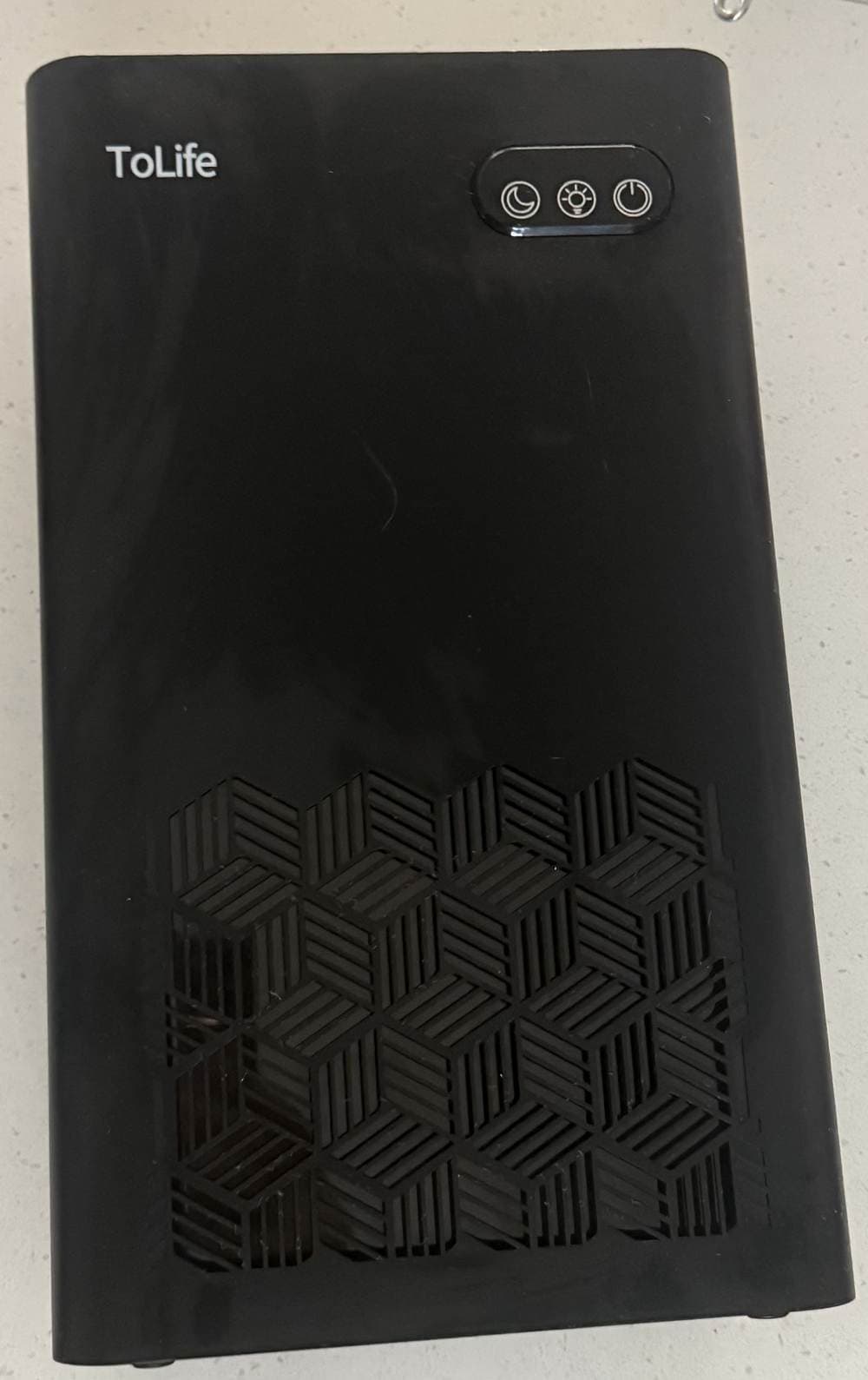
The dehumidifier I used is a compact black ToLife unit with touch controls for sleep, light, and power. I ran it every night back when I lived in the Midwest, where the summer humidity made it hard for me to fall asleep, and it pulled enough moisture out of the bedroom air to make the room comfortable again. It works well, the water tank is easy to remove and empty, and I never had any issues with it over regular nightly use. I do not run it anymore now that I am in Arizona, where the dry air means a dehumidifier is not needed, but in a humid climate it earned its spot by the bed. Water on the glass is the visible version of the same moisture, and our condensation picks cover it. Our note on dehumidifier that collects no water covers that in more detail.
A bedroom dehumidifier is one of the most underrated sleep-environment investments available. Humidity above 60% promotes mold growth, dust mite reproduction, and allergic reactions. Humidity above 70% in summer creates the heavy, sticky air that makes sleep genuinely difficult. The right dehumidifier brings bedroom humidity into the 40-50% range that’s optimal for sleep, allergy management, and home preservation, without the noise that ruins the benefit. Closets need a different approach entirely, since small enclosed spaces rarely have an outlet to work with.
This guide covers the five best dehumidifiers for bedroom use in 2026, evaluated specifically on noise levels at sleep distances, capacity matched to bedroom size, energy efficiency for nightly use, and the practical features that determine whether the unit becomes part of your sleep setup or gets moved to a closet within months.
Why Bedroom Humidity Matters for Sleep
Humidity affects sleep through multiple mechanisms. The most direct is thermal regulation. Humid air holds heat against your skin and prevents the evaporation that normally cools your body during sleep. The result is restless sleep, frequent waking, and the experience of sweating without feeling refreshed.
Beyond temperature, high humidity drives biological problems. Dust mites, the most common indoor allergen, thrive at humidity above 50% and become inactive below 40%. Mold spores germinate and spread at humidity above 60%. For sleepers with allergies, asthma, or chronic respiratory issues, controlling bedroom humidity often produces better symptom relief than any single medication. Runtime is the part most people get wrong, and our note on how often to run one covers it.
The optimal bedroom humidity range is 40-50%. Below 30%, the air becomes too dry, irritating sinuses and causing the same morning congestion that high humidity produces. Above 60%, the biological problems start. The right dehumidifier holds your bedroom in the 40-50% zone consistently, which is what produces the sleep quality benefits.
For sleepers in humid climates, Florida, the Gulf Coast, much of the Southeast, the Pacific Northwest in winter, a bedroom dehumidifier may be more important than air conditioning for sleep quality. AC reduces temperature but doesn’t always pull enough moisture, especially at night when you set the thermostat higher.
What to Look For in Bedroom Dehumidifiers
Not all dehumidifiers work in bedrooms. The criteria that matter for bedroom use differ significantly from those for basements or whole-house applications.
Noise Level at Operating Speed
The single biggest difference between bedroom-suitable dehumidifiers and general dehumidifiers is noise. A unit that runs at 50dB is unobtrusive in a basement and miserable next to a bed. Look for units rated below 45dB at standard operating speed, ideally below 40dB in quiet mode. The difference between 40dB and 50dB sounds small, but it is the difference between background hum and active disturbance.
Pay attention to noise spec disclosure. Reputable manufacturers publish dB ratings at multiple speeds. Vague “quiet operation” claims without specific dB ratings usually mean the unit is louder than competitors who disclose openly.
Capacity Matched to Room Size
Dehumidifier capacity is rated in pints of moisture removed per day. For typical bedrooms (200-400 square feet), 20-30 pint units handle the load efficiently without short-cycling. For larger primary bedrooms or open-plan setups, 35-50 pint units provide margin without becoming oversized.
Undersized units run constantly and never reach target humidity. Oversized units cycle on and off frequently, which is loud and reduces lifespan. Matching capacity to actual bedroom size produces the quietest, most efficient operation.
Continuous Drain Option
For sustained use, the unit needs continuous drain capability. Manual emptying every 12-24 hours is fine for basement use, but it becomes a chore in a bedroom and creates failure points where you forget to empty the tank and the unit stops working overnight.
A continuous drain hose connection lets you route condensate to a nearby drain or sink, eliminating the manual emptying. This single feature transforms a bedroom dehumidifier from “thing I have to maintain” to “thing that just runs.”
Auto-Restart and Humidity Setting
Power outages happen. A unit without auto-restart stays off until you manually start it, which means waking up to a humid room hours later. Auto-restart with stored humidity setting means the unit returns to normal operation immediately when power resumes.
The humidity target setting also matters for bedroom use. Cheaper units have only on/off operation or vague “low/medium/high” settings. Quality units let you set a specific humidity target (45%, 50%, etc.) and the unit cycles to maintain that level.
Best Dehumidifiers for Bedroom in 2026: Our Top 5 Picks
1. Frigidaire FFAD2233W1 22-Pint Dehumidifier, Best Overall
Best Overall Bedroom Dehumidifier | Price: ~$210
Best for: Most bedrooms 200-400 sq ft, sleepers in moderately humid climates, owners wanting reliable performance with sleep-friendly noise levels.
The Frigidaire FFAD2233W1 hits the practical sweet spot for bedroom use. The 22-pint capacity matches typical bedroom volumes without running constantly or short-cycling. The noise level is rated at 42dB on low speed, quiet enough to sleep through for most users without producing the constant fan noise that disrupts light sleepers.
The continuous drain port works with a standard garden hose, letting you route condensate to a nearby drain or out a window. The humidistat lets you set specific humidity targets in 5% increments, and the unit cycles to maintain that level rather than running continuously.
The Energy Star certification matters for nightly use. At typical operation, the unit costs roughly $5-8 per month in electricity for sustained nightly running, which is reasonable for the sleep quality and home preservation benefits.
PROS:
- 42dB noise level at low speed, sleep-friendly
- 22-pint capacity matches typical bedroom size
- Continuous drain with garden hose connection
- Specific humidity target settings in 5% increments
- Energy Star certified for efficient operation
CONS:
- May be undersized for primary bedrooms over 500 sq ft
- Tank empty alert beeps loudly on continuous mode failure
- Plastic build feels less premium than higher-priced alternatives
- No app connectivity for remote monitoring
For broader sleep environment optimization, our guide on the best bedroom temperature for sleep covers the climate-control side that pairs with humidity management, and our guide on the best mattress protectors for allergies addresses the dust mite mitigation that humidity control supports.
2. Midea Cube 35-Pint Dehumidifier, Best for Larger Bedrooms
Best for Larger Bedrooms | Price: ~$280
Best for: Primary bedrooms over 500 sq ft, open-plan bedroom-bathroom layouts, sleepers in very humid climates needing aggressive moisture removal.
The Midea Cube takes a different design approach. Instead of a tall traditional dehumidifier shape with a small tank at the bottom, the Cube uses a stackable design where the entire base is the water tank. Capacity is dramatically higher, the integrated tank holds 11.6 pints versus 6-8 pints in standard designs, meaning manual emptying happens less often even without continuous drain.
The 35-pint capacity handles larger bedrooms comfortably without running constantly. The noise level at 44dB is slightly higher than the Frigidaire but still acceptable for most sleepers. The smart features include WiFi connectivity and app control, which sounds gimmicky but actually matters for bedroom use because you can adjust settings without getting out of bed.
The unique form factor is divisive. Some users love the stackable cube design that fits in corners and looks less like an appliance. Others find it less stable and harder to move than traditional designs.
PROS:
- 35-pint capacity for larger or more humid bedrooms
- Integrated 11.6-pint tank reduces manual emptying frequency
- WiFi app control for adjusting settings remotely
- Stackable cube design fits unconventional spaces
- Energy Star certified efficiency
CONS:
- 44dB is slightly louder than the quietest alternatives
- Higher price than capacity-matched alternatives
- App connectivity unnecessary for some users
- Less stable form factor on uneven floors
3. hOmeLabs HME020031N 22-Pint Dehumidifier, Best Budget Pick
Best Budget Dehumidifier | Price: ~$170
Best for: Owners on tight budgets, smaller bedrooms 150-300 sq ft, first-time dehumidifier buyers testing whether the category helps their sleep.
The hOmeLabs delivers core dehumidification at the lowest price point that still meets quality standards. The 22-pint capacity matches typical bedrooms, the continuous drain connection works reliably, and the humidistat provides specific target settings.
The trade-off is noise. At 51dB on standard operation, the hOmeLabs is noticeably louder than the Frigidaire. For sleepers who already use a white noise machine or who sleep through ambient noise easily, the difference is irrelevant. Or for light sleepers or those sensitive to mechanical noise, the hOmeLabs becomes part of the problem rather than a solution.
For occasional use, humid summers, monsoon season, specific weeks rather than constant operation, the hOmeLabs is the right answer. And for sustained nightly use, the Frigidaire’s quieter operation justifies the additional spend.
PROS:
- Lowest price point meeting quality standards
- 22-pint capacity adequate for typical bedrooms
- Continuous drain connection included
- Specific humidity target settings
- Reliable for the price point
CONS:
- 51dB operation is noticeably louder than premium options
- Less effective for light sleepers or noise-sensitive users
- Plastic becomes less durable over the years of use
- Less efficient than Energy Star-certified alternatives
4. LG PuriCare 50-Pint UD501KOG5, Best Premium Pick
Best Premium Dehumidifier | Price: ~$330
Best for: Sleepers in extremely humid climates (Florida, Gulf Coast, tropical), large primary bedrooms over 700 sq ft, owners wanting premium build quality and quietest operation available.
The LG PuriCare is the quietest dehumidifier in our roundup at 38dB on low speed, quiet enough that most users genuinely forget it’s running. The 50-pint capacity handles aggressive moisture removal in large bedrooms or extremely humid conditions without short-cycling.
The build quality matches the price point. The unit feels solid, the controls are intuitive, the continuous drain operation is reliable across years of use, and the LG service network handles warranty issues better than no-name alternatives. For sleepers committing to a long-term humidity control solution, the durability matters.
The price is the trade-off. At $330, the LG costs more than double the budget option. For sleepers in moderately humid climates with typical bedrooms, the Frigidaire delivers comparable practical results at a lower cost. For sleepers in extreme humidity or those who specifically value a premium build, the LG justifies the price.
PROS:
- Quietest operation in our roundup at 38dB
- 50-pint capacity handles extreme humidity
- Premium build quality across years of use
- Reliable continuous drain operation
- LG service network for warranty support
CONS:
- Highest price in our roundup
- 50-pint capacity is overkill for typical bedrooms
- Larger physical footprint than smaller units
- Premium features unnecessary for moderate climates
5. Pro Breeze Electric Mini Dehumidifier, Best for Small Spaces
Best for Small Bedrooms | Price: ~$60
Best for: Bedrooms under 200 sq ft, dorm rooms, RV bedrooms, supplemental humidity control in small enclosed spaces.
The Pro Breeze uses Peltier (thermoelectric) technology rather than the compressor-based system of larger dehumidifiers. The trade-off is straightforward, significantly quieter operation (33dB) at the cost of meaningfully lower capacity (18 ounces per day, well under any compressor unit).
For genuinely small spaces, dorm rooms, RV bedrooms, walk-in closets, bedrooms under 200 sq ft, the Pro Breeze handles humidity control without the noise of a full-size unit. The compact size also means it fits on a nightstand or shelf rather than requiring floor space.
For typical bedrooms, the Pro Breeze is undersized and won’t keep up with normal humidity loads. The capacity gap is large enough that pairing two Pro Breeze units doesn’t substitute for a single full-size unit, the moisture removal scales with compressor capability, not unit count.
PROS:
- 33dB quietest operation in our roundup
- Compact size fits anywhere
- Lowest price point at ~$60
- Adequate for genuinely small spaces
- Plug-and-play simplicity
CONS:
- 18 oz/day capacity insufficient for typical bedrooms
- No continuous drain option, manual empty only
- No humidistat, runs continuously when on
- Peltier technology is less energy efficient than compressors
How to Match a Dehumidifier to Your Bedroom
Three variables determine the right unit for your specific situation.
Bedroom size is the first cut. Under 200 sq ft, the Pro Breeze is adequate. 200-400 sq ft, the Frigidaire 22-pint is the practical choice. 400-700 sq ft, step up to the Midea 35-pint. Over 700 sq ft or open-plan setups, the LG 50-pint handles the load.
Climate humidity is the second variable. Moderately humid climates (Midwest, much of the Northeast) work fine with capacity matched to room size. Extremely humid climates (Florida, Gulf Coast, Pacific Northwest in winter) benefit from sizing up one tier, for a typical bedroom in Houston, choose the Midea 35-pint over the Frigidaire 22-pint.
Noise sensitivity is the third. For light sleepers or noise-sensitive users, prioritize lower dB ratings even at the cost of capacity. The LG at 38dB is the quietest, the Frigidaire at 42dB is the practical choice for most users, and the hOmeLabs at 51dB is acceptable only for users who sleep through mechanical noise easily.
Quick Comparison Table
| Dehumidifier | Best For | Capacity | Noise | Price |
|---|---|---|---|---|
| Frigidaire FFAD2233W1 | Most bedrooms | 22 pint | 42dB | ~$210 |
| Midea Cube 35-Pint | Larger bedrooms | 35 pint | 44dB | ~$280 |
| hOmeLabs 22-Pint | Budget pick | 22 pint | 51dB | ~$170 |
| LG PuriCare 50-Pint | Extreme humidity | 50 pint | 38dB | ~$330 |
| Pro Breeze Mini | Small spaces | 18 oz/day | 33dB | ~$60 |
Our Verdict
For most bedrooms, the Frigidaire FFAD2233W1 22-Pint Dehumidifier is the right choice. The 42dB noise level is sleep-friendly, the 22-pint capacity matches a typical bedroom size, the continuous drain works reliably, and the price point doesn’t require justifying premium spend.
For larger bedrooms or extremely humid climates, Midea Cube 35-Pint provides the additional capacity without a significant noise penalty.
Or for tight budgets or smaller spaces with users who sleep through ambient noise, hOmeLabs 22-Pint delivers core function at the lowest practical price.
And for sleepers in the most humid climates with large primary bedrooms, the LG PuriCare 50-Pint justifies premium pricing through quietest-in-class operation and aggressive moisture removal.
For genuinely small spaces under 200 sq ft, Pro Breeze Mini handles humidity control without taking up floor space.
Pair the right dehumidifier with a quality mattress protector for allergies, the right bedroom temperature, and a thoughtful approach to reducing night sweats, and you have addressed the major environmental contributors to sleep quality.
Frequently Asked Questions
What humidity should my bedroom be for sleep?
40-50% relative humidity is optimal for sleep. Below 30%, the air becomes too dry, causing sinus irritation and morning congestion. Above 60% promotes mold growth, dust mite reproduction, and the heavy heat retention that disrupts sleep. The right dehumidifier holds your bedroom in the 40-50% zone consistently.
How long do bedroom dehumidifiers last?
Quality dehumidifiers last 5-10 years with proper maintenance. Compressor-based units (Frigidaire, Midea, LG, hOmeLabs) have longer lifespans than Peltier units (Pro Breeze) because the technology is more durable. Cleaning the filter monthly and the coils annually extends the lifespan significantly.
Are dehumidifiers expensive to run?
Energy Star-certified dehumidifiers cost $5-15 per month in electricity for sustained nightly use, depending on humidity load and unit efficiency. The Frigidaire and LG models in this guide are Energy Star certified and run on the lower end of that range. Non-certified units can cost meaningfully more.
Can I use a dehumidifier and an air purifier together?
Yes, dehumidifiers and air purifiers address different problems and complement each other. Dehumidifiers control moisture to prevent mold and dust mites. Air purifiers remove particulates already in the air. For comprehensive bedroom air quality, running both produces better results than either alone.
Where should I place a bedroom dehumidifier?
Place the unit at least 6-12 inches from walls and furniture for proper airflow. Avoid placing it directly next to the bed, 6-8 feet away is ideal for noise mitigation while still affecting bedroom humidity. Don’t place it on carpet without an underlayment if using continuous drain, as condensation hose connections can leak slightly.
Do dehumidifiers help with allergies?
Yes, significantly. Dust mites, the most common indoor allergen, require humidity above 50% to survive and reproduce. Mold spores germinate at humidity above 60%. Reducing bedroom humidity to 40-50% kills dust mites and prevents mold growth, which often produces meaningful allergy symptom relief.
Is a 22-pint dehumidifier enough for a bedroom?
For typical bedrooms 200-400 sq ft in moderate humidity climates, a 22-pint capacity is adequate. For larger bedrooms over 500 sq ft or extremely humid climates (Florida, Gulf Coast), step up to 35-50 pint capacity to maintain target humidity without running constantly.
Can I sleep with a dehumidifier on?
Yes, dehumidifiers are designed for continuous use, including overnight operation. Choose models with sleep-friendly noise levels (under 45dB ideally) and continuous drain to avoid waking up to a full tank. The Frigidaire at 42dB and the LG at 38dB are quiet enough for most sleepers without disturbance.
Related Reading
Explore more: bedroom air conditioners, air quality monitors for bedroom, how to choose bedroom essentials, space heaters for bedroom, and how to keep your bedroom cool in summer.
Recommended Reading
See also our guides to air quality monitors for bedroom, and how to keep your bedroom cool in summer.
Related: put a dehumidifier in a bedroom.
Keep reading: our bedroom floor lamps guide.
Apartment rooms have their own constraints on size and noise. Units sized for apartments covers the smaller end.
