
Disclosure: RestRight is reader-supported. As an Amazon Associate, we earn from qualifying purchases made through links on this page, at no extra cost to you.
The Honest Problem With Most Mattress Reviews
Most Purple mattress reviews you’ll find online follow the same pattern: someone gets a free mattress, sleeps on it for two weeks, then writes a glowing review about a product they have no real reason to criticize. The result? Reviews that all sound positive and all feel useless when you’re staring down a $1,200 to $4,000 decision. I’m taking a different approach here. We’ll dig into what the GelFlex Grid actually does, who it truly works for, who should probably skip it, and whether that price tag really makes sense for your sleep situation. If you’re shopping, start with our guide to the best mattress toppers.
Purple built its reputation on real engineering, not just clever marketing. The GelFlex Grid isn’t just a fancy name for gel foam, it’s a genuinely different sleep surface that behaves unlike anything else on the market. Understanding how it’s different is the key to knowing whether Purple is the right call for you or an expensive mistake.
If you’re looking at mattress toppers instead, a smart move when you want to fix specific sleep issues without replacing the whole bed, check out our guides to the best mattress toppers for back pain and the best mattress toppers for hot sleepers. They’re worth considering alongside any full mattress purchase.
What the GelFlex Grid Actually Does
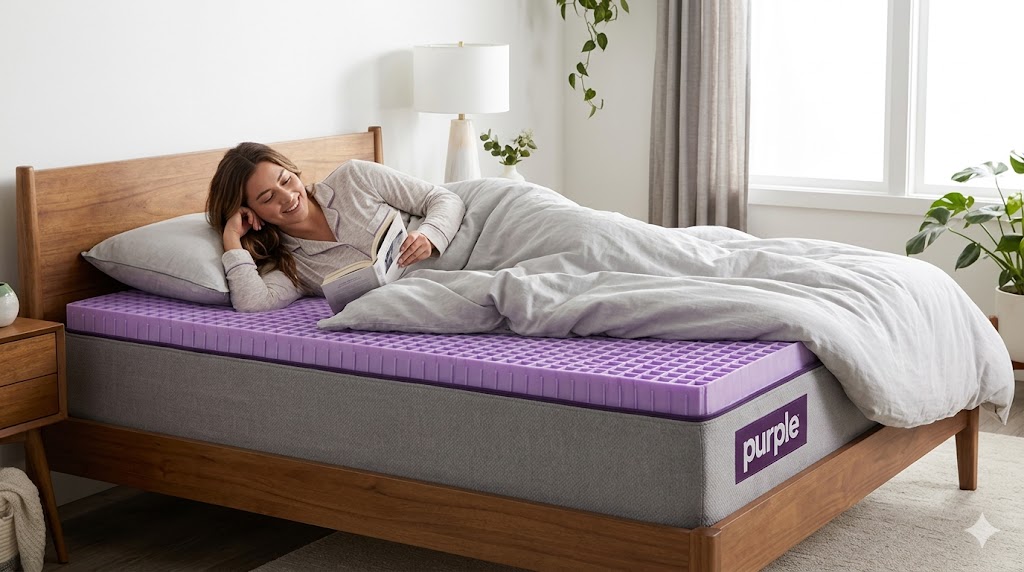
The GelFlex Grid is a hyper-elastic polymer grid, basically a lattice of flexible columns that reacts to pressure in a completely different way than foam or springs. When pressure is concentrated in one spot, like your hips or shoulders, the columns buckle and collapse. That gives you deep pressure relief right where you need it. But when the pressure is spread out, like across your back and torso, those same columns stay upright and give you firm support.
This is what Purple calls “pressure relief with support”, and unlike most mattress marketing, this claim actually holds up mechanically. The grid can’t deliver firm support and deep pressure relief from the same spot at the same time, but it does give you each one exactly where your body needs it. Foam can’t pull this off. Foam just softens uniformly under any pressure, concentrated or spread out.
For side sleepers, this makes a real difference. Your hips and shoulders, the two biggest pressure points when you sleep on your side, sink into the collapsing columns while your waist and torso stay supported. High-end foam mattresses try to do this, but Purple actually solves it.
Who Purple Suits Best
Side sleepers with hip and shoulder pressure issues are the buyers who’ll get the most out of Purple. The way the grid’s columns collapse under concentrated pressure gives you relief that foam alternatives simply can’t match, no matter the density. If you’ve been waking up with hip or shoulder pain and foam toppers haven’t fixed it, Purple’s mechanical approach solves the problem in a way foam never will.
Hot sleepers also benefit in a way no foam, not even gel-infused or graphite-infused kinds, can match. Here’s the thing: the grid isn’t foam. It has no thermal mass to soak up your body heat. Air flows freely through the open lattice, and the polymer itself doesn’t warm up the way foam compounds do. This is the most complete temperature solution you’ll find in any mattress. Not the best foam cooling solution, a genuine non-foam answer that sidesteps the heat problem entirely.
Combination sleepers who switch between side and back will appreciate how responsive the grid is. Memory foam takes 3-5 seconds to bounce back after you move, which creates that annoying resistance feeling when you shift positions. The elastic polymer rebounds right away. People who move around a lot in bed report fewer disruptions on Purple than on comparable memory foam mattresses.
Who Purple Does Not Suit
Stomach sleepers consistently end up the least happy Purple buyers. The column collapse that’s great for side sleeping hip pain becomes a problem when you’re on your stomach, your hips sink too deep, your lower back arches, and your spine ends up misaligned. Stomach sleepers need a surface that keeps hips up, not one that lets them sink. If you sleep on your stomach, our guide to the best thin pillows for stomach sleepers covers the pillow side of the equation, since you’ll need to manage spinal alignment from both the mattress and the pillow.
Memory foam loyalists, the people who love that slow, sinking, hug-like feel, usually don’t love Purple. The grid feels nothing like foam. It’s bouncy, responsive, and firm between pressure points, which foam fans tend to describe as “different, but not better.” If you’ve spent years on memory foam and loved it, Purple is going to feel strange at first. It’s an acquired taste, not an instant upgrade.
Budget-conscious buyers need to be honest with themselves about the math. The Purple Original starts around $1,099 for a Queen. Purple Plus, with its thicker grid, runs about $400 more. And the Purple Premium, with the thickest grid, tops out around $2,299 for a Queen. Those prices sit well above mid-range foam mattresses that work perfectly fine for most sleepers. The GelFlex Grid earns its premium specifically for hot sleepers and side sleepers with real pressure issues. For everyone else, the math doesn’t always work out in Purple’s favor over a solid foam alternative.
Purple Mattress Lineup, Which Model Is Right
| Model | Grid Thickness | Price (Queen) | Best For |
|---|---|---|---|
| Purple Original | 2 inch | ~$1,099 | Budget entry, combination sleepers |
| Purple Plus | 3 inch | ~$1,499 | Side sleepers, moderate pressure sensitivity |
| Purple Premium | 4 inch | ~$2,299 | Significant pressure sensitivity, hot sleepers |
Grid thickness directly affects how much pressure relief you get, more grid means more room for your body to sink in before hitting the support layer underneath. Side sleepers dealing with serious hip and shoulder pressure will feel a real difference between the Premium’s 4-inch grid and the Original’s 2-inch. But if you’re a combination sleeper or a hot sleeper whose main issue is temperature rather than pressure, the Original gives you the same cooling benefits at the lowest entry price.
Amazon Alternatives: When Purple Isn’t the Right Call
Purple is a strong mattress for the right sleeper. It’s also a $1,400 to $4,000 commitment to a feel that some sleepers find polarizing after the 21-night break-in. If the GelFlex Grid sounds appealing but the price doesn’t, or if you read the breakdown above and recognized that you’re not the ideal Purple buyer, here are the Amazon-available alternatives that deliver most of what Purple offers, at significantly lower prices, with the return policy infrastructure Amazon provides.
If You Want Purple’s Cooling: DreamCloud Premier Rest Hybrid
Check Price on AmazonThe DreamCloud Premier Rest is the closest Amazon-available alternative to Purple’s cooling performance. The hybrid construction, cashmere blend cover over gel memory foam over individually wrapped coils, provides the same convective airflow that makes Purple sleep cool. You’re trading the GelFlex Grid’s unique “floating” feel for traditional memory foam contouring, but for the hot-sleeping problem specifically, the coil core delivers comparable results. The 365-night home trial is meaningfully longer than Purple’s 100 nights. For most hot sleepers, this is the smarter pick.
If You Want Purple’s Pressure Relief at Half the Price: Nectar Memory Foam
Check Price on AmazonThe Nectar is the right alternative for side sleepers and pressure-relief seekers who were considering Purple primarily for hip and shoulder support. The contouring is fundamentally different, memory foam embrace versus GelFlex Grid responsiveness, but the pressure relief outcome is comparable for most sleepers under 230 pounds. Many side and back sleepers report that the GelFlex Grid eases morning lower-back stiffness, with reviewers often noting relief within the first few weeks of switching. The trade-off is heat: the Nectar sleeps warmer than Purple. If pressure relief matters more than cooling, the Nectar is the strongest value pick under $1,000.
If You Want Purple’s Responsive Feel: Sweetnight Twilight Hybrid
Check Price on AmazonThe Sweetnight Twilight is the closest budget alternative for sleepers drawn to Purple’s responsive, bouncy feel, the sensation of the mattress springing back rather than absorbing. The hybrid construction with phase-change material handles cooling actively rather than passively, and the coil core delivers the responsiveness that pure memory foam mattresses cannot. It does not replicate the GelFlex Grid’s unique floating sensation, but it provides the underlying performance characteristics, temperature regulation, motion response, pressure adaptation, at less than half of Purple’s entry price.
If You’re Heavier Than 250 Pounds: Bear Original or Lucid Hybrid
Purple’s GelFlex Grid is widely reported to underperform for sleepers over 250 pounds, multiple independent reviewers note potential sagging within a year and insufficient support. If you’re in this weight range, skip Purple regardless of price. The Bear Original at ~$799 provides better support with the Celliant recovery cover, and the Lucid 12-Inch Hybrid at ~$449 delivers coil-core support at a budget price. Our best mattresses for heavy people guide covers the full picture for sleepers in this category.
The Honest Bottom Line on Alternatives
Purple’s GelFlex Grid is genuinely unique, no Amazon-available mattress replicates the exact feel of sleeping on the hyper-elastic polymer grid. If that specific feel is what you want, Purple is the only place to get it. But if you were considering Purple for what it delivers (cooling, pressure relief, responsive feel) rather than how it delivers it, the Amazon alternatives above provide most of the outcome at meaningfully lower prices, with return policies that protect your decision.
For the full picture across budgets and sleep needs, our best mattresses for back pain and best mattresses for hot sleepers guides cover the complete Amazon-monetizable lineup.
Our Verdict on the Purple Mattress
Purple earns its reputation for two specific types of sleepers, hot sleepers, and side sleepers with real hip and shoulder pressure issues. For both groups, the GelFlex Grid delivers something no foam mattress can, and the 100-night trial takes the risk out of a $1,000+ decision that would otherwise feel permanent.
Everyone else, stomach sleepers, memory foam fans, and people whose sleep issues aren’t really about pressure or temperature, should look hard at other options at the same price before pulling the trigger. Purple is genuinely unique. But unique doesn’t mean better for everyone.
The 100-night trial is really the smartest way to approach this. Sleep on it for 90 nights before you decide. Either the grid changes how you sleep, or it doesn’t, and Purple gives you enough time to know for sure.
Check Price on AmazonFrequently Asked Questions: Purple Mattress Review
Is the Purple mattress worth the price?
If you’re a hot sleeper or a side sleeper dealing with hip or shoulder pressure, yes, confidently. The GelFlex Grid’s cooling and pressure relief deliver results that foam alternatives at the same price just can’t match for these sleep styles. For everyone else, you’ll want to honestly compare Purple against other options in the same price range. Something else might suit you just as well, or even better.
How long does a Purple mattress last?
Purple mattresses come with a 10-year warranty that covers manufacturing defects and sagging deeper than one inch. The hyper-elastic polymer grid doesn’t break down the way foam does, it gets its support from the column shape, not from foam density (which compresses over time). Most Purple owners say the mattress still feels consistent five years in, compared to when they first got it.
Does Purple sleep cool?
Yes, more reliably than any foam mattress, including the gel-infused and copper-infused ones. The open grid lets air move through the surface instead of trapping heat against your body. The polymer itself has low thermal mass, so it doesn’t soak up body heat during the night. Hot sleepers who’ve tried every foam mattress out there consistently say Purple is the first one that actually solves the temperature problem structurally, not with some cooling gimmick on top.
What is the Purple mattress return policy?
Purple offers a 100-night free trial with free returns. If you’re not happy within 100 nights, they’ll arrange pickup and give you a full refund. The 10-year warranty covers sagging over one inch and any manufacturing defects, starting from your original purchase date.
Can I use my existing bed frame with a Purple mattress?
Yes, Purple works with most standard bed frames. That includes platform beds, slatted bases (as long as the slats are no more than 4 inches apart), box springs, and adjustable bases. Purple specifically warns against foundations with center support gaps wider than 4 inches, since those can let the grid sag between support points over time.
Recommended Reading
See also our guides to how to clean a mattress, how to store a mattress, and nectar vs purple mattress. Also see our Nectar mattress review, a firsthand look at the memory foam bed.
Related Reading
Explore more: why is my mattress sagging, how to store a mattress, mattress cleaners, heated mattress pads, Are Heated Mattress Pads Safe? A Practical Safety Guide, king vs california king mattress, mattress topper vs mattress pad, and hybrid vs latex mattress.
