
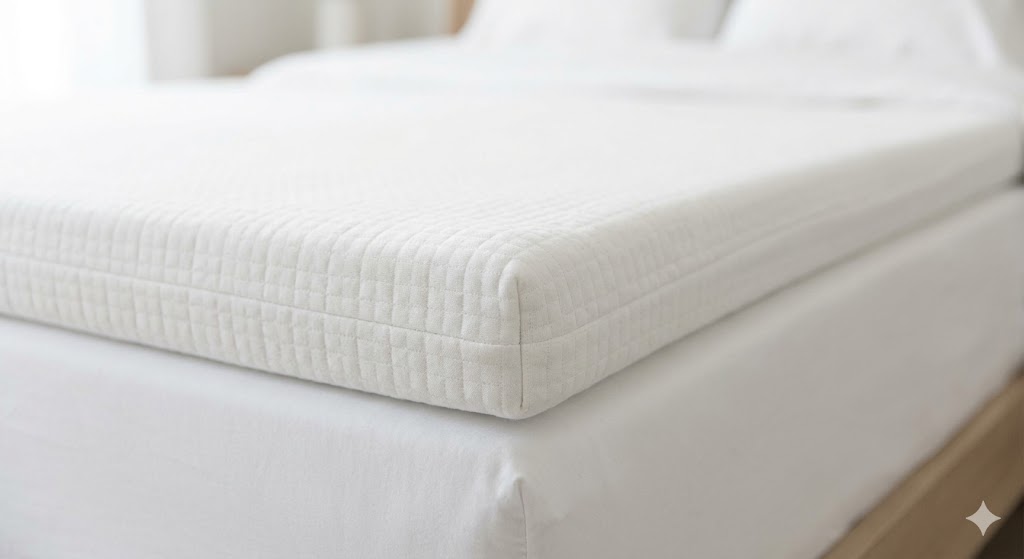
Most people buy a mattress topper the same way they buy most things they do not fully understand, they look at the star rating, pick something in their budget, and hope it works. Sometimes it does. More often, they end up with a topper that is either too firm, too warm, too thin, or wrong for their sleep position, and they assume the problem is that mattress toppers just do not work, rather than that they bought the wrong one. Comparing options? See our best mattress toppers roundup.
A mattress topper is not a universal product. The right topper for a 230-pound side sleeper who sleeps hot on an aging innerspring mattress is completely different from the right topper for a 140-pound back sleeper who sleeps cold on a medium-firm memory foam mattress. Getting the match right requires understanding four variables, your sleep position, your body weight, your temperature profile, and your mattress’s current condition, before any specific product recommendation makes sense. Part of choosing well is knowing the signs a topper has broken down.
This guide covers all four variables systematically so that by the end, you have a clear, specific direction for which topper type addresses your actual sleep situation rather than a generic recommendation that may or may not apply to you.
For readers who have already identified their topper type and want specific product recommendations, our guides to the best mattress toppers for back pain, best mattress toppers for side sleepers, and best mattress toppers for hot sleepers cover specific product options for each profile. Couples with different sleep needs should check our best mattress toppers for couples guide, which covers split and dual-zone options.
Step 1, Identify What Your Mattress Actually Needs
Before choosing a topper material or thickness, you need to be honest about what problem you are trying to solve. Toppers fix different problems, and choosing the wrong solution for your actual problem is how most topper purchases fail.
Problem 1, Your mattress is too firm
Signs: You wake with pressure point pain in the shoulders and hips. You feel the mattress pushing back against your body. Side sleeping is uncomfortable. You find yourself avoiding certain sleep positions because of contact discomfort.
Solution: A comfort layer topper, memory foam, latex, or soft fiber fill, that adds pressure relief between you and the firm mattress surface. A thickness of 2 to 3 inches is typically adequate for a too-firm mattress.
Problem 2, Your mattress is too soft or sagging
Signs: You sink into a depression in the mattress. You wake with lower back pain. You feel like you are sleeping in a hammock. Getting out of bed requires more effort than it should.
Important distinction: A topper cannot fix a sagging mattress. A topper sits in the sag and conforms to the depression rather than bridging it. If your mattress has visible sagging deeper than 1 to 1.5 inches, the solution is mattress replacement rather than a topper. A firmer topper on a sagging mattress adds a firm layer that still sags in the middle, it does not correct the underlying structural problem.
Problem 3, Your mattress sleeps too warm
Signs: You wake during the night, sweating. You frequently throw off the covers. Or you sleep better in cooler environments. Or maybe you have tried cooling bedding without adequate improvement.
Solution: A breathable topper material, latex, wool, or cooling gel-infused foam, that allows heat to escape from the sleep surface rather than trapping it against the body. Cooling topper effectiveness is limited if the mattress beneath is itself a significant heat source, a cooling topper on a dense memory foam mattress helps, but does not fully counteract the mattress’s heat retention.
Problem 4, Your mattress is worn but not fully sagging
Signs: Your mattress is 7 to 10 years old. The surface has lost some of its original feel but has no visible deep sag. The mattress used to feel comfortable and now feels marginally less supportive.
Solution: A topper that restores the comfort layer the mattress has lost without trying to correct structural problems that do not yet exist. This is the problem toppers solve most effectively, mild surface wear correction rather than structural sagging correction.
Step 2, Match Topper Type to Sleep Position
Side sleepers need the most pressure relief.
Side sleeping concentrates body weight on the shoulder and hip contact points. A too-firm surface creates concentrated pressure at these points that disrupts circulation and produces the shoulder and hip pain that wakes side sleepers or produces morning discomfort. Side sleepers benefit most from softer, more conforming topper materials, memory foam and soft latex, that allow the shoulder and hip to sink slightly into the surface rather than bearing concentrated contact force.
Recommended for side sleepers: 3-inch memory foam or shredded latex topper in soft to medium firmness. The 3-inch depth allows adequate shoulder and hip sink without the mattress feeling so soft that spinal alignment is compromised.
Back sleepers need balanced support and moderate pressure relief.
Back sleeping distributes body weight more evenly across the sleep surface than side sleeping, reducing the pressure point problem and increasing the importance of lumbar support. The lower back naturally curves away from the mattress surface during back sleeping and needs adequate support to prevent that curve from deepening into a position that strains the lumbar muscles and discs overnight. Back sleepers benefit from medium-firmness toppers that provide some comfort layering without the deep sink that allows the lumbar curve to deepen excessively.
Recommended for back sleepers: 2 to 3-inch medium-firmness memory foam or latex topper. Avoid very soft toppers that allow excessive lumbar curve deepening during back sleeping.
Stomach sleepers need the firmest option.
Stomach sleeping already puts the lumbar spine into extension, the pelvis tilts forward and the lower back arches. A soft topper that allows the pelvis to sink deepens this extension and increases lumbar strain. Stomach sleepers need the firmest possible sleep surface to minimize the pelvic sink that compounds lumbar extension. For stomach sleepers whose mattress is already appropriately firm, a topper may not be necessary, and a soft topper actively makes their sleep posture worse.
Recommended for stomach sleepers: Thin 1 to 2-inch firm topper if any topper is needed at all. Avoid soft and medium memory foam that allows pelvic sink.
Combination sleepers need versatility.
Combination sleepers who move between side, back, and stomach positions during the night need a topper that performs adequately across all positions rather than optimally for one. Latex toppers are generally the best material for combination sleepers, the responsive feel accommodates position changes more naturally than slow-recovery memory foam that retains impressions from previous positions during the position change.
Recommended for combination sleepers: a 2 to 3-inch medium latex topper that provides adequate pressure relief for side sleeping phases without the excessive sink that compromises back and stomach sleeping phases.
Step 3, Factor in Body Weight
Body weight affects how deeply you sink into a topper and, therefore, which thickness and firmness actually delivers the intended comfort.
Under 130 pounds: Lighter sleepers do not compress foam as deeply as heavier sleepers, a medium-firmness topper may feel firm to a lighter sleeper because they do not generate enough pressure to reach the soft comfort zone of the foam. Lighter sleepers should choose toppers in soft to medium-soft firmness to get the pressure relief they need. See our full breakdown on choosing between firm and plush before ordering.
130 to 230 pounds: The average weight range for which most topper firmness ratings are calibrated. Medium firmness recommendations in this guide apply directly to sleepers in this range.
Over 230 pounds: Heavier sleepers compress foam more deeply and more quickly than lighter sleepers. A topper that provides adequate support for a 170-pound sleeper may bottom out under a 260-pound sleeper, compressing completely and providing no meaningful comfort benefit. Heavier sleepers should choose denser foam toppers, 4 lb per cubic foot or higher, and consider 3-inch thickness as the minimum rather than an upgrade.
Step 4, Match Material to Temperature Profile
Memory foam, best for pressure relief, worst for temperature
Memory foam provides the best pressure relief and motion isolation of any topper material. It is also the warmest, the density that makes it comfortable for pressure relief also makes it effective at retaining body heat. Standard memory foam is only appropriate for sleepers who do not sleep warm. Gel-infused memory foam reduces heat retention meaningfully but does not eliminate it, appropriate for neutral temperature sleepers. Copper or graphite-infused memory foam provides better temperature neutrality than gel infusion for warm sleepers who specifically need memory foam pressure relief.
Latex, best overall balance
Latex provides good pressure relief, better temperature neutrality than memory foam, and greater durability than foam alternatives. Talalay latex is the more breathable and consistent of the two latex processing methods, more appropriate for warm sleepers than Dunlop latex. Natural latex is the most temperature-neutral and most durable option, also the most expensive. For most sleepers who want the best all-around topper material and are willing to pay for it, natural Talalay latex is the answer.
Wool, best for temperature regulation
Wool regulates temperature in both directions, absorbing excess heat during warm phases and releasing it during cool phases. It is the most temperature-neutral natural material available for sleep products. Wool toppers are less common than foam and latex alternatives and typically more expensive for comparable thickness. For sleepers with significant temperature sensitivity, either running hot or cold, wool addresses the temperature problem more completely than any foam alternative.
Down and fiber fill, softest feel, least support
Down and high-quality fiber fill toppers provide the softest contact surface of any topper material. They are appropriate for sleepers whose primary problem is contact surface softness rather than pressure point relief or temperature management. They provide the least structural support and are least appropriate for back pain sufferers who need the mattress to maintain lumbar support.
Step 5, Thickness and Density Guide
| Sleeper Profile | Recommended Thickness | Recommended Density |
|---|---|---|
| Side sleeper under 130 lbs | 3 inch | 3 lb per cubic foot |
| Side sleeper 130-230 lbs | 3 inch | 3-4 lb per cubic foot |
| Side sleeper over 230 lbs | 3-4 inch | 4+ lb per cubic foot |
| Back sleeper under 130 lbs | 2 inch | 3 lb per cubic foot |
| Back sleeper 130-230 lbs | 2-3 inch | 3-4 lb per cubic foot |
| Back sleeper over 230 lbs | 3 inch | 4+ lb per cubic foot |
| Stomach sleeper any weight | 1-2 inch firm | 4+ lb per cubic foot |
| Combination sleeper | 2-3 inch medium | 3-4 lb per cubic foot |
The Topper Decision Tree
Use this to identify your specific recommendation:
Is your mattress visibly sagging more than 1.5 inches? Yes, replace the mattress. A topper will not fix this. No, continue.
What is your primary sleep problem? Too firm, choose memory foam or soft latex 2 to 3 inches. Too warm, choose Talalay latex or wool. Worn surface, choose medium memory foam or latex 2-inch. Back pain, see our best mattress toppers for back pain guide
What is your sleep position? Side, soft to medium, 3 inch minimum Back, medium, 2 to 3 inch Stomach, firm, 1 to 2 inch maximum Combination, medium latex, 2 to 3 inch
What is your temperature profile? Neutral, memory foam or latex both work. Warm, Talalay latex or cooling gel foam. Very warm, wool or copper-infused foam, Cold, standard memory foam or down fill
What is your body weight? Under 130 lbs, go one firmness softer than the recommendation. 130 to 230 lbs, use the recommendation directly. Over 230 lbs, go one firmness firmer and choose 4+ lb density
Frequently Asked Questions: How to Choose the Right Mattress Topper
How do I know if I need a mattress topper or a new mattress?
A mattress topper is the right solution if your mattress is too firm, sleeping warm, or has minor surface wear or compression, but is structurally intact with no visible sagging. A new mattress is the right solution if your mattress has visible sagging deeper than 1 to 1.5 inches, broken springs, or structural damage. The test is simple, lie on your mattress and check whether you sink into a depression. If you do, a topper will sit in that depression rather than correcting it.
How long does a mattress topper last?
Low-density foam toppers under 2.5 lb per cubic foot compress to inadequate support levels within 12 to 18 months of nightly use. Medium-density foam at 3 to 4 lb per cubic foot maintains meaningful support for 2 to 4 years. Natural latex toppers maintain their original feel for 5 to 8 years. Wool toppers last 5 to 10 years with proper care. The per-year cost of a quality latex topper is often lower than multiple budget foam replacements over the same period.
Can I use a mattress topper with an adjustable base?
Yes, most mattress toppers work with adjustable bases. The key consideration is whether the topper is thick and flexible enough to bend with the base without bunching or separating at the fold points. Thinner toppers of 2 inches or less flex more easily than 3 to 4-inch alternatives. Shredded fill toppers flex more naturally than solid foam alternatives. Confirm the topper’s adjustable base compatibility before purchasing if you use a split king or queen adjustable configuration.
Does a mattress topper change how firm my mattress feels?
Yes, a mattress topper changes the feel of the sleep surface meaningfully when matched correctly to the problem. A 3-inch soft memory foam topper on a too-firm mattress transforms the sleep feel from firm and uncomfortable to pressure-relieving and comfortable. The mattress beneath does not change, its structural support profile remains the same, but the comfort layer between the mattress and the sleeper changes dramatically. This is why toppers solve too-firm mattress problems effectively and do not solve sagging mattress problems, they change the comfort surface but not the structural foundation beneath it.
Recommended Reading
See also our guides to mattress topper vs mattress pad, and why is my mattress sagging.
Related Reading
Explore more: how to choose sleep aids, how to choose bedroom essentials, mattress topper vs mattress pad, The Ultimate Step-by-Step Guide on How to Clean a Mattress, nectar vs purple mattress, firm vs soft mattress, how to choose a weighted blanket, and mattress foundations and bases.
- when a topper is enough and when you need a new mattress
- whether a topper can rescue a sagging bed
- whether cooling toppers do anything measurable
- how long one lasts before it flattens
- stopping a topper sliding around at night
- how to choose a mattress
- signs your mattress is too hard
- how heavy a topper is to handle
