
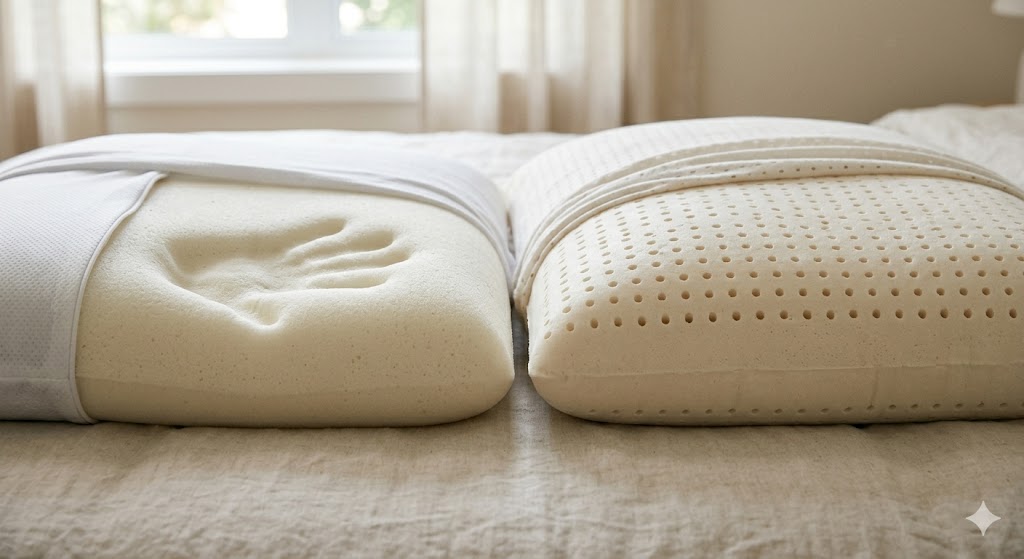
Memory foam vs latex pillow is one of those debates that sounds simple until you actually try to make a decision, and then you realize that every source you read gives you a different answer depending on which pillow they are trying to sell you. For our current top picks, see the best memory foam pillows guide.
Here is the honest version. Both materials work. Both have genuine advantages. And the right choice depends almost entirely on what you are trying to fix, which means the answer is different for a hot sleeper managing neck pain than it is for a side sleeper who just wants more pressure relief. Getting this wrong does not just cost you money. It costs you weeks of bad sleep before you realize the pillow you bought is making things worse rather than better.
This guide breaks down every meaningful difference between memory foam and latex pillows, support, cooling, durability, feel, and price, so you can make the right call for your specific situation rather than guessing based on marketing language.
For readers who have already decided on memory foam and want to narrow down the best options, our guide to the best pillows for neck pain covers the top memory foam and hybrid cervical pillows in one place. Hot sleepers specifically should check our best pillows for hot sleepers guide before deciding, cooling performance is where the two materials diverge most dramatically. And for readers managing shoulder pain alongside neck discomfort, our best pillows for shoulder pain guide covers position-specific options for both materials.
Disclosure: RestRight is reader-supported. As an Amazon Associate, we earn from qualifying purchases made through links on this page, at no extra cost to you.
What Is the Real Difference Between Memory Foam and Latex
Before comparing them directly, it helps to understand what each material actually is and why it behaves the way it does during sleep.
Memory foam is a polyurethane foam with added chemicals that increase its viscosity and density. The viscoelastic response, the slow sink and slow recovery that memory foam is known for, comes from the material softening under body heat and pressure. That slow response is what produces the cradling, contouring feel that memory foam advocates love and what produces the stuck, difficult-to-move feeling that memory foam critics hate.
Latex comes in two forms. Dunlop latex is denser and heavier, produced by pouring liquid latex into a mold in a single pour, which causes the denser particles to settle at the bottom. Talalay latex is lighter and more consistent, produced by vacuum-sealing the latex in the mold before freezing and baking it, which distributes the cell structure more evenly throughout. Both forms of latex are more responsive than memory foam, they push back against pressure rather than slowly conforming to it, and they recover to their original shape faster after pressure is removed.
Memory Foam vs Latex: The Direct Comparison
Support and spinal alignment
Both materials support the cervical spine adequately when the pillow loft matches the sleeper’s shoulder width and sleep position. The difference is in how that support is delivered. Memory foam delivers support through conforming, it fills the gap between the head and mattress by slowly softening to match the exact shape of the contact zone. Latex delivers support through resistance, it pushes back against head weight and maintains a consistent support surface rather than softening beneath it.
For most neck pain sufferers, latex’s consistent resistance produces more reliable overnight cervical alignment than memory foam’s heat-dependent conforming. Memory foam softens more as it warms through the night, which means the support profile at hour one of sleep is different from the support profile at hour six. Latex maintains consistent firmness regardless of temperature change.
Cooling and temperature
This is where the two materials diverge most clearly. Standard memory foam retains body heat, the density that makes it supportive also makes it effective at trapping warmth at the head and neck contact zone. Gel-infused memory foam reduces heat retention meaningfully but does not eliminate it entirely. Shredded memory foam improves airflow over solid foam but still retains more heat than latex alternatives.
Latex, particularly Talalay latex, is naturally more breathable than memory foam due to its open-cell structure. Air moves through the latex material during sleep rather than being trapped in dense, closed cells. For hot sleepers, this difference is immediately noticeable. For neutral or cold sleepers, it matters less.
Durability
Latex outlasts memory foam consistently. Quality latex pillows maintain their original feel and support profile for 5 to 10 years of nightly use. Memory foam pillows at comparable price points typically compress and lose meaningful support within 2 to 4 years. The durability advantage of latex is most significant when comparing mid-range options, budget memory foam degrades faster than budget latex under the same use conditions.
Feel and motion response
Memory foam feels slow and cradling, you sink into it, and it holds the impression briefly before recovering. Some sleepers find this deeply comfortable. Others find it makes repositioning during sleep feel effortful, the pillow resists quick position changes rather than accommodating them. Latex feels responsive and springy, it pushes back immediately and recovers shape instantly after pressure is removed. Position changes feel natural rather than effortful.
Price
Memory foam is generally less expensive than latex at comparable quality levels. Quality solid memory foam pillows run $50 to $100. Quality Talalay latex pillows run $80 to $150. The price gap narrows when comparing on a per-year basis, given latex’s durability advantage, a $120 latex pillow that lasts 8 years costs less per year than a $70 memory foam pillow that lasts 3 years.
Who Should Choose Memory Foam
Memory foam is the better choice if:
- You are a side or back sleeper who wants deep contouring pressure relief at the shoulder and neck contact zone
- You sleep in a cool room where memory foam heat retention is not a significant problem
- You prefer the slow-sink cradling feel over responsive pushback
- Your primary concern is pressure point relief rather than temperature management
- You want a lower upfront cost and replace pillows on a 2 to 3 year cycle anyway
Best memory foam pillow option:
Who Should Choose Latex
Latex is the better choice if:
- You sleep hot, and heat retention from memory foam has been a problem with previous pillows
- You want consistent overnight support that does not change as the pillow warms through the night
- You prefer a responsive feel over slow-sink cradling
- You want a pillow that lasts 5 to 10 years without significant compression
- You are willing to pay more upfront for a lower per-year cost over the pillow’s lifespan
- You prioritize natural materials and want to avoid synthetic polyurethane foam
Best latex pillow option:
The Verdict: Which Is Actually Better for Neck Pain
Neither material is categorically better for neck pain, the right choice depends on the specific mechanism of your neck discomfort.
Choose latex if your neck pain is worse in the morning after sleeping, the consistent overnight support of latex maintains cervical alignment more reliably through a full night than heat-softening memory foam. Many neck pain sufferers find that memory foam feels supportive initially and gradually loses effective support as it softens overnight, contributing to the morning stiffness that wakes them.
Choose memory foam if your neck pain is related to pressure points, the deep contouring of memory foam at the head and neck contact zone relieves localized pressure more effectively than the consistent resistance of latex. For sleepers whose neck pain comes from specific contact pressure rather than alignment issues, memory foam’s contouring advantage is meaningful.
The honest middle ground: Shredded latex pillows with adjustable fill are the most versatile option for neck pain sufferers who are unsure which mechanism drives their discomfort, the adjustable loft accommodates different cervical support needs, and the latex breathability addresses temperature concerns that solid memory foam cannot. Our best cervical pillows guide covers the best adjustable options in both materials.
Frequently Asked Questions: Memory Foam vs Latex Pillow
Which is better for neck pain, memory foam or latex?
Latex is generally better for neck pain caused by overnight alignment loss because its consistent support does not change as the pillow warms through the night. Memory foam is better for neck pain caused by pressure points because its deep contouring relieves localized contact pressure more effectively than latex’s consistent resistance. Identifying which mechanism drives your neck discomfort determines which material serves you better.
Do latex pillows sleep cooler than memory foam?
Yes, Talalay latex sleeps measurably cooler than standard memory foam due to its open-cell structure that allows airflow through the material. Gel-infused memory foam reduces the heat gap but does not eliminate it. For hot sleepers whose neck pain is compounded by overnight heat discomfort, latex’s cooling advantage is a meaningful secondary benefit alongside the support difference.
How long does a latex pillow last compared to memory foam?
Quality latex pillows maintain meaningful support for 5 to 10 years of nightly use. Memory foam pillows at comparable price points typically compress to inadequate support levels within 2 to 4 years. The durability gap is most significant at mid-range price points, premium memory foam like Tempur-Pedic TEMPUR material lasts significantly longer than commodity memory foam and narrows the gap with latex longevity.
Can I be allergic to a latex pillow?
Natural latex allergy affects a small percentage of the population, estimated at 1 to 6 percent. If you have a known latex allergy, natural latex pillows are not appropriate, regardless of their support advantages. Synthetic latex and latex-alternative materials provide a similar responsive feel without the allergen risk. Memory foam is a safe alternative for latex-allergic sleepers. If you are unsure whether you have a latex sensitivity, consult a physician before purchasing a natural latex pillow.
Recommended Reading
See also our guides to how to fluff a pillow, memory foam vs down alternative pillow, and silk vs satin pillowcase.
