
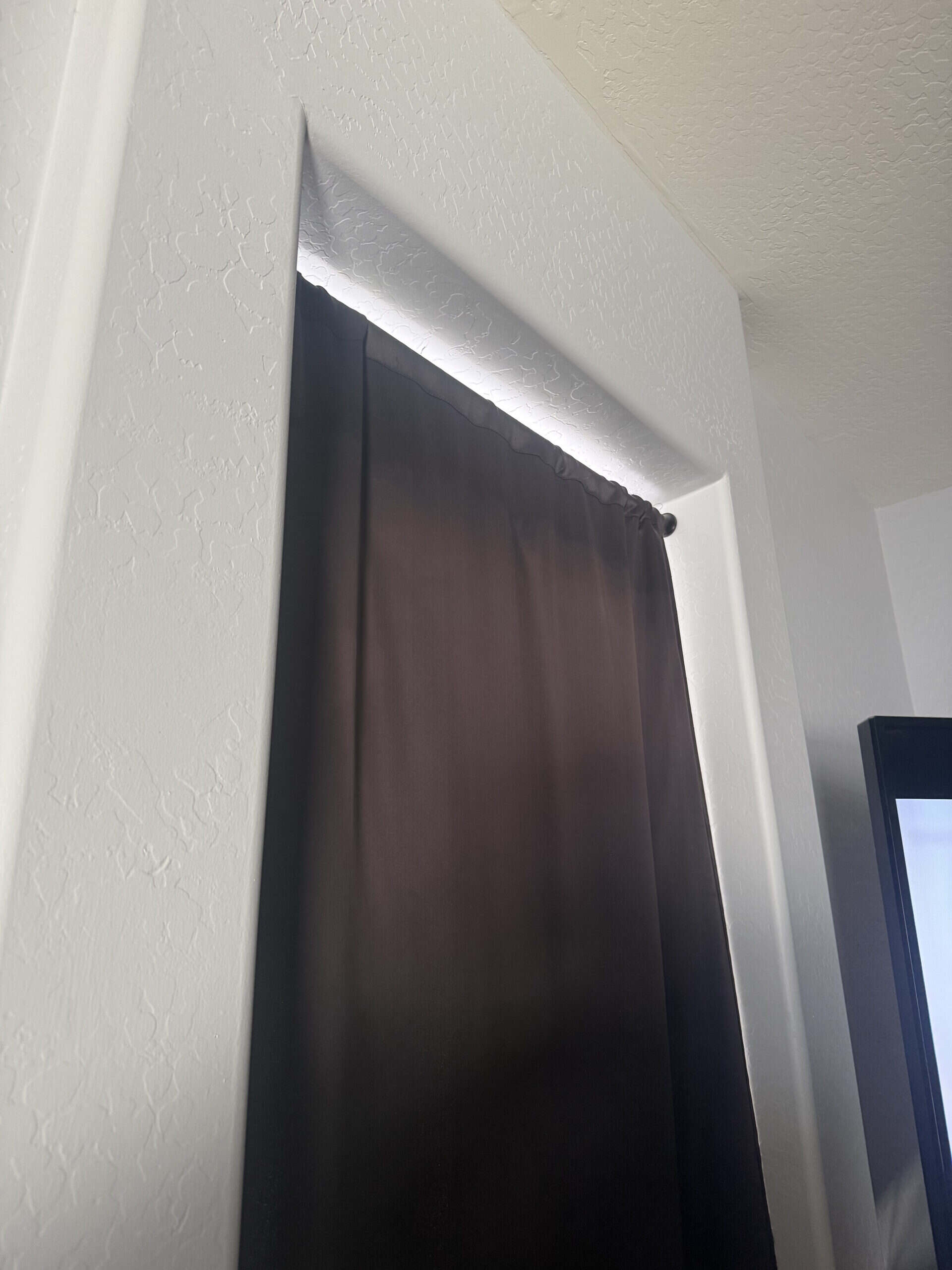
Yes, and it works well for visual separation and light control while doing almost nothing for sound. Blackout curtains instead of a door suit an opening you pass through rather than one you need to close against noise, a pet, or a draft, and the honest trade is privacy for sightlines rather than privacy for real.
The comparison that matters is usually not curtain against door. It is curtain against an open doorway, and our roundup of doorway curtains for privacy and light control covers the panels made for it.
| What You Want | Curtain | Door |
|---|---|---|
| Block sightlines | Yes | Yes |
| Block light | Mostly, leaks at edges | Mostly, leaks at gaps |
| Block sound | Barely | Meaningfully |
| Latch shut | No | Yes |
| Keep a pet out | No | Yes |
| Install with no tools | Yes | No |
| Cost | Low | Much higher |
| Renter friendly | Yes | Rarely |
Quick Answer
A blackout panel on a tension rod gives you visual privacy and useful light control in a doorway for very little money and no modification to the frame. It will not latch, will not stop a pet, and will not do much about noise. For a doorway you walk through rather than sit beside, that is usually an acceptable set of trades.
What a Curtain Actually Achieves in a Doorway
Sightlines first. A hanging panel removes the view straight through an opening, which is the thing most people are trying to fix when a room has no door.
Light second. Blackout fabric stops most of what passes through the opening, and what gets past comes around the edges rather than through the cloth.
Airflow third, and this cuts both ways. A curtain slows air movement without sealing, which is helpful if you want a little separation and unhelpful if you were hoping to hold temperature in one room.
Where a Curtain Will Disappoint You
Sound is the big one. Fabric absorbs a small amount of high frequency and blocks essentially nothing else, so a curtain between a sleeping space and a television is not going to work the way people hope.
There is no latch, which matters more than it sounds. Anything that can push through will, including a pet, a toddler, and a draft.
Edge light is the third. A panel on a rod leaves a gap at the top and at both sides unless it overlaps the frame generously, and our guide to stopping light leaking around blackout curtains covers closing those.
The Doorway Mine Covers
The panel I use hangs in a doorway leading to a bathroom and a closet. It is a standard blackout rather than a thermal one, and it stops a foot or two above the floor rather than reaching it.
It goes through several passes a day, held on a tension rod that has never come down in three to four years.
What I noticed is about viewing angle rather than about the fabric. The panel is cut off by the bed frame when I am lying down, so from the position that actually matters, it is not visible.
That is a good illustration of why this arrangement works where it works. The doorway is a route rather than a boundary, and nothing about it needs to seal.
What I cannot speak to is using a curtain in place of a real door between two rooms people occupy. I have not done that, so the sound and privacy sections describe how those limits work rather than something I have lived with.
Making It Work as Well as It Can
Overlap the opening generously
A panel several inches wider than the frame on each side closes most of the side gap. Width does more for darkness than fabric grade does at this point.
Mount above the frame, not inside it
Hanging higher and wider than the opening is what kills the top leak. Our guide to how high to hang blackout curtains covers the geometry.
Weight the hem
An unweighted panel swings back at you and hangs unevenly. Sewn weights or a hem rod fix both at once.
Keep the hem off the floor
A panel that clears the floor snags on less and stays cleaner, which matters in a doorway you use constantly rather than a window you never touch.
Size the rod properly
Blackout fabric is heavy. Our roundup of curtain rods for doorways covers rods rated for it.
When a Curtain Is the Right Call
An opening with no door and no realistic way to hang one. Here you are comparing a curtain to nothing, and a curtain wins easily.
A rental where modifying the frame is not allowed. No holes, no hardware left behind, and the whole thing comes down in a minute.
A closet or bathroom route, where sound does not matter and you want the opening visually closed. This is the case the arrangement is genuinely good at.
A temporary partition while something else is being figured out, since the cost is low enough that a wrong guess is cheap.
Doorways that are the wrong size or shape for a standard door. An arch, an oversized opening, or a frame that is out of square all make a hung door an expensive custom job and a curtain a five-minute one.
Openings where you want the option of leaving it open most of the time. A tieback gives you a fully open doorway in a second, which no door does without swinging into a room.
When to Hang a Real Door Instead
Anywhere sound matters. A bedroom off a living space, a home office, or a room shared with someone on a different schedule all need mass rather than fabric.
Anywhere a latch matters. Pets, small children, and anything you need to keep contained are not curtain problems.
Anywhere you need real darkness. A window is easier to black out than a doorway, because the opening is smaller and the frame gives you something to seal against. Our comparison of blackout curtains versus blinds covers the window decision, and our guide to making a bedroom dark covers the whole job.
For large openings the curtain route scales badly, and our roundup of blackout curtains for sliding glass doors covers the closest case, while blackout curtains for sleep covers the panels themselves.
Frequently Asked Questions
Can you use blackout curtains instead of a door?
Yes, for visual separation and light control in a doorway. You give up a latch, most sound blocking, and the ability to keep a pet or a draft out. For an opening you pass through rather than sit beside, the trades are usually acceptable.
Do curtains block sound in a doorway?
Barely. Fabric absorbs a little high frequency and blocks almost no low frequency, which is what travels between rooms. If noise is the problem you are solving, a curtain is the wrong tool regardless of how heavy it is.
How do you get privacy from a doorway curtain?
Visual privacy comes from a panel wide enough to overlap the frame and heavy enough to hang straight. There is no latch, so anyone can walk through. Decide whether you need to be unseen or to be undisturbed.
Will a blackout curtain make the room dark enough to sleep?
It handles the light coming through that opening and leaks at the edges. For a sleeping space you usually need the window covered as well, and the top gap closed. A doorway panel is one part of the job.
What do you hang a doorway curtain on?
A tension rod is the usual answer, since doorways are framed on both sides and the rod needs no holes. Check the rod’s weight rating, because blackout fabric is heavier than most rods assume.
Should a doorway curtain reach the floor?
Usually not. A hem that clears the floor by an inch or two snags on less, stays cleaner, and swings more predictably. Floor-length looks better and is less practical in a doorway you use daily.
Can you use a curtain on a bedroom doorway?
You can, and it will not give you the sound separation most people want from a bedroom. It works better on openings to bathrooms, closets, and hallways where noise is not the point.
Is this a permanent solution or a stopgap?
Either, depending on the opening. On a closet or bathroom route it is a reasonable permanent arrangement. Between two occupied rooms it usually functions as a stopgap until a door goes in.
