
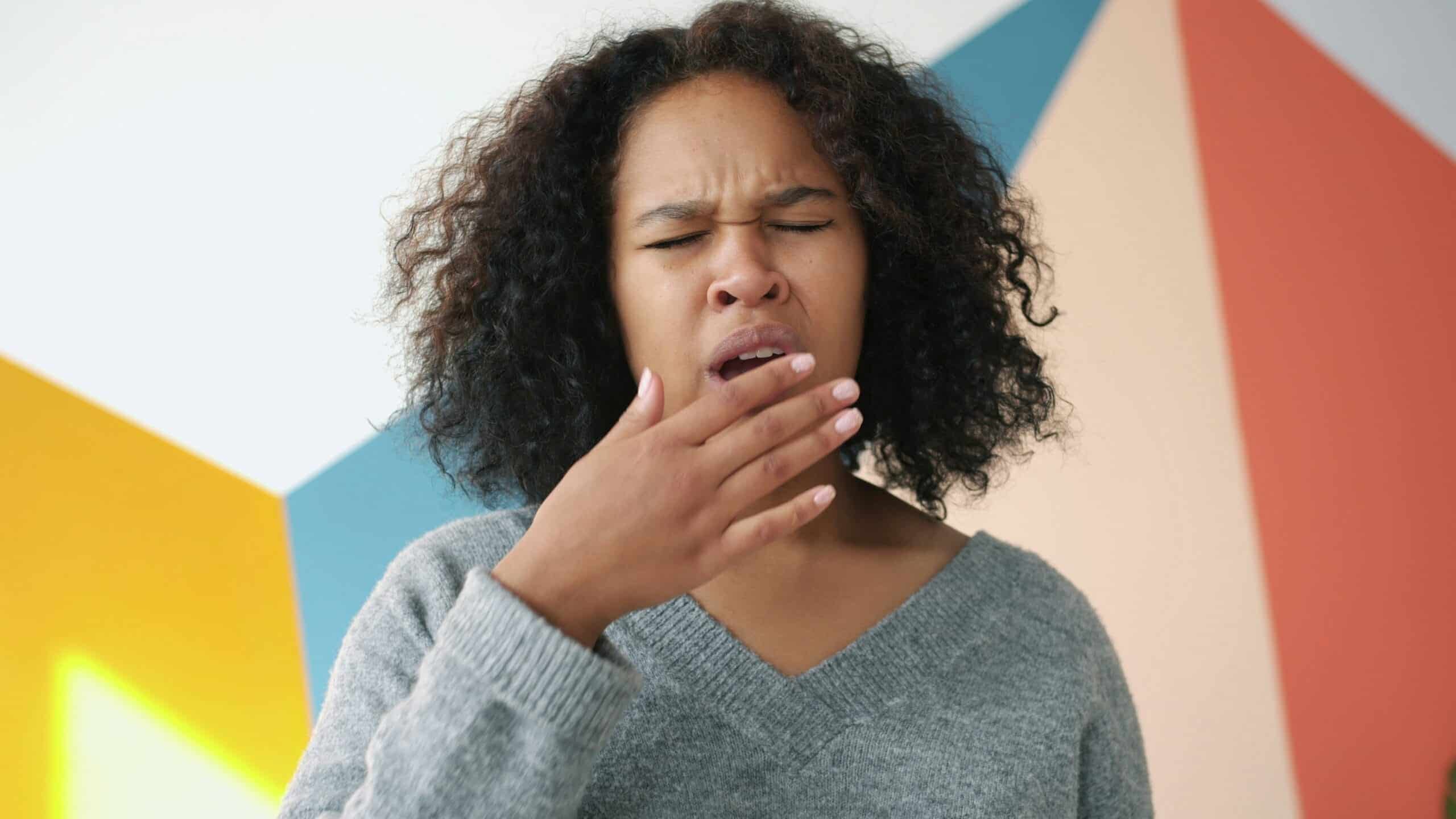
You watch someone yawn, and within seconds, you find yourself yawning too. You read the word “yawn” in a sentence (like that one) and may feel the urge to yawn. You can yawn just by thinking about yawning carefully enough. The behavior is so reliable that researchers can study it in labs by showing people videos of yawning faces and counting how many viewers yawn within a few minutes. A substantial portion does, and contagion tends to be stronger when the viewer feels socially connected to the person yawning.
Contagious yawning is a real neurological phenomenon, not a social convention or a learned habit. It happens in chimpanzees, bonobos, and other primates. It happens between dogs and their owners. It happens in infants as young as a few months old. The behavior crosses cultures, languages, and even species in ways that suggest it’s deeply rooted in mammalian brain wiring rather than being something we picked up from imitation.
This article covers what’s known about why yawning happens at all (spoiler: oxygen is probably not the main reason), why it spreads from person to person, the empathy and social-bonding hypothesis that’s dominated recent research, the brain regions involved when you catch a yawn from someone, and why some people seem completely immune while others catch yawns from a single brief glimpse.
Last updated: May 31 2026
Key Takeaways
- Contagious yawning has been documented since at least Robert Provine’s foundational 1986 research, with subsequent studies refining understanding of the mechanism
- Watching, hearing, reading about, or thinking about yawning can all trigger yawn responses; the visual face cue is particularly potent
- The empathy hypothesis (yawn contagion reflects emotional contagion mechanisms) has support but is not universally accepted; alternative hypotheses, including attentional bias, also have research support
- Individual variation in yawn contagion is large; some people catch yawns reliably while others rarely do, and the differences are largely stable across time
Why We Yawn at All
Before getting to why yawns spread, the more basic question: why does yawning exist in the first place? The conventional answer most people learned in school is that yawning increases oxygen intake. This explanation has been largely abandoned by researchers because the data doesn’t support it.
Studies have measured oxygen levels in people who are yawning and found no consistent relationship between yawn frequency and blood oxygen. Breathing pure oxygen doesn’t reduce yawning. Breathing carbon dioxide doesn’t increase it. People with respiratory conditions don’t yawn more often than people with normal breathing. The oxygen hypothesis was a reasonable guess based on the deep inhalation that yawning involves, but extensive testing has failed to confirm it.
Current research points to several other functions, none of which is universally accepted but each of which has supporting evidence:
Brain temperature regulation. Yawning may help cool the brain by drawing in cool air and by increasing blood flow that carries heat away. Some studies have shown that yawning frequency correlates with ambient temperature in expected ways (more yawning at warmer brain temperatures), and the deep inhalation may indeed have a cooling effect on circulating blood that supplies the brain.
Transition signaling. Yawning happens most often during transitions: when waking up, when getting drowsy, when changing activity levels. The yawn may serve to signal a state change in arousal, both internally (preparing the body) and externally (communicating to others that the arousal level is shifting).
Inner ear pressure equalization. The deep mouth-opening of yawning equalizes pressure between the middle ear and the external environment. This is a documented but probably secondary function, since people yawn when there’s no obvious pressure change to address.
Stretching the jaw and facial muscles. The full yawn stretches the musculature that doesn’t get much exercise otherwise. Whether this matters functionally or is just a byproduct is debated.
The most likely answer is that yawning serves multiple functions and evolved to address several biological pressures simultaneously. All of the proposed functions may be partially correct.
The 1986 Foundational Study
Robert Provine, a psychologist at the University of Maryland Baltimore County, conducted the foundational research on contagious yawning in 1986. His work established several findings that have held up across subsequent research:
- Yawning is highly stereotyped; individual yawns are remarkably consistent in duration (averaging around 6 seconds) and form
- Within-subject yawn duration and frequency are stable over weeks to months
- Visually observed yawns are potent triggers for yawning in observers
- Reading about yawning, thinking about yawning, or hearing the word “yawn” can also trigger yawning, though less reliably than visual cues
- Yawning meets several criteria for what ethologists call a “fixed action pattern” or “stereotyped action pattern,” a highly consistent behavioral sequence that runs to completion once triggered
Provine’s framing of yawning as both a stereotyped action pattern and a releasing stimulus (something that triggers the same behavior in another individual) became the foundation for decades of subsequent research. The concept is borrowed from ethology, the study of animal behavior, where similar fixed action patterns and their releasing stimuli have been documented in many species.
The Empathy Hypothesis
Since Provine’s foundational work, much research has focused on whether contagious yawning reflects empathy or other social-cognitive processes. Several lines of evidence support an empathy connection:
Closer social relationships produce stronger contagion. People are more likely to catch yawns from family members, close friends, or in-group members than from strangers or out-group members. The pattern holds in humans and has been replicated in chimpanzees, bonobos, and dogs.
Empathic individuals are more susceptible. Some studies have found that people who score higher on empathy measures catch yawns more reliably. Other studies have failed to replicate this, making the empathy connection contested rather than settled.
Developmental timing. Children begin showing contagious yawning around age 4-5, roughly the same age that empathic abilities emerge developmentally. Younger children yawn spontaneously but don’t reliably catch yawns from others.
Some populations show reduced contagion. Research has explored whether autism spectrum conditions, which can involve different empathic processing, show reduced yawn contagion. Results have been mixed, with some studies finding differences and others not.
Alternative hypotheses also have support. The “attentional bias hypothesis” proposes that yawn contagion reflects attentional and motor mimicry processes rather than specifically empathic ones. Both empathy-based and attention-based mechanisms may be operating simultaneously, with their relative importance varying across individuals and situations.
What Happens in the Brain
Brain imaging studies have identified several regions activated when people observe yawns. The mirror neuron system (regions that activate when watching someone perform an action you could perform yourself) plays a role. The brain’s social processing areas (including the medial prefrontal cortex and superior temporal sulcus) are activated when watching yawning faces. The motor planning regions that would produce a yawn become more active in response to observed yawns.
The cascade appears to work roughly like this: visual face information enters processing streams that recognize it as a yawn. Social processing networks evaluate the context (familiar person, in-group member, etc.). Mirror neuron-like activation begins simulating the observed action. Motor planning crosses a threshold, and the simulation becomes execution. The observer yawns.
The threshold for execution varies between individuals. Some people have a low threshold and catch yawns easily; others have a high threshold and rarely yawn from observation. The individual variation appears to be largely stable over time, meaning your susceptibility to catching yawns is probably about the same now as it was years ago.
Why Some People Seldom Catch Yawns
Research on individual variation in yawn contagion has found that susceptibility is highly stable within individuals but varies substantially between them. Some adults catch yawns reliably across multiple testing sessions; others rarely or never catch yawns; many are somewhere in between. The differences are consistent enough that individual susceptibility appears to be a stable personal trait rather than a transient state.
The differences aren’t well explained by any single variable. Empathy measures predict some variance but not most. Personality traits, social closeness to the yawning model, fatigue level, and stress all contribute. Age plays a role; contagion may decrease somewhat in older adults but not dramatically. Sex differences are small or inconsistent across studies.
One stable finding is that people who don’t catch yawns aren’t usually unaware they’re not catching them; they often notice that they don’t yawn when others do. Being a “non-catcher” doesn’t mean you’re somehow defective socially. The trait simply varies.
Why Cross-Species Contagion Happens
One of the more striking findings in this research is that yawn contagion crosses species boundaries. Dogs catch yawns from humans, particularly their owners. Chimpanzees catch yawns from familiar humans and from each other. Cats may catch yawns from humans, though evidence is weaker. Some birds appear to show yawn-like responses to yawning, though their physiology of yawning is different enough that direct comparisons are difficult.
Cross-species contagion is unusual among social behaviors. Most behaviors that spread within a species don’t spread to others. The fact that yawn contagion crosses species lines suggests the underlying mechanism is more fundamental than species-specific social learning. The deep neurological wiring for yawning and yawn-detection appears to be ancient enough that the system operates between very distantly related species.
For dog owners, this is the basis of the observation that your dog yawns when you yawn (and may yawn when you’re tired or stressed in ways that involve yawning). The dog isn’t being polite; the same neurological cascade that causes humans to catch yawns is firing in your dog. For another canine behavior shaped by sensitivity to human cues, see why dogs tilt their heads when you talk to them.
Triggers Other Than Visual Yawns
Visual observation of a yawn is the most potent trigger, but several other cues can also produce yawning:
Auditory. Hearing someone yawn (even without seeing them) can trigger yawning, though less reliably than visual cues. The yawn sound has characteristic acoustic features that the brain recognizes.
Reading or thinking about yawning. Words and concepts related to yawning can trigger the behavior. This is why reading about yawning often makes people yawn. The brain’s representation of yawning gets activated by the abstract concept, which can, in turn, activate motor planning enough to produce execution.
Discussion of fatigue, boredom, or sleep. Topics adjacent to yawning may trigger yawns indirectly through activating related concepts and states. People in conversations about insomnia or tiredness often start yawning.
Time of day. Spontaneous yawning peaks at predictable times: shortly after waking, before bed, and during low-arousal periods of the day. The internal state may make people more susceptible to external yawn triggers as well. For more on the sleep transition states where yawning peaks, see our piece on why we twitch when falling asleep.
Is Contagious Yawning Useful?
If yawn contagion is so widespread, evolutionarily ancient, and cross-species, it probably serves some function. Several possibilities have been proposed:
Group synchronization. If yawning relates to arousal-level transitions (waking, sleeping, attention shifts), having group members synchronize their transitions might benefit social animals. A group that wakes together, gets drowsy together, and pays attention to common stimuli together has potential coordination advantages.
Empathy and social bonding. If yawn contagion reflects empathy circuits, the behavior may serve as a low-stakes signal of emotional attunement between social partners. Catching a yawn from a friend may strengthen the social bond in subtle ways.
Vigilance coordination. Yawning may signal a change in attention or vigilance state. Group members who synchronize these signals may coordinate threat detection or environmental monitoring.
Vestigial. The behavior may have been useful in ancestral environments and persists without current function. Lots of evolved behaviors are partially or fully vestigial; yawn contagion may be among them.
The honest answer is that researchers don’t yet know definitively what function yawn contagion serves. Multiple hypotheses are plausible and not mutually exclusive.
Frequently Asked Questions
Why do I yawn even when I’m not tired?
Yawning correlates with state transitions, not just with tiredness. You can yawn when you’re transitioning out of sleep (still tired), transitioning into sleep (getting tired), shifting from one activity to another, becoming bored, or watching someone else yawn. The behavior responds to multiple internal and external triggers, not just sleep pressure.
Can I make myself yawn on purpose?
Most people can produce a yawn voluntarily, often by thinking about yawning or opening the mouth wide as if to yawn. The voluntary yawn isn’t quite the same as a spontaneous one (somewhat shorter, less complete), but it counts as a yawn for most purposes. Why this works isn’t fully understood; the brain seems to be able to trigger the yawn motor program through several pathways.
Is it rude to yawn during a conversation?
Culturally, yes, in most contexts. The social interpretation of yawning is that it signals boredom or disinterest, which can feel insulting to the person being yawned at. Covering the mouth during yawning is a near-universal convention. Notably, the actual yawn doesn’t usually mean what people interpret it as; you can be fascinated by a conversation and still yawn for thermal or transitional reasons.
Why do I yawn when I’m exercising?
Exercise involves arousal-state changes and temperature shifts, both of which can trigger yawning. Some athletes yawn before competitions; this is thought to be related to the brain temperature regulation hypothesis and the arousal-shift hypothesis. The yawning isn’t a sign of poor preparation; it may actually help with cognitive readiness.
Do animals other than mammals yawn?
Most vertebrates show yawn-like behaviors, though the mechanisms and functions vary considerably. Birds, reptiles, and fish all display behaviors that researchers have described as yawning. Whether these are mechanistically the same as mammalian yawning is debated; the deep face-mouth-stretching pattern that defines mammalian yawns isn’t always present in other groups.
