
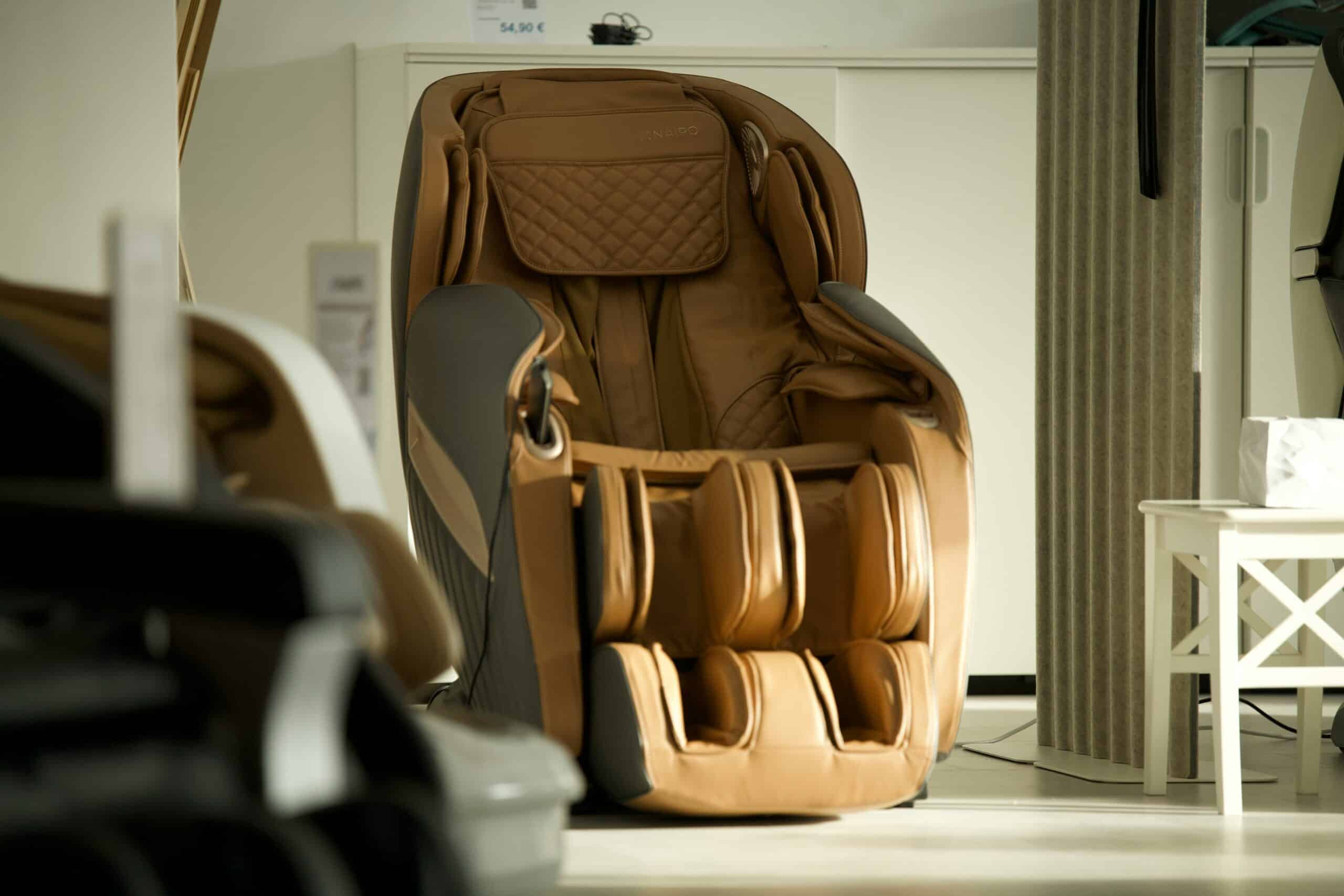
A shiatsu massage chair works by driving rollers along a curved track behind your spine, and the shape of that track decides how much of your body it can actually reach. Shiatsu massage chairs vary far more in coverage than in price, so a mid-priced chair with a long track often does more useful work than an expensive one with a short one. Anyone weighing a chair against a simpler device should also see our roundup of back massagers, since the gap in cost is large.
This guide explains what the track letters mean, what roller depth changes, and where the honest limits of the format sit.
Medical Disclaimer
This article is general information, not medical advice. Massage is not appropriate for everyone, and the National Center for Complementary and Integrative Health notes rare but serious complications including blood clots, nerve injury, and fractures, particularly with vigorous pressure or in frail users. If you have osteoporosis, a clotting disorder, recent surgery, an implanted device, or you are pregnant, ask a doctor before using a massage chair.
Quick Verdict
An SL-track chair with 3D rollers is the strongest all-round choice, because the track follows the spine into the seat and the rollers adjust depth. L-track chairs cover more body for less money. A back cushion suits anyone who wants shiatsu pressure without surrendering a corner of the room.
Key Takeaways
- Track shape decides coverage: S covers the back, L continues under the thighs, SL does both
- 2D rollers move up and across, 3D adds depth, 4D adds variable speed within a stroke
- Evidence for massage is stronger on neck and shoulder discomfort than on chronic low back pain
- Most full-size chairs need three to four feet of clearance behind unless they are wall-huggers
- Body scan quality matters more than roller count, since a misplaced stroke helps nobody
- A back cushion delivers similar roller pressure for a fraction of the cost and space
How We Picked
Coverage came first. A chair that stops at the lower back leaves out the glutes and hamstrings, which is where a great deal of everyday tightness sits. Longer tracks ranked ahead of shorter ones at every price point.
Roller adjustability came second. Fixed-depth rollers feel identical on a slim frame and a broad one, so chairs that let you set intensity ranked higher than chairs that only change speed.
Fit and footprint came third. A chair sized for a six-foot frame handles a five-foot user badly, and recline clearance rules out many rooms before comfort ever enters the discussion. Chairs with adjustable shoulder positions and wall-hugging recline earned credit here.
Therapeutic claims stayed out of the ranking entirely. Whether massage helps your particular discomfort is a clinical question, and no chair changes that answer.
1. The 4D SL-Track Massage Chair
Why It Stands Out
The SL track runs from the neck, down the spine, and forward under the seat toward the hamstrings. That single design choice roughly doubles the area a chair can reach compared with a back-only track. Adding 4D rollers lets the stroke change speed and pressure partway through, which reads as far more human than a metronome pass.
Worth Knowing
These chairs are heavy, frequently over two hundred pounds, and they arrive in crates that two people struggle with. The extra mechanical complexity also means more parts that can eventually fail, so warranty terms on the frame and the rollers matter more here than anywhere else in the category.
Right for regular daily use and for anyone who wants glute and hamstring coverage. Skip it if the room cannot take a permanent large chair.
Check Price on Amazon2. The 3D L-Track Massage Chair
Why It Stands Out
The L track carries the rollers past the lower back and under the thighs, so it reaches the glutes that an S track misses. Pairing it with 3D rollers gives you depth control without the price jump that 4D brings. For most people this is the sweet spot between coverage and cost.
Worth Knowing
An L track usually delivers less shoulder and neck detail than an SL track, because the upper section is shorter. If your tension sits high, that tradeoff runs the wrong way. Check where the track actually starts rather than trusting the marketing diagram.
Right for lower body and hip tightness on a mid-range budget. Skip it if neck and shoulder work is your main reason for buying.
Check Price on Amazon3. The 2D S-Track Massage Chair
Why It Stands Out
An S track follows the natural curve of the spine, so contact stays consistent from neck to lower back. With 2D rollers the mechanism stays simple, which keeps both the price and the failure rate down. For back-focused shiatsu this format does the core job well.
Worth Knowing
Depth is fixed, so the pressure that suits one person can feel harsh or vague to another. There is no coverage below the lower back at all. Many chairs in this tier compensate with airbags on the arms and calves, which is a different sensation rather than a substitute.
Right for a first chair and for anyone whose tension is concentrated in the back. Skip it if you want variable pressure.
Check Price on Amazon4. The Wall-Hugger Compact Chair
Why It Stands Out
Wall-huggers slide forward as they recline, so they reach a full reclined angle with only a few inches of clearance behind. That turns a chair from impossible into practical in an apartment or a narrow room. Compact models also sit lower and weigh less, which makes placement and delivery far easier.
Worth Knowing
Smaller frames usually mean shorter tracks and less powerful motors. Taller users often find the shoulder rollers land too low, and shoulder height adjustment is the feature to check before anything else. Our roundup of recliners built for sleeping covers the clearance problem in more detail.
Right for apartments, spare rooms, and anyone under about five foot ten. Skip it if you are tall or want deep glute coverage.
Check Price on Amazon5. The Shiatsu Back Cushion
Why It Stands Out
A shiatsu cushion straps to a chair you already own and delivers rolling kneading pressure along the same paths. It costs a small fraction of a full chair and stores in a closet. For anyone unsure whether they will use a chair daily, it answers that question cheaply.
Worth Knowing
Cushions cannot recline you, so gravity keeps loading your spine while the rollers work. They also press you forward against the rollers rather than cradling you, which changes the sensation considerably. Coverage stops at the seat, and our roundup of calf massagers covers the lower half separately.
Right for small spaces, travel, and trying shiatsu before committing. Skip it if you specifically want the reclined, weight-supported position.
Check Price on Amazon6. The Heated Chair With Air Compression
Why It Stands Out
Airbags wrap the arms, calves, and feet, squeezing rhythmically in a way rollers cannot replicate. Lumbar heat runs alongside, and warmth makes tight tissue easier to work through. Together they cover the limbs that a roller track never touches.
Worth Knowing
Air compression is loud, and the compressor cycle is audible across a room. Heat elements are usually low wattage and warm rather than hot, so anyone expecting a heating pad will find them mild. Our roundup of neck massagers covers targeted heat more directly.
Right for circulation-focused use and for tired legs after standing all day. Skip it in a shared room where noise matters.
Check Price on AmazonShiatsu Massage Chairs at a Glance
| Type | Coverage | Depth control | Space needed |
|---|---|---|---|
| 4D SL-track | Neck to hamstrings | Depth and speed within a stroke | Large, permanent |
| 3D L-track | Mid back to glutes | Depth adjustable | Large |
| 2D S-track | Neck to lower back | Fixed | Large |
| Wall-hugger compact | Back, often shorter | Varies | Few inches behind |
| Back cushion | Back only | Usually two settings | Stores away |
| Heat and air compression | Adds arms, calves, feet | Airbag intensity | Large |
What to Look For in a Shiatsu Massage Chair
Where does the track actually start and stop?
Ask for the track length in inches rather than accepting the letter alone. Manufacturers apply S, L, and SL loosely, and two chairs sharing a label can differ by a foot of coverage. The number tells you what the letter will not.
Can you set roller depth?
2D rollers move vertically and horizontally only. 3D adds forward pressure, which is the difference between a chair that suits one body and a chair that suits several. If more than one person will use it, depth control stops being optional.
Does the body scan adjust shoulder height?
Most chairs scan your back before the first pass and place the shoulder rollers from that reading. A poor scan lands the rollers on your neck or your shoulder blades. Manual shoulder adjustment is the fix, and cheaper chairs frequently omit it.
How much room does full recline need?
Measure behind the chair and in front of the footrest before buying. A standard chair wants three to four feet behind, while a wall-hugger wants a few inches. A chair that cannot fully recline cannot deliver the position it was designed around.
Massage Chair vs Massage Cushion
Where a chair wins
Reclining transfers your weight into the frame, so the rollers work against supported muscle rather than muscle holding you upright. Most chairs offer a zero gravity setting for this, a knees-above-hips position that NASA Spinoff traces to Johnson Space Center research on how the body settles in weightlessness. Chairs also reach the legs and feet, which a cushion never does.
Where a cushion wins
Cost, storage, and portability. A cushion moves between an office chair and a sofa, costs a fraction as much, and disappears when guests arrive. For occasional use it is frequently the more honest purchase. Our roundup of full body massage mats covers a third format that lies flat on the floor.
What Trips People Up
Buying on roller count
Marketing often quotes the number of airbags or rollers, and neither predicts how a chair feels. Track length and depth control do. A chair with fewer, better-placed rollers regularly outperforms one with more.
Ignoring user height
Chairs list a supported height range, and it is a real constraint rather than a formality. Outside that range the shoulder rollers miss and the leg rest either crushes or dangles. Check it before comparing anything else.
Expecting a therapist
A chair repeats a program precisely. It cannot find a knot, change plan mid-session, or respond to feedback. Our roundup of massage tables covers the alternative for anyone working with a practitioner instead.
Using it too long, too often
Longer sessions are not better sessions, and most manufacturers cap programs around fifteen to thirty minutes for good reason. Soreness the next day usually means the intensity was too high rather than the session too short. Anyone using pressure devices alongside other tools should see our roundup of massage guns for how the two compare.
Recommended Reading
- heat therapy for back and neck discomfort
- electrical stimulation devices for pain
- foot massagers for winding down
- trigger point tools for targeted pressure
- managing pain that interferes with sleep
Frequently Asked Questions
Do shiatsu massage chairs actually help back pain?
The evidence is mixed and weaker than marketing suggests. The National Center for Complementary and Integrative Health reports low-strength evidence for massage in chronic low back pain, with guidelines supporting it mainly for acute cases. Evidence looks somewhat better for neck and shoulder discomfort, though benefits there may be short-lived.
What is the difference between an S, L, and SL track?
An S track curves with the spine from neck to lower back. An L track continues past the lower back and under the thighs to reach the glutes. An SL track combines both, giving the longest coverage, and it usually costs the most as a result.
Is 4D worth paying for over 3D?
For most people, no. 3D already gives you adjustable depth, which is the change that matters most. 4D varies speed and pressure within a single stroke, producing a more organic feel, but the improvement is subtle next to the price gap between the two.
How much space does a massage chair need?
A standard chair needs roughly three to four feet of clearance behind it plus room ahead for the footrest. Wall-hugger designs slide forward as they recline and need only a few inches behind. Measure both directions before ordering.
How long should a massage chair session last?
Most built-in programs run fifteen to thirty minutes, and that range suits typical use. Going longer or turning the intensity up rarely helps and can leave you sore. Starting with the gentlest setting for the first week is the sensible approach.
Can anyone use a massage chair?
No. Massage carries rare but real risks, and vigorous pressure is riskier for people with fragile bones or clotting problems. Anyone with osteoporosis, a bleeding disorder, recent surgery, an implanted device, or a pregnancy should get medical advice first.
When should I talk to a doctor instead of buying a chair?
If pain wakes you at night, follows an injury, comes with numbness, weakness, or unexplained weight loss, or has lasted more than a few weeks without improving, see a doctor. Those patterns need evaluation rather than a comfort purchase.
Sources
- National Center for Complementary and Integrative Health. Massage Therapy: What You Need To Know. nccih.nih.gov
- NASA Spinoff. Zero-Gravity Body Posture Influences Acupressure Massage Chair. spinoff.nasa.gov
