
Stop a mattress topper sliding by anchoring it under a deep-pocket fitted sheet, and add straps or a non-slip pad only if the sheet alone is not enough. Almost every sliding topper is a fit problem wearing a friction disguise, which is why grip solutions get bought when a sheet would have solved it. The order you try things in matters more than what you buy.
Quick Verdict. Beyond keeping it in place, it helps to know cleaning a mattress topper.
Start with a deep-pocket fitted sheet stretched over both the topper and the mattress. That fixes most cases at zero extra cost. If it still creeps, add corner straps. Non-slip pads and grip sheets are the last resort, not the first purchase.
Key Takeaways
- A fitted sheet that covers topper and mattress together is the primary fix.
- Standard pockets are the usual culprit, since a topper adds two to four inches.
- Straps handle the cases a sheet cannot. Grip pads are rarely necessary.
- Foam creeps more on slick surfaces such as vinyl-backed protectors.
- Removing and re-seating a topper regularly stops slow creep before it starts.
Why Toppers Slide in the First Place
A topper is a loose layer sitting on a smooth surface, and nothing holds it there except friction and whatever you stretch over it. Add a body that moves all night and it migrates. The surprise is not that toppers slide, it is that any of them stay put.
Two things make it worse. A slick mattress surface, such as a vinyl-backed protector, gives foam almost nothing to grip. And a fitted sheet that only reaches the mattress leaves the topper entirely unsecured underneath, which is the most common setup mistake by a distance.
Fix One: The Sheet You Already Own
| Try this | Cost | Works when |
|---|---|---|
| Deep-pocket sheet over topper and mattress together | Often nothing | Most cases |
| Corner straps or an elastic band | Low | Sheet is not enough, or topper is thick |
| Non-slip pad or rug gripper underneath | Low | Slick mattress surface |
| Remove the vinyl protector | Nothing | The protector is the slick layer |
The first move is to stretch a fitted sheet over the topper and the mattress as one unit. That converts two loose layers into a single package, and for most people the problem ends there.
The catch is depth. A topper adds two to four inches, so a standard sheet that fit fine before will now pop off a corner in the night, which reads like a sliding problem and is actually a sizing one. Measure the mattress and topper together, then buy for that number. Deep-pocket sheets exist for exactly this,, and getting that measurement right is what governs whether any sheet stays on.
The Layer Order That Causes Half of This
The order you stack things in decides whether anything grips. From the bottom: mattress, then protector, then topper, then fitted sheet over everything. Most sliding complaints trace to a protector sitting on top of the topper rather than beneath it, which puts a slick surface exactly where you need friction.
If you use a waterproof protector, it belongs against the mattress, under the topper. Putting it over the topper defeats the fitted sheet’s ability to clamp both layers together, and vinyl against foam is close to frictionless. Some people run two protectors, one under and a washable one over, which works provided the top one is fabric rather than backed.
Fix Two: Straps and Grip
If the sheet is not enough, corner straps are the next step. They hook under the mattress and hold the topper’s corners down, and they cost little. Some toppers ship with them, which tells you the manufacturer expected this.
Non-slip pads and rug grippers go underneath the topper to add friction against a slick mattress. They work, but they are treating a symptom, and it is worth asking why the surface is that slick first. A vinyl-backed protector is often the answer, and it is doing more harm than the topper is.
What Stops It Before It Starts
My own topper does not slide, and the reason is slightly accidental. It is washable, so it comes off and goes through the wash regularly, and it gets put straight back on the bed. It never really has the opportunity to creep, because it is being re-seated before slow drift adds up.
That is worth borrowing as a habit rather than as a product. Sliding is usually gradual, a small shift each night that becomes obvious after a few weeks. Pulling the topper straight every time you change the sheets resets the clock, and it costs nothing.
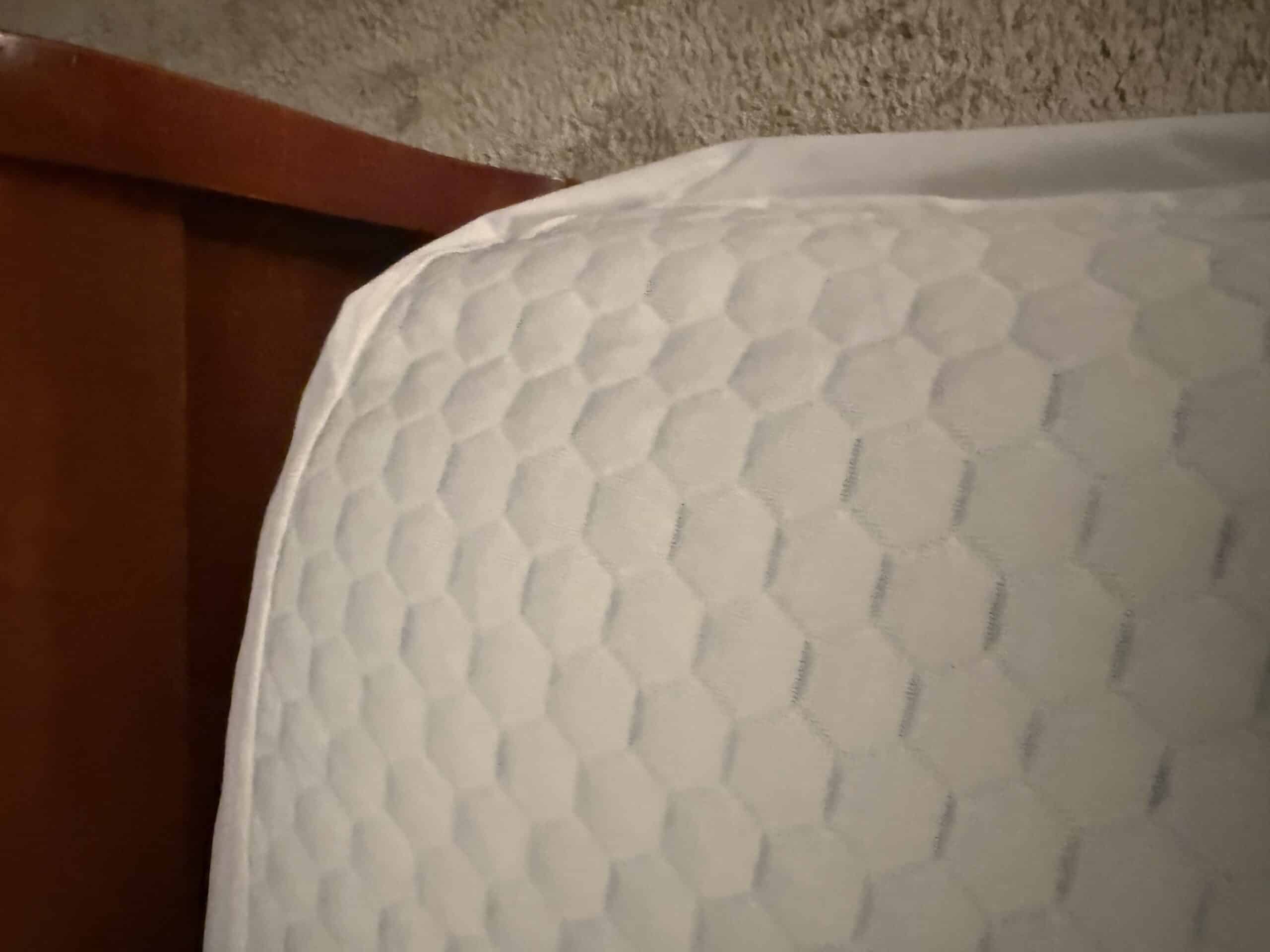
I should be clear that my setup is one unbranded honeycomb-quilted topper on a memory foam bed, so I cannot tell you how a heavy latex slab behaves on a slick protector. That is a different problem and it may need the straps.
Sizing Is Not the Same as Depth
Two different measurements get confused here, and only one of them is about grip. Depth is how tall the mattress and topper are together, and it decides which pocket size you need. Footprint is length and width, and it decides whether the topper matches the bed at all.
A topper cut generously for a queen will overhang slightly and never sit still, because the excess has to go somewhere every time you move. That is not solvable with straps. Check the stated dimensions against your mattress rather than trusting the size label, since a few inches of overhang produces a topper that walks off the bed no matter what you do to hold it.
When Sliding Means Something Else
A topper that slides badly on a bed that also sags is telling you about the mattress, not the topper. Foam settles into a dip and then everything on top migrates toward it, so if you are chasing a sliding topper on an old bed, the sag underneath is the thing to look at.
Size mismatch is the other one. A topper cut for a different size, or a generously sized one on a snug mattress, will never sit still. That is not fixable with grip, and choosing the right topper in the first place is the only real answer.
Recommended Reading
If your sheets are the issue, see deep-pocket options and how to keep sheets in good shape. To pick a topper on more than grip, use the selection framework, or compare toppers against pads. For heat, see hot-sleeper picks.
Mattress Topper Sliding FAQ
Why does my mattress topper keep sliding down?
Because nothing is holding it. A topper is a loose layer on a smooth surface, and a fitted sheet that only reaches the mattress leaves it unsecured. Slick mattress protectors make it worse by removing what little friction foam has. The fix is stretching a sheet over both layers together.
Should I use a fitted sheet over my mattress topper?
Yes, and over the mattress at the same time. Treating them as one package is the single most effective fix, and it usually costs nothing. Just measure the combined depth first, because a topper adds two to four inches and a standard-pocket sheet will pop off corners at that height.
Do mattress topper straps actually work?
They do, and they are the right next step when a sheet alone is not enough. They hook under the mattress and hold the corners down. They are most useful on thick toppers and on slick surfaces. Some toppers include them, which is a fair signal that the maker expected slippage.
Will a non-slip pad damage my mattress?
Not usually, though it adds a layer that can trap heat, which matters if you already sleep hot. It is also worth asking why the surface is slick enough to need one. A vinyl-backed protector is often the real culprit, and removing it can solve the sliding and the heat at once.
What size sheet do I need with a mattress topper?
Measure the mattress and topper together, then buy for that total. Most toppers add two to four inches, which pushes many beds past what a standard pocket handles. Deep-pocket sheets are made for this, and getting it wrong produces corners that pop off nightly and look like a sliding problem.
Do all mattress toppers slide?
No. Weight, material, and the surface underneath all matter, and some setups never move. Mine does not slide, partly because it is washed regularly and re-seated on the bed each time, which stops slow creep from accumulating. Heavier toppers on grippy surfaces tend to stay put on their own.
Can a sliding topper mean my mattress is worn out?
Sometimes. If the mattress has a dip, whatever sits on top migrates toward it, and no amount of grip fixes that. Persistent sliding on an older bed is worth investigating as a sag problem rather than a friction one, because the topper is only reporting what the mattress is doing.
See the complete guide: the complete mattress selection framework.
